Showing posts with label Vejovoidus. Show all posts

18 January, 2022

Population density estimation of scorpions in the coastal dunes at Laguna Manuela, Baja California, Mexico


 Baja California in Mexico has been a hotspot for scorpion diversity for many years with more than 60 reported species. But few studies have documented how abundant each species are in this area. 

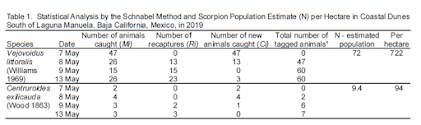
Natalia Rodríguez-Revelo and Michael Wall have now published a study of the population density of the sccorpions in the Coastal Dunes at Laguna Manuela, Baja California, Mexico. The results showed that Vejovoidus longiunguis (Williams, 1969) Vajovidae), a purported dune specialist, was in extraordinarily large numbers relative to Centruroides exilicauda (Wood, 1863) (Buthidae), a widespread habitat generalist species.

Abstract:
While scorpion fauna of the Baja California Peninsula is well known for diversity, the biology of individual species has been less studied. The objective of the study was to assess abundance of scorpions of the coastal dunes at Laguna Manuela, Baja California, Mexico. In total, 182 scorpions were marked during 4 nights of sampling. Vejovoidus longiunguis (Williams, 1969), a purported dune specialist, was in extraordinarily large numbers relative to Centruroides exilicauda (Wood, 1863), a widespread habitat generalist species. The results contrasted with previous studies of V. longiunguis in different areas of its range.

Reference:
Rodríguez-Revelo N, Wall M. Population Density Estimation of Scorpions in the Coastal Dunes at Laguna Manuela, Baja California, Mexico. Southwestern Entomologist. 2021;46(4):941-6. [Subscription required for full text]

Thanks to Luis Roque for sending this article to me!

08 February, 2009

A major review of the tarsal spinules and setae of vaejovid scorpions

Tarsal characters has been used in identification and classification of scorpions. Kari McWest has now done a major mapping of the tarsal spinules and setae of more than 400 vaejovid specimens representing over half of the species in the family. The result of this impressive work can be used in understanding vaejovid systematics and creating ID keys for the family.

Abstract:
The relative importance of tarsal characters in vaejovid scorpions has long been neglected. The spinules and setae of the third leg basitarsus and telotarsus of the North American scorpion family Vaejovidae are illustrated, described, and compared. Nomenclature for tarsal spinules and setae is included. Variation in setal numbers and patterns within taxonomic groups, including some species, is addressed. Certain tarsal setal and spinule patterns are found to provide good characters at the genus, species group, and species levels. Over 400 specimens representing over half of the species in the family Vaejovidae were examined for setal and spinule characters. The majority of these specimens were involved in ananalysis of telotarsal spinule counts of each leg. The most consistent characters that have taxonomic value were found on the telotarsus, including the relative numbers of the retroinferior and proinferior setae, the retroinferior terminal and proinferior terminal setae, and the numbers of the distal spinules of the ventromedian telotarsus surface. Other characters involving the basitarsus and additional telotarsus characters are addressed.

Reference:
McWest KJ. Tarsal spinules and setae of vaejovid scorpions (Scorpiones: Vaejovidae). Zootaxa. 2009(2001):1-126 [Subscription required for fulltext]

Family Vaejovidae