Showing posts with label defensive behavior. Show all posts

19 June, 2026

Sex differences in morphology cause sex differences in stridulation in the buthid Jaguajir rochae


It is not that well known that scorpions can produce sound that probably is meant to function defensively as an anti-predator defense. The sound is often called stridulation, and in scorpions it can be produced by morphological structures on the chelicera, legs, cauda or pectines.

Welton Dionisio-da-Silva and co-workers have recently published a study on stridulation Jaguajir rochae (Borelli, 1910) (Buthidae) and any sex-differences in the morphology of the sound producing structures and the acoustic output.

They found that there were several differences in the morphology of the sound producing structures of the pectins between the sexes, and they also found that females produced longer and more intense signals while the males exhibited slightly higher peak frequencies.

Abstract:
Stridulation, acoustic communication produced by friction between specialized body structures, is a poorly studied antipredator mechanism. Scorpions may display multiple defensive responses, yet acoustic signaling in such defensive context remains poorly studied. Given the sexual dimorphism commonly observed in scorpion body size and pectines, the latter, which may be involved in sound production, could vary morphologically and result in acoustic differences. We hypothesized that (1) stridulatory apparatus of the scorpion Jaguajir rochae (Borelli, 1910) is sexually dimorphic, (2) sexual dimorphism in stridulatory structures affects acoustic parameters, and (3) stridulatory responses vary with stress, tested via (2.1) mechanical and (2.2) mechano-chemical stimulation. Sound-producing structures and acoustic parameters were measured and stridulation was tested under high/low mechanical stress and mechano-chemical stress, the latter using chemical cues from a mammalian predator. Females exhibited larger pectinal structures, whereas males showed a higher allometric ratio relative to body size. Stridulatory signals in J. rochae showed sexual differentiation primarily in delta time, dB Sound Pressure Level, and low frequency, as revealed by Principal Component Analysis, what explains 38.7% of acoustic variance. Females produced longer and more intense signals, whereas males exhibited slightly higher peak frequencies. Yet, the occurrence of stridulatory responses was similar across different stress treatments. These findings reveal that sexual dimorphism in stridulatory apparatus influences acoustic parameters and that stridulation in J. rochae can be triggered by mechanical stimulation, supporting its role as a defensive behavior. This study provides the first evidence of sex specific acoustic variation in scorpion stridulation and elucidates its function as an antipredator strategy.

Reference:
Dionisio-da-Silva W, Luna NMC, da Rocha PA, Willemart RH, daSilva MB. She Doesn't Whisper: Female-Prominent Stridulation Shaped by Morphology in a Buthid Scorpion and Insights on Its Function. Ethology. 2026;First published 25.05.26. [Open Access]

16 June, 2026

Do hot temperatures cause hot tempered scorpions?


Scorpions are dependent on the temperatures in its environment to regulate their body temperatures (being ectothermic) and they will probably also have an effect on scorpion behavior. Scorpions use their sting and venom in prey capture and defense. 

Zia Nisani and co-workers have recently published a study looking into if and how different temperatures impact stinging behavior in Hadurus obscurus Williams, 1970 (Hadruridae). They tested how different temperatures impacted the defensive sting response and also the prey capture behavior at three different temperatures.

Scorpions with higher temperatures were faster to sting and required less provocation before stinging. In addition, "hotter" scorpions were quicker to catch prey and succeed with it. A physiological explanation for these results is probably that increased temperatures will increase muscle performance and metabolic rate. 

Abstract:
Scorpions employ their stinging mechanism both for defense and predation, and being ectothermic, temperature influences their physiology and behavior. As such, we hypothesized that temperature both affects defensive stinging and prey-capture behavior in scorpions. We tested the effects of body temperature on these behaviors in the desert hairy scorpion, Hadrurus obscurus Williams, 1970. In the first experiment, scorpions were placed in temperature-controlled chambers with either high (26-28°C) or low (21-22°C) temperatures and probed to elicit a defensive sting. We recorded the reaction time and the number of probes needed to elicit a sting. In the second experiment, we observed and recorded prey capture behavior at three different temperatures (21, 29, and 33°C). Scorpions with higher body temperatures had faster defensive reaction times and required fewer probes to elicit a sting. Furthermore, at a higher temperature, scorpions were more likely to attempt and succeed in prey capture, but temperature did not seem to affect post-capture stinging behavior. As the temperature rises, increasing muscle performance and metabolic rate in ectotherms, it may cause an increase in prey capture attempts and faster reaction times, as observed in our experiment. These results support our hypothesis that both defensive and predatory behavior in H. obscurus is affected by temperature, allowing more insight into scorpion thermal ecology.

Reference:
Nisani Z, Bennett M, Enriquez A, Iniquez M, Martinez Rios E, Stone B. Effect of temperature on the defensive and predatory behavior of the scorpion Hadrurus obscurus (Scorpiones: Hadruridae). Euscorpius. 2026;2026(433):1–9. [Open Access]

25 June, 2025

Cannibalism in two buthid species from Brazil


It is well known that scorpions catch and eat other scorpions (either the same species or other species). Guilherme Melo-dos-Santos and co-workers recently published a study documenting cannibalistic events in the species Rhopalurus laticauda Thorell, 1876 and Tityus silvestris Pocock, 1987 (Buthidae) from Brazil.

Scorpions will eat other scorpions as prey (to get food), but the study also suggests that cannibalism can be part of an intraspecific competition (e.g. competition for territories (microhabitats) or food), that may have a regulatory effect on the populations.

The study was done under controlled captive conditions, but the researchers observed similar behaviors in the scorpions' natural environment. 

Abstract:
Scorpions are predators, with diets ranging from insects to other arachnids. Despite this, their predatory habits, especially in the Brazilian Amazon, are still poorly understood. This study documents, for the first time, cannibalistic events in the species Rhopalurus laticauda Thorell, 1876 and Tityus silvestris Pocock, 1987, both species found in Roraima. The first species is more common in open areas known as lavrado, while the second inhabits humid forests. During the study, we observed that, in most cases, the individuals involved in cannibalistic acts were of similar sizes. Only in one case, an adult preyed on a juvenile. These interactions, frequently associated with territorial disputes and for food, culminated in confrontations in which the weaker individual was subjugated. Our data, obtained under controlled captive conditions, revealed an aggressive and competitive behavior among scorpions of these species. It is important to highlight that similar behaviors were recorded in videos collected during field expeditions, suggesting that cannibalism also occurs in natural environments. The subjugated animals are consumed entirely in many cases, and in others, only parts of the consumed animals were found. These results contribute significantly to the understanding of the population dynamics of scorpions in the Amazon, indicating that intraspecific competition may be an important factor in the regulation of these populations.

Reference:
Melo-dos-Santos G, Melo-dos-Santos G, Leite TM, Rocha AM, Jati SR, Frezarin-da-Silva E, et al. Cannibalistic behavior in Rhopalurus laticauda Thorell, 1876 and Tityus silvestris Pocock, 1897 (Scorpiones: Buthidae) under captivity in the extreme north of the Brazilian Amazon. Revista Chilena de Entomología. 2025;51(2):169–75. [Open Access]

05 June, 2025

Sting use in Centruroides sculpturatus in a defensive context


Several studies shows that scorpions are selective when it comes to sting and venom use i defense and prey capture. The basis for this is that venom is costly to replace and this cause the scorpions to be restrictive in using venom.

Lindsay Marston and co-workers recently published a study where they tested antipredator behaviors of Centruroides sculpturatus Ewing, 1928 (Buthidae) exposed to two different "threats" in their natural environment. 

Interestingly, the results of the different experiments contrasted with those of previous studies.The article discuss possible reasons for this.

Abstract:
Scorpion antipredator behavior incorporates risk assessment that informs decision-making and venom usage. We quantified antipredator behaviors of the clinically significant Arizona bark scorpion (Centruroides sculpturatus) in their natural environment using exposure to two stimuli: a freshly thawed laboratory mouse (Mus musculus) and a membrane-covered glass beaker. We videotaped and compared envenomation behaviors between sexes (females, gravid females, and males), across sizes, and between animal orientations (on vertical or horizontal substrates). Results failed to show consistent support for any of our four hypotheses. Females (especially gravid females) were no more likely than males to exhibit higher levels of stinging and venom expenditure. Scorpions on horizontal surfaces compared to those on vertical surfaces, and larger scorpions compared to smaller ones, were likewise no more likely to exhibit higher levels of responsiveness. Mice were more likely to be stung than the membrane-covered beaker, but with fewer and briefer stings, suggesting the scorpions did not attempt to deliver more venom into the mice. Thus, we discerned no clear patterns in risk assessment, stinging, and venom use associated with sex, substrate orientation, body size, or threat stimuli. These findings contrasted with those of several prior laboratory studies. Variation from unaccounted environmental variables may have obfuscated divergent behavioral tactics. Nevertheless, the behaviors we document here provide insights on the range of defensive behaviors exhibited by C. sculpturatus under natural environmental conditions, including the frequency of dry stings (11.8%) to the membrane-covered beakers.

Reference:
Marston LA, Fox GA, Hung KY, Delo SJ, Hayes WK. A Sting Operation: Risk Assessment and Venom Expenditure by Arizona Bark Scorpions (Centruroides sculpturatus) in a Defensive Context. Toxins. 2025;17(4):198. [Open Access]

06 January, 2025

Arm-span competition between males in the buthid scorpion Tityus rosenbergi


Courtship and mating behaviors between male and female scorpions are well documented. Intrasexual interactions (between female-female or male-male scorpions) are not mentioned often in the literature. Recently, a new ritualized behavior between the same sex was described and labeled "arm-span competition”.

In a recent article, Jules Thornton Wyman and co-workers present observations of "arm-span competition" between males of Tityus rosenbergi Pocock, 1898 (Buthidae). The behavior is interpreted as a ritualized male-male contests. 

The authors suggest that the elongated pedipalps seen in males of many species might be the result of selective pressure related to ritualized arm-span competition.

Abstract:
Although courtship and mating behaviors have been described for nearly all scorpion lineages, intrasexual interactions in scorpions remain understudied. Recently, a novel ritualized behavioral unit, termed “arm-span competition,” in which individuals face off and extend their pedipalps laterally, was described from analyses of male-male contests in several scorpionid species. Here, we present the first documented observation of arm-span competition in a buthid scorpion, Tityus cf. rosenbergi Pocock, 1898. Interestingly, both T. cf. rosenbergi and most scorpionid species known to engage in arm-span competition exhibit a similar sexual dimorphism: males have markedly longer and more slender pedipalps than females. We suggest that the elongated pedipalps in males of these species might be the result of selective pressure related to ritualized armspan competition. We also highlight the potential for citizen science to contribute rare observations to scientific literature.

Reference:
Wyman JT, Wright-Ueda J, Agnew Q, Castellano I, Simone Y. First report of arm-span competition in buthid scorpions: male-male contest in Tityus cf. rosenbergi Pocock, 1898. The Journal of Arachnology. 2025;52(3):210-3. [Open Access]

Thanks to Yuri for sending me this article!

18 December, 2024

A new species in the genus Tityus from Colombia is also South America's first venom spraying scorpion


A very interesting article was recently published by Leo Laborieux. In this article he describes a new species of Tityus C. L. Koch, 1836 (Buthidae) from Colombia, which is the first venom spraying scorpion reported from South America.

Tityus achilles Laborieux, 2024

Venom spraying has been well documented for several scorpion species as a defense behavior and especially in the African genus Parabuthus (e.g. Parabuthus transvaalicus Purcell, 1899). Interestingly, the new species from Colombia seems to have to types of venom spraying that have different venom use: Flick and Spray. The article discusses the different behaviors and the use of prevenom (cheap) and venom (costly) in T. achilles and compares this to the existing research on venom spraying in Parabuthus. This article brings in new insight into the composition of scorpion venom(s) and the use of it.

Abstract:
Venom is a metabolically expensive secretion used sparingly in a variety of ecological contexts, most notably predation and defence. Accordingly, few animals employ their toxins from a distance, and venom-squirting behaviour is only known from select taxa. In scorpions, species belonging to two genera are known to spray venom when threatened, and previous work in Parabuthus transvaalicus shows that venom delivery depends on perceived levels of threat. Here, I describe Tityus (Tityus) achilles sp. nov., a new species of buthid scorpion from Cundinamarca, Colombia. Remarkably, this species is capable of venom spraying, a first for both the genus and the South American continent. Using frame-by-frame video analysis and ballistic equations, I show that T. (Tityus) achilles sp. nov. employs not one, but two types of airborne defences with dramatic differences in reach and venom expenditure. Further, the new species uses an unusually large reserve of prevenom-like secretion for spraying, as opposed to the costly venom used by other spraying scorpions. In light of these key specializations, I propose that toxungen spraying convergently evolved in response to different selection pressures, laying the groundwork for future investigation.

Reference:
Laborieux L. Biomechanics of venom delivery in South America’s first toxungen-spraying scorpion. Zoological Journal of the Linnean Society. 2024;202(4):zlae161. [Full text supplied by author]

Thanks to Leo and Gerard for sending me this interesting article!

Family Buthidae

24 October, 2024

Survival strategies of first-instar scorplings of Olivierus martensii


Ecdysis (molting, changing skin) is the way that scorpions and many other arthropods grow. This is a risky part of an young scorpions life, especially during the first molts. Yiyuan Guo and co-workers have recently published a study on the strategies used by first-instar scorplings of Olivierus martensii (Karsch, 1879) (Buthidae) to optimize survival (the article use the old name for this species, Mesobuthus martensii). 

The study shows that newborn scorpions exhibit special aggregate molting behavior, which increases their chances of survival. This aggregating behavior makes it easier for the mother scorpion to keep the scorplings on her back, even though this behavior is also observed when scorplings molt away from the mother's back. The cooperative nature of aggregate molting in first-instars combined with staying on the mother's back and in her care is probably an essential role in increasing the survival of the young scorplings.

Abstract:
Ecdysis is a well-known developmental feature among arthropods. Because the aggregate and synchronous molting of first-instar scorpions is markedly different from the common independent molting behavior of older scorpions and most arthropods, knowledge on the biological benefits of the unusual behavior of first-instar scorpions remain limited. Before the molting of newborn scorpions, their mothers exhibited a remarkable ability to efficiently locate the fallen offspring and help them climb onto their back, which was supported by strong maternal behavior because they climbed more swiftly than the 7-day postpartum scorpions. Most newborn scorpions molted and survived on the mother’s back, with a survival rate of approximately 100%, and most newborn scorpions survived via aggregate molting behavior on sand in the absence of mothers (89.83% ± 1.91%). The important role of the mother scorpion was further highlighted in mothers with one to five first-instar scorpions.While all first-instar scorpions individually or reciprocally molted and survived on the mother’s back, only 52.00% ± 7.14% to 79.20% ± 4.24% of newborn scorpions isolated from the mother could individually or reciprocally molt and survive on the sand, and the aggregated states of first-instar scorpions strengthened as their numbers on sand increased before molting. These results highlight collaborative molting as an evolutionary driving force for newborn scorpions. Taken together, both maternal care and collaborative aggregate molting behavior enhanced the survival of first-instar scorpions before and after molting, and these benefits for first-instar scorpions play essential and evolutionary roles in scorpion survival.

Reference:
Guo Y, Li S, Lu S, Wang X, Cao Z, Wu Y. Special Survival Strategy of First-Instar Scorpions Revealed by Synchronous Molting Behavior from Social Facilitation of Maternal Care and Reciprocal Aggregation. Insects. 2024;15(9). [Open Access]

04 October, 2024

A study of the defensive behaviour of the buthid scorpion Buthus atlantis


The scorpions' sting and venom use is important in both prey capture and defense. Several studies have previously investigated sting use in defense and also the use of venom (dry versus wet stings and the discovery of prevenom). 

Youssef El Joud and co-workers have recently published a study analyzing how various factors such as temperature, prey type, and threatening conditions influence stinging behaviour, venom usage and regeneration in the scorpion Buthus atlantis Pocock, 1889 (Buthidae) from Morocco.

Their study shows that the scorpions are more ready to sting in defense in higher temperatures and that venom expenditure in B. atlantis is regulated by both temperature and threatening conditions.

Abstract:
Understanding animal’s behaviour and adaptation in the face of threats and predators under different biotic and abiotic conditions is fundamental in ecology. In this study we examined defensive behaviour of Buthus atlantis scorpion in order to assess how various factors such as temperature, prey type, and threatening conditions influence stinging behaviour, venom usage and regeneration. Our study had revealed that stings frequency was significantly lower in cooler temperature compared to the medium and warm temperature. Threatening condition had no significant effect in medium and warmer temperature, the difference between the two conditions was only significant in the cooler temperature. Conversely, we had shown that venom expenditure in B. atlantis is regulated by both temperature and threatening conditions. Our results show that scorpions maintained in higher temperatures yielded the greatest amount of venom compared to those in lower temperatures. Analyses of proteins concentration according to temperature and diet variation had revealed that scorpions placed in intermediate (25 ◦C) and warmer temperature (40 ◦C) had a significantly higher venom proteins concentration when compared to the cooler temperature (10 ◦C). Results also showed that scorpions adjust their venom usage based on their perception of danger, which can be influenced by temperature.

Reference:
El Joud Y, El Bouazzaoui A, El-Ghali S, Laghzaoui EM, Toulon O, Ait Larradia M, et al. Assessing the effects of temperature, diet and threat conditions on defensive behaviour and venom regeneration in scorpion (Buthus atlantis). J Therm Biol. 2024;124:103966. [Subscription required for full text]

31 May, 2024

A thorough investigation of the anatomy and morphology of the pedipalps the Australian black rock scorpion, Urodacus manicatus


The pedipalps in scorpions are important for prey capture, defense and reproduction. Russel Bicknell and co-workers recently published a thorough investigation of the anatomy and morphology of the pedipalps the Australian black rock scorpion, Urodacus manicatus (Thorell, 1876) (Scorpionidae) and related these to the behavioral use of them.

Abstract:
Pedipalps – chelate ‘pincers’ as the second pair of prosomal appendages – are a striking feature of scorpions and are employed in varied biological functions. Despite the distinctive morphology and ecological importance of these appendages, their anatomy remains underexplored. To rectify this, we examined the pedipalps of the Australian black rock scorpion, Urodacus manicatus, using a multifaceted approach consisting of microcomputed tomography, scanning electron microscopy, energy dispersive X-ray spectroscopy, and live pinch force measurements. In doing so, we document the following aspects of the pedipalps: (1) the musculature in three dimensions; (2) the cuticular microstructure, focusing on the chelae (tibial and tarsal podomeres); (3) the elemental construction of the chelae teeth; and (4) the chelae pinch force. We recognise 25 muscle groups in U. manicatus pedipalps, substantially more than previously documented in scorpions. The cuticular microstructure – endo-, meso-, and exocuticle – of U. manicatus pedipalps is shown to be similar to other scorpions and that mesocuticle reinforces the chelae for predation and burrowing. Elemental mapping of the chelae teeth highlights enrichment incalcium, chlorine, nickel, phosphorus, potassium, sodium, vanadium, and zinc, with a marked lackof carbon. These elements reinforce the teeth, increasing robustness to better enable prey capture and incapacitation. Finally, the pinch force data demonstrate that U. manicatus can exert high pinch forces (4.1 N), further highlighting the application of chelae in subduing prey, asopposed to holding prey for envenomation. We demonstrate that U. manicatus has an array of adaptions for functioning

Reference:
Bicknell RD, Edgecombe GD, Goatley CH, Charlton G, Paterson JR. Pedipalp anatomy of the Australian black rock scorpion, Urodacus manicatus, with implications for functional morphology. Aust J Zool. 2024;72(2). [Open Access]

25 August, 2023

Ananteris mauryi uses different defense behavior depending on how "dangerous" the predator is


It is well known that scorpions often will use different behavior tactics to catch different prey types, usually with the aim to save venom and costs of venom production. Similar behavior differences have been observed when it comes to defense against different predator types. 

André O. Silva-Júnior and co-workers have recently published a study on defensive behavior in Ananteris mauryi Lourenço, 1982 (Buthidae) against different predator species. Seven defensive behavior acts were identified and the study confirms the hypothesis that this species can change its defensive behavior according to the type of predator they face.

Abstract:
Small species often fall prey to a wide range of predators in their natural habitats, and therefore require behavioural strategies to mitigate predation rates. In this study, we investigated the defensive behaviour of Ananteris mauryi, a small-bodied scorpion, against different natural predator species. Behavioural trials were conducted with A. mauryi individuals facing two different predators, spider and scorpion. Our results show that A. mauryi altered their defensive acts depending on the predator type, swinging their telson, cleaning their pedipalps, and run more frequently when facing spiders than scorpions. Additionally, we observed variation in the duration of behaviours according to predator type, with stinging attempts being performed more frequently against scorpions and run and metasoma swinging against spiders. Our findings suggest that scorpions have the ability to modulate their defensive behaviour according to the type of predator they face.

Reference:
Silva-Júnior AO, Barbosa-da-Silva HR, Salomao RP, Moura GJB, Lira AFA. Defensive behaviour plasticity in Ananteris mauryi Lourenço, 1982 (Scorpiones: Buthidae) facing different predator species. Behaviour. 2023; Published online 21.08.23. [Subscription required for full text]

Thanks to Andre Lira for sending me this article!

21 February, 2023

Non-aggressive competition in Srilankametrus yaleensis and a review of other types of agonistic behavior in scorpions


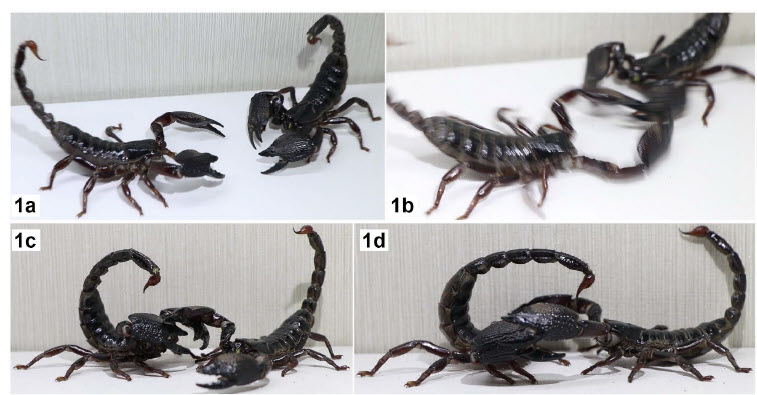
Competition happens in scorpions, both between species and within the same species. The cause of competition can be food, territory, hiding places, mates etc. As with many other animals, competition and other types of encounters do not have to be aggressive and cause damage.

Victoria Tang has recently published an article describing non-aggressive physical combat between adult males of Srilankametrus yaleensis (Kovařík et al., 2019) (Scorpionidae). The article also list other known examples of agonistic behaviors (intraguild or antipredatory) observed in scorpions.

The article is illustrated with many pictures illustration the different types of agonistic behavior. Video documentation can also be found in the supplemental materials.

Abstract:
A peculiar intraspecific agonistic behavior involving a non-aggressive physical combat is reported between the adult males of Srilankametrus yaleensis (Kovařík et al., 2019) (Scorpionidae: Heterometrinae). The adult males were observed to resort to a ritualized and relatively gentle way for strength demonstration. The combat is characterized by lateral spreading of pedipalps, chelicerae-to-chelicerae collision, and entanglement of metasomal segments. This behavior is hereby considered a form of an intrasexual combat defined as the “arm-span competition”. It is hypothesized to be beneficial for solving territorial and/ or sexual competitions while avoiding unnecessary mortality which could pose adverse impact to the natural populations. Other Heterometrinae species that possess sexually dimorphic, elongate pedipalps in males were also found to display similar behavior. This may account for at least one potential reason for the evolution of such sexual dimorphism. Finally, this study supplements several other agonistic behaviors (intraguild or antipredatory) observed in scorpions, with special attention to the family Scorpionidae. Three basic types of behavior are defined for this family: aggressive response, shielding response, and armspan competition. These types of behavior may have implications for the evolution of this family.

Reference:
Tang V. Non-aggressive competition between males of Srilankametrus yaleensis (Kovařík et al., 2019)(Scorpionidae), and other types of agonistic behavior observed in scorpions. Euscorpius. 2023;2023(368):1-17. [Open Access]

07 December, 2022

Scorpion mimicry observed in a Brazilian gecko


Avoid being killed and eaten is one of the central tasks for most animals. There is a host of anti-predator strategies around and one popular strategy is to mimic the look and/or the behavior of another dangerous animal (Batesian mimicry).  

Scorpions can be classified as a dangerous animal because of the venomous sting. They are also very characteristic with their tail with a stinger clearly displayed above the body. So it is not surprising that other animals may try to mimick scorpions in appearance and behavior to scare off potential predator. E. g., this can be seen in many stick insects where they curve the posterior part of their body above the rest of the body mimicking a scorpion's tail.

Matheus Feitosa and co-workers have recently published an article describing scorpion mimicry in the sphaerodactylid gecko Coleodactylus meridionalis (Boulenger, 1888) from Brazil, that share their habitat with Tityus pusillus Pocock, 1893 (Buthidae).

Abstract:
No abstract.

Reference:
Feitosa MLB, da Silva Júnior AO, da Justa Ximenes RE, Lins AHA, Moura GJ, de Araújo Lira AF. Scorpion mimicry behavior in Coleodactylus meridionalis (Squamata: Sphaerodactylidae) in the northeastern Atlantic forest. Herpetology Notes. 2022;15:829-31. [Open Access]

11 October, 2022

I play dead


Thanatosis, or "playing dead" is a known anti-predator behavior both in scorpions and other invertebrates. This behavior, which is also know as tonic immobility, is often associated with cryptic coloration. In a recent paper, Felipe Triana and co-workers describe and discuss this special behavior in the two buthids Tityus ocelote Francke & Stockwell, 1987 and Ananteris platnicki Lourenço, 1993 from Central America. 

The study concludes that this behavior may be more common than previously known and that it may have a basis in American buthids (but more studies are necessary to confirm the latter).

Abstract:
Thanatosis, or tonic immobility, is a behavior where animals adopt a motionless posture after a physical contact or very close proximity of a predator. This behavior has been described in a wide range of taxa, from invertebrates to vertebrates. For scorpions, tonic immobility has been reported in two buthids, Tityus pusillus and Tityus cerroazul, one hormurid, Liocheles australasiae, and one scorpiopsid, Scorpiops jendeki. Here we report other cases of this thanatosis for two buthid scorpions from lower Central America: Tityus ocelote and Ananteris platnicki. Thanatosis in these species were observed in wild, but was better documented in the laboratory. After human handling, several individuals for both species rolled over and laid on their back, adopting a distinctive rigid position, where they did not respond to external mechanical stimuli. As tonic immobility might be associated with other defense strategies, such as cryptic colorations, it is hypothesized that this behavior is used as a strategy in both species only if there is physical contact that simulated by a predator. On the other hand, the observations of thanatosis we reported here and the ones reported in other Tityus scorpions suggest that this behavior may have a phylogenetic basis in American buthids and that it could be more widespread than initially thought. However, more observations of tonic immobility in buthids would allow the evaluation of this hypothesis.

Reference:
Triana F, Bonilla F, Alfaro-Chinchilla A, Víquez C, Díaz C, Sasa M. Report of thanatosis in the Central American scorpions Tityus ocelote and Ananteris platnicki (Scorpiones: Buthidae). Euscorpius. 2022;(359):1-5. [Open Access]

20 September, 2022

Research on the impact of constipation on scorpion sex life win The 2022 Ig Nobel Prize in biology


Do you remember my blog post in June about articles on the costs of autotomy (tail loss) in scorpions? The authors behind these articles, Solimary García-Hernández and Glauco Machado, have now won The 2022 Ig Nobel Prize in biology. 

 According to the price homepage, "The Ig Nobel Prizes honor achievements that make people LAUGH, then THINK. The prizes are intended to celebrate the unusual, honor the imaginative — and spur people’s interest in science, medicine, and technology".

Studying how constipation affects the sex life of scorpions has probably raised a few eye browes and I understand why they got this world famous prize. I guess this is probably the first Ig Nobel Prize to scorpion researchers.

Congratulations!

Reference:
Ig® Nobel Prize Winners 2022. Available from: https://improbable.com/ig/winners/ [Cited: 20.09.22]

29 July, 2022

"Smelling" the enemy triggers anti-predator behavior in Ananteris mauryi


Fear is a powerful agent both in humans and animals and has an impact on behavior. For scorpions, the fear of being eaten by a predator (e.g. another scorpion) should promote behavior to avoid this happening. Matheus Feitosa and co--workers have recently publish an study on Ananteris mauryi Lourenço, 1982 (Buthidae) abilities to detect chemical cues left by its predator Tityus pusillus Pocock, 1893 (Buthidae) in the substrate when exploring new sites, and if this results in behavioral responses to avoid the risk of encounters and predation.

Their study confirms that Ananteris mauryi seems to be able to taste/smell its enemy Tityus pusillus because it tended to avoid substrates with chemical traces of T. pusillus. In addition, the taste/smell of its enemy also triggered anti-prdator behaviors like tail wagging.

Abstract:
Fear level and intraguild predation are factors that act together to directly influence animal behavior, population dynamics, and community structure. These factors trigger stress, which promotes behavioral, morphological, physiological, and demographic changes, especially in the prey. Some invertebrates, such as scorpions, are known to have a refined chemoreception system to perceive both prey and predators. Therefore, we investigated the ability of an intraguild prey, the scorpion Ananteris mauryi Lourenço, 1982, to detect chemical traces of its predator, the scorpion Tityus pusillus Pocock, 1893. Our goal was to verify whether A. mauryi exhibits antipredator behavior induced exclusively by chemical cues from its predator. Ananteris mauryi specimens were subjected to two experimental treatments: one with and one without traces of T. pusillus. The results showed that A. mauryi tended to avoid substrates with chemical traces of T. pusillus, confirming its capacity for chemical detection. As a result of this perception, changes in behavioral frequencies were triggered, generating an antipredator behavioral repertoire. These findings were supported by behavioral changes, such as tail wagging, which is performed exclusively by scorpions in the presence of a predator and at imminent risk of predation.

Reference:
Feitosa MLB, Dionisio-da-Silva W, Lira A, Teles-Pontes WJ. Fear as an enemy? Behavioral changes of Ananteris mauryi Lourenço, 1982 (Scorpiones: Buthidae) are triggered by chemical cues from an intraguild predator. Can J Zool. 2022;100:488-93 [Subscription required for full text]

Thanks to Andre Lira for sending me his articles!


23 June, 2022

New information about the costs of autotomy (tail loss) in scorpions


I have previously reported about the facinating discovery of autotomy of the cauda (tail) as an anti-predatory behavior in the scorpion Ananteris mauryi Lourenco, 1982 (Buthidae). The cauda contains important parts of the scorpion's nervous, circulatory and digestive systems, and of course the very important sting and the venom glands. The tail doesn't regenerate and an automized scorpion will eventually die from constipation (but can survive for several months befor it die).

I was recently made aware of three papers authored by Solimary García-Hernandez and Glauco Machado presenting research into the cost of autotomy (tail loss) in scorpions. One article stufy the effect of autotomy on predation success, the second article adresses short- and long-term consequences on locomotor performance of male and female sorpions with tail loss, and finally the third article studies the effects of autotomy on reproductive sucess.

To sum up, tail loss in scorpions has negative effects prey capture, exposure to predators, and reproductive success, but the size of the effects differ between the sexes. The reduction of reproductive succcess was much more dramatic for females than for males. For details on the results and conclusion I refer to the abstracts below.

Abstracts:

Paper1:
Predation success depends on factors such as hunger, prey size, prey availability and intensity of competition. A neglected factor that may also influence predation success is the proper function of morphological traits related to prey search, capture and manipulation. Injuries that compromise the functionality of these morphological traits may reduce predation success. In many invertebrates, autotomy can compromise predation success because the detached body part may be crucial for hunting. However, empirical evidence linking autotomy and predation success is relatively scarce. We filled this gap using the scorpion Ananteris balzani, which autotomizes the last abdominal segments, known as the ‘tail’. This is a unique form of autotomy as ‘tail’ autotomy implies the loss of the stinger, an organ used for venom inoculation, which is the main form of large prey subjugation. Using a paired experimental design, we found that for both small and large prey, subduing success was higher when individuals were intact than when they were autotomized. After autotomy, subduing success of male scorpions decreased
from 90% to 17% for small prey and from 47% to 1% for large prey. Subduing success of female scorpions after autotomy decreased from 98% to 93% for small prey and from 97% to 70% for large prey. Autotomized individuals took longer than intact individuals to subdue both small and large prey, but the effect size was higher for large prey. Considering that the tail does not regenerate, autotomized individuals (especially males) will experience a lifelong reduction in trophic niche breadth because their diet will be mostly composed of small prey. Moreover, autotomized individuals probably move more to enhance the likelihood of finding small prey, which may increase their exposure to predators and consequently the costs related to tail loss.

Paper 2:
In many taxa, individuals voluntarily detach a body part as a form to increase their chances of escaping predation. This defense mechanism, known as autotomy, has several consequences, such as changes in locomotor performance that may affect fitness. Scorpions of the genus Ananteris autotomize the “tail”, which in fact corresponds to the last abdominal segments. After autotomy, individuals lose nearly 25% of their body mass and the last portion of the digestive tract, including the anus, which prevents defecation and leads to constipation, because regeneration does not occur. Here, we experimentally investigated the short- and long-term effects of tail loss on the locomotor performance of Ananteris balzani. In a short-term experiment, the maximum running speed (MRS) of males and females did not change after autotomy. Moreover, the relative mass of the lost tail did not affect the change in MRS after autotomy. In a long-term experiment, autotomy had a negative effect on theMRS of males, but not of females. Autotomized over-fed individuals suffered from severe constipation but were not slower than autotomized normally fed individuals. In conclusion, tail loss has no immediate effect on the locomotor performance of scorpions. The long-term decrease in the locomotor performance of autotomized males may impair mate searching. However, because death by constipation takes several months, males have a long time to find mates and reproduce. Thus, the prolonged period between autotomy and death by constipation is crucial for understanding the evolution of one of the most extreme cases of autotomy in nature.

Paper 3:
The ability to detach a body part in response to a predation attempt is known as autotomy, and it is perhaps the most
intensively studied form of nonlethal injury in animals. Although autotomy enhances survival, it may impose reproductive costs on both males and females. We experimentally investigated how autotomy affects the reproductive success of males and females of a scorpion species. Individuals of Ananteris balzani autotomize the last abdominal segments (the tail), losing the anus and leading to lifelong constipation, since regeneration does not occur. Although the male tail is used during courtship and sperm transfer, autotomy has no effect on male mating success. The combined effect of increased mortality and reduced fecundity resulted in autotomized females producing nearly 35% fewer offspring than intact females. In conclusion, the negative effects of tail autotomy are clearly sex dependent, probably because the factors that influence reproductive success in males and females are markedly different.

References:

Paper1:
García-Hernández S, Machado G. ‘Tail’ autotomy and consequent stinger loss decrease predation success in scorpions. Anim Behav. 2020;169:157-67. [Subscription required for full text]

Paper 2:
Garcia-Hernandez S, Machado G. Short- and long-term effects of an extreme case of autotomy: does 'tail' loss and subsequent constipation decrease the locomotor performance of male and female scorpions? Integr Zool. 2021;Accepted Manuscript:1-17. [Subscription required for full text]

Paper 3:
García-Hernández S, Machado G. Fitness implications of nonlethal injuries in scorpions: Females, but not males, pay reproductive costs. Am Nat. 2021;197(3):379-89. [Open Access]

Thanks to Solimary García-Hernandez for sending me their articles on this interesting topic!

13 January, 2022

A study of the defensive behavior of Tityus pusillus in relation to sex and threat level


Scorpions have a range of tactics to avoid being caught and eaten by predators. Some are passive like camouflage, while others are active like using the stinger and inject venom. Strategies chosen vary both between species and within species, and even between the sexes. 

Kamila Bento Cavalcanti de Albuquerque and Andre Felipe de Araujo Lira have recently published a study on the defensive behavior chosen by male and female Tityus pusillus Pocock, 1893 (Buthidae) in relation to threat level. One of their main findings was that  the scorpions, independently of sex, stung more often under high threat compared to low threat treatments. But there was no difference in female and male defensive behavior in respons to the threat intensity.

It is well known that scorpion use their venom with care as venom production is costly and this study is another confirmation of this.

Abstract:
Scorpion venom is composed mainly of peptides and proteins and has high metabolic cost. Thus, individuals need to be economic in its use. This study aimed to evaluate the reactions of Tityus pusillus Pocock, 1893 scorpion to threats of different intensities. For the experiments, 28 males and 26 females were used; animals were gently touched five times on their mesosoma at different time intervals. Touches with five second intervals were considered as the highintensity threats, while those with five-minute intervals were considered as the low-intensity threats. We found that scorpions, independently of sex, stung more often under high threat compared to low threat treatments. However, no significant differences in the defensive behavior of males and females were observed according to threat intensity. We can thus infer that regardless of sex, T. pusillus uses its stings and consequently venom only in situations of high threat.

Reference:
de Albuquerque KBC, de Araujo Lira AF. Sex-based defensive behavior influenced by threat level in the scorpion Tityus pusillus (Scorpiones: Buthidae). J Arachnol. 2021;49(3):402-6. [Subscription required for full text]

Thanks to Andre Lira for sending me their article!

14 September, 2021

All you need to know about scorpion weapons and their function


Scorpions are armed with two types of weapons: their pedipalps with powerful pincers and their stinger which can inject an effective venom. These weapons are essential for the scorpion's survival and have three main functions: Prey capture, defense and sexual behavior. 

Yuri Simone and Arie van der Meijden have recently published an very thorough and interesting review on all aspects of the scorpion weapons. Here you will find all you need to know about our current knowledge on the scorpion's use of their pincers, sting and venom, how they work and how the originated. This is probably the most complete overview I have ever read on this topic and I recommend the article very much! 

Abstract:
Scorpions possess two systems of weapons: the pincers (chelae) and the stinger (telson). These are placed on anatomically and developmentally well separated parts of the body, that is, the oral appendages and at the end of the body axis. The otherwise conserved body plan of scorpions varies most in the shape and relative dimensions of these two weapon systems, both across species and in some cases between the sexes. We review the literature on the ecological function of these two weapon systems in each of three contexts of usage: (i) predation, (ii) defense and (iii) sexual contests. In the latter context, we will also discuss their usage in mating. We first provide a comparative background for each of these contexts of usage by giving examples of other weapon systems from across the animal kingdom. Then, we discuss the pertinent aspects of the anatomy of the weapon systems, particularly those aspects relevant to their functioning in their ecological roles. The literature on the functioning and ecological role of both the chelae and the telson is discussed in detail, again organized by context of usage. Particular emphasis is given on the differences in morphology or usage between species or higher taxonomic groups, or between genders, as such cases are most insightful to understand the roles of each of the two distinct weapon systems of the scorpions and their evolutionary interactions. We aimed to synthesize the literature while minimizing conjecture, but also to point out gaps in the literature and potential future research opportunities.

Reference:
Simone Y, Meijden Avd. Armed stem to stinger: a review of the ecological roles of scorpion weapons. J Venom Anim Toxins Incl Trop Dis. 2021;27. [Open Access]

Thanks to Yuri Simone for informing me about their article!

11 September, 2020

An investigation of the defensive behaviors of the southern unstriped scorpion, Vaejovis carolinianus


 In the last decade there have been several studies looking into sting use and venom use in scorpions in relation to prey capture and defense. Venom metering in scorpions has been well documented, but few studies have focused on the other behavioral options a scorpion has in regard to prey capture or defense.

David Nelson and co-workers have now published a study on the defensive behaviors of Vaejovis carolinianus (Beauvois, 1805) (Vaejovidae) with regards to the scorpion's assessment of risk and refuge availability. The study concludes that V. carolinianus can assess risk and features of the local environment and, therefore, alter their defensive strategies accordingly.

Abstract:
Selection should favor individuals that acquire, process, and act on relevant environmental signals to avoid predation. Studies have found that scorpions control their use of venom: both when it is released and the total volume expelled. However, this research has not included how a scorpion’s awareness of environmental features influences these decisions. The current study tested 18 Vaejovis carolinianus scorpions (nine females and nine males) by placing them in circular arenas supplied with varying numbers (zero, two, or four) of square refuges and by tracking their movements overnight. The following morning, defensive behaviors were elicited by prodding scorpions on the chelae, prosoma, and metasoma once per second over 90 s. We recorded stings, venom use, chelae pinches, and flee duration. We found strong evidence that, across all behaviors measured, V. carolinianus perceived prods to the prosoma as more threatening than prods to the other locations. We found that stinging was a common behavior and became more dominant as the threat persisted. Though tenuous, we found evidence that scorpions’ defensive behaviors changed based on the number of refuges and that these di erences may be sex specific. Our findings suggest that V. carolinianus can assess risk and features of the local environment and, therefore, alter their defensive strategies accordingly.

Reference:
Nelsen DR, David EM, Harty CN, Hector JB, Corbit AG. Risk Assessment and the Effects of Refuge Availability on the Defensive Behaviors of the Southern Unstriped Scorpion (Vaejovis carolinianus). Toxins. 2020;12(9). [Open Access]

17 January, 2020

Scorpions use different defensive behavior depending on sex, age and the threat level


Scorpions have developed multiple strategies for the defense against predators ranging from playing dead, running away to fighting back with the use of sting and venom. Interestingly, there seems to be differences in defensive behavior within the same species depending on the sex, age, size/strength of the threat and time of the day.

Andre Lira and co-workers published a study last Fall on the defensive behavior in the scorpion Tityus pusillus Lourenço, 2013 (Buthidae) from Brazil. A plasticity in defensive behavior was observed in this species, seeming to be influenced by the sex, age, diel period, and the body part targeted by the predator.

Abstract:
Differences in gender and age and the balance between aggressive behavior and the ability to escape are fundamental in predator–prey interactions, as well as for survival, foraging, and mating success. We investigated the defensive behavior of the scorpion Tityus pusillus and assessed possible differences in their behavior responses associated with sex, age, and diel period, by simulating a predation threat. Predator attacks were simulated by pressing the telsons with forceps, dropping the animals from a height of 25 cm on a plastic tray, restraining the pincers using large rubber-tipped tweezers, or restricting the prosoma. Tityus pusillus (Buthidae) showed five defensive behaviors: thanatosis, fleeing, stinging, standing still, and tail wagging. The scorpions responded with thanatosis or fleeing when their telsons were restricted. The frequency of these responses varied with sex and diel period. Stinging was the primary behavior response to prosoma restriction in both adults and juveniles while standing still was the most frequently observed behavior response to restraining pincers. These results indicate that the plasticity of defensive behavior in T. pusillus in response to predation is influenced by sex, age, diel period, and the body part targeted by the predator.

Reference:
Lira AFA, Almeida FAF, Albuquerque CMR. Reaction under the risk of predation: effects of age and sexual plasticity on defensive behavior in scorpion Tityus pusillus (Scorpiones: Buthidae). Journal of Ethology. 2019;38(1):13-9. [Subscription required for full text]

Thanks to André for sending me this interesting article that I have been way to slow to read!