Showing posts with label Srilankametrus. Show all posts

21 February, 2023

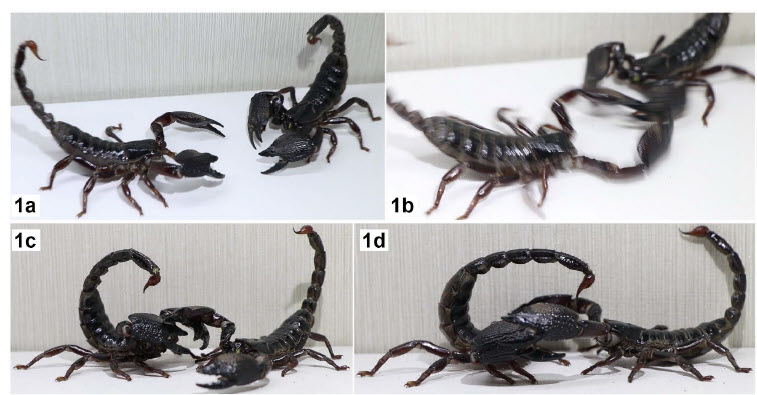
Non-aggressive competition in Srilankametrus yaleensis and a review of other types of agonistic behavior in scorpions


Competition happens in scorpions, both between species and within the same species. The cause of competition can be food, territory, hiding places, mates etc. As with many other animals, competition and other types of encounters do not have to be aggressive and cause damage.

Victoria Tang has recently published an article describing non-aggressive physical combat between adult males of Srilankametrus yaleensis (Kovařík et al., 2019) (Scorpionidae). The article also list other known examples of agonistic behaviors (intraguild or antipredatory) observed in scorpions.

The article is illustrated with many pictures illustration the different types of agonistic behavior. Video documentation can also be found in the supplemental materials.

Abstract:
A peculiar intraspecific agonistic behavior involving a non-aggressive physical combat is reported between the adult males of Srilankametrus yaleensis (Kovařík et al., 2019) (Scorpionidae: Heterometrinae). The adult males were observed to resort to a ritualized and relatively gentle way for strength demonstration. The combat is characterized by lateral spreading of pedipalps, chelicerae-to-chelicerae collision, and entanglement of metasomal segments. This behavior is hereby considered a form of an intrasexual combat defined as the “arm-span competition”. It is hypothesized to be beneficial for solving territorial and/ or sexual competitions while avoiding unnecessary mortality which could pose adverse impact to the natural populations. Other Heterometrinae species that possess sexually dimorphic, elongate pedipalps in males were also found to display similar behavior. This may account for at least one potential reason for the evolution of such sexual dimorphism. Finally, this study supplements several other agonistic behaviors (intraguild or antipredatory) observed in scorpions, with special attention to the family Scorpionidae. Three basic types of behavior are defined for this family: aggressive response, shielding response, and armspan competition. These types of behavior may have implications for the evolution of this family.

Reference:
Tang V. Non-aggressive competition between males of Srilankametrus yaleensis (Kovařík et al., 2019)(Scorpionidae), and other types of agonistic behavior observed in scorpions. Euscorpius. 2023;2023(368):1-17. [Open Access]

16 September, 2021

Phylogeny of the Asian forest scorpions and the evolution of ecomorphotypes


Last year,  Lorenzo Prendini and Stephanie Loria published a huge systematic revision of the Asian Forest Scorpions (Scorpionidae). Recently, they have published a follow-up article with a phylogenetic analysis of these scorpions. This analysis seems to confirm the taxonomic decisions made in the 2020 paper. 

The new article also looks into the ecomorphological adaptions seen in Heterometrinae. Three ecomorphotypes were found: A wet silvicolous (living in or inhabiting woodlands) ecomorphotype inhabiting evergreen forest, a dry silvicolous ecomorphotype inhabiting deciduous forest, and a savannicolous ecomorphotype inhabiting savanna or scrubland. Most Asian scorpionid genera exhibited one or two of these ecomorphotypes among their species. The authors conclude that the ancestor of Asian scorpionids probably was wet silvicolous and inhabited humid, evergreen forests.

Abstract:
Asian forest scorpions (Scorpionidae Latreille, 1802: Heterometrinae Simon, 1879) are distributed across South and Southeast Asia. All are fossorial, constructing burrows under stones or in open ground, in habitats differing in precipitation and vegetation cover, from rainforests and tropical deciduous forests to savanna and scrubland. The systematics of these scorpions has long been confused due to bad taxonomy and the absence of a phylogenetic framework. Although the monophyly of the group was previously confirmed as part of broader phylogenetic analyses based on exemplar species, the only quantitative analysis of species-level variation to date was based on overall similarity. This contribution presents the first species-level phylogenetic analysis of Asian Scorpionidae, based on 186 morphological characters and 4188 aligned base-pairs of DNA sequence data from two nuclear and three mitochondrial loci for 132 terminals including all 41 ingroup species and four outgroup species. Simultaneous analyses of the morphological and molecular datasets with parsimony, Maximum Likelihood and Bayesian Inference provided the framework for a revised classification presented elsewhere. In order to understand how adaptation following dispersal into new habitats has driven the morphological diversification of Asian forest scorpions, species were scored for 10 characters concerning morphology and burrow architecture, which contributed to an ensemble index of adaptation to habitat aridity. Species were classified into three ecomorphotypes based on the index, and ancestral state reconstruction of ecomorphotypes performed on the phylogeny. A pattern was recovered in which lineages and species occurring in different habitats on a continuum from wet (evergreen forest) to dry (savanna, scrubland) exhibited characters presumed to be adaptive and hence responsible for driving scorpion diversification.

Reference:
Loria SF, Prendini L. Burrowing into the forest: Phylogeny of the Asian forest scorpions (Scorpionidae: Heterometrinae) and the evolution of ecomorphotypes. Cladistics. 2021;37(2):109-61. [Subscription required for full text]

Family Scorpionidae

18 February, 2021

A hypothesis for the evolution and diversification of the Asian forest scorpions


Stephanie Loria and Lorenzo Prendini published last fall an interesting article on the evolution and diversification of the Asian forest scorpions (subfamily Heterometrinae of Scorpionidae). There are several hypothesis for explaining explain patterns of distribution among Southeast Asian animal taxa. The authors concludes that the "out of India" hypothesis is the most probable for the Asian forest scorpion. What does this mean:

1. Scorpionid taxa originated in Africa and the Heterometrinae diverged from other Scorpionidae on the African continent after the Indian subcontinent became separated in the Cretaceous period. 

2. A mass extinction event with subsequent environmental stress restricted Heterometrinae to refugia in southern India (the Western Ghats) and Sri Lanka (the Central Highlands).

3. Heterometrinae dispersed to Southeast Asia three times during India’s collision with Eurasia ("Out of India").

4.  Indian Heterometrinae, confined to southern India and Sri Lanka during the mass extinction mentioned above, recolonized the Deccan Plateau and northern India, diversifying into new, more arid habitats after environmental conditions stabilized.

This article confirms previous suggestions that the ‘Out of India’ hypothesis best explains the origin of Southeast Asian Heterometrinae, given their sister-group relationship with the African Pandininae, and the absence of Heterometrinae or Pandininae between the Middle East and the Indian subcontinent.

Abstract:
The ‘Out of India’ hypothesis is often invoked to explain patterns of distribution among Southeast Asian taxa. According to this hypothesis, Southeast Asian taxa originated in Gondwana, diverged from their Gondwanan relatives when the Indian subcontinent rifted from Gondwana in the Late Jurassic, and colonized Southeast Asia when it collided with Eurasia in the early Cenozoic. A growing body of evidence suggests these events were far more complex than previously understood, however. The first quantitative reconstruction of the biogeography of Asian forest scorpions (Scorpionidae Latreille, 1802: Heterometrinae Simon, 1879) is presented here. Divergence time estimation, ancestral range estimation, and diversification analyses are used to determine the origins, dispersal and diversification patterns of these scorpions, providing a timeline for their biogeographical history that can be summarized into four major events. (1) Heterometrinae diverged from other Scorpionidae on the African continent after the Indian subcontinent became separated in the Cretaceous. (2) Environmental stresses during the Cretaceous–Tertiary (KT) mass extinction caused range contraction, restricting one clade of Heterometrinae to refugia in southern India (the Western Ghats) and Sri Lanka (the Central Highlands). (3) Heterometrinae dispersed to Southeast Asia three times during India’s collision with Eurasia, the first dispersal event occurring as the Indian subcontinent brushed up against the western side of Sumatra, and the other two events occurring as India moved closer to Eurasia. (4) Indian Heterometrinae, confined to southern India and Sri Lanka during the KT mass extinction, recolonized the Deccan Plateau and northern India, diversifying into new, more arid habitats after environmental conditions stabilized. These hypotheses, which are congruent with the geological literature and biogeographical analyses of other taxa from South and Southeast Asia, contribute to an improved understanding of the dispersal and diversification patterns of taxa in this biodiverse and geologically complex region.

Reference:
Loria SF, Prendini L. Out of India, thrice: diversification of Asian forest scorpions reveals three colonizations of Southeast Asia. Sci Rep. 2020;10(1):22301.[Open Access]

Family Scorpionidae