Showing posts with label Mexico. Show all posts

11 November, 2026

A new species of Bioculus from Baja California Sur, Mexico


Juan Oscar Gomez Del-Pozo amd co-workers have recently published an article with the description of a new species of Bioculus Stahnke, 1968 (Diplocentridae) from the Sierra de la Laguna mountain range in Baja California Sur, Mexico.

Bioculus nataliae Del-Pozo, Contreras-Feliz & Navarrete-Heredia, 2026 

Abstract:
A new endemic scorpion species, Bioculus nataliae sp. nov., is described from the Sierra de la Laguna mountain range in Baja California Sur, Mexico. This discovery represents the highest elevational record for the genus, occurring at up to 1434 m a.s.l. and complements the distribution of the genus in the Baja California Peninsula.

Reference:
Del-Pozo JOG, Contreras-Félix GA, Navarrete-Heredia JL. Description of a New Species of Bioculus Stahnke, 1968 (Scorpiones: Diplocentridae) from the Sierra de la Laguna, Baja California Sur. Zootaxa. 2026;5900(4):386–400. [Subscription required for full text]

Thanks to Oscar for sending me their article!

Family Diplocentridae 

02 January, 2026

A redescription of Centruroides infamatus and the description of a new species from Mexico


Happy New Year! 

Javier Ponce-Saavedra and co-workers recently published an article with a redescription of Centruroides infamatus (C.L. Koch, 1844) from Mexico. The study also identify a new species that previously were considered a population of this species from the municipality of Jalpa in the southern region of the state of Zacatecas, Mexico.

Centruroides rommeli Ponce-Saavedra, Linares-Guillen, Quijano-Ravell & Chassin-Noria, 2025

The article is in Spanish. 

Abstract:
Centruroides infamatus (C.L. Koch) is redescribed based on individuals obtained from a population from the León, Guanajuato region, in central Mexico. The species is redescribed because in the original description only the country is mentioned as the type locality with no further details. Also, Centruroides rommeli sp. nov. is described based on individuals obtained from a population of scorpions from Jalpa, municipality of Jalpa in the southern region of the state of Zacatecas, Mexico. This species is placed in the subgroup "infamatus" as part of the "striped" scorpions. Morphological comparisons are carried out with C. suffusus (Pocock) and C. vittatus (Say), both species that belong to the same subgroup talso recorded in Zacatecas. Additionally, is included the redescription of C. infamatus, because the population of the new species was previously identified with this specific name. Centruroides rommeli sp. nov. is sympatric with Mesomexovis spadix (Hoffmann), scorpions of the Vaejovidae family.

Reference:
Ponce J, Linares Guillén JW, Quijano-Ravell A, Chassin-Noria O. Redescription of Centruroides infamatus (Scorpiones: Buthidae) and description of a new species of “striped” scorpion of the “infamatus” subgroup from north-central México. Revista de la Sociedad Entomologica Argentina. 2025;84(4):e0409. [Full text supplied by authors]

Family Buthidae 

30 June, 2025

A new species of Mesomexovis from Mexico


André Felipe de Araujo Lira and González-Santillán recently identified a new species of Mesomexovis Gonzalez-Santillan & Prendini, 2013 (Vaejovidae) from Estación de Biología Chamela, Jalisco in Mexico  while studying the scorpion fauna in this area.

Mesomexovis caxcan Lira & Gonzalez-Santillan, 2025

The article also has an identification key for the scorpions in this area.

Abstract:
Mesomexovis Gonzalez-Santillan & Prendini, 2013 is a scorpion genus of the Vaejovidae family that comprises seven species, all endemic to Mexico. The present study describes a new species from Estación de Biología Chamela, Jalisco, related to M. occidentalis (Hoffmann, 1931), M. atenango (Francke & Gonzalez-Santillan, 2006), and M. subcristatus (Pocock, 1898). Mesomexovis caxcan sp. nov. differs from these species in several respects. Firstly, the carinae of the pedipalp chelae are vestigial. Secondly, the ventral lateral carinae of metasomal segments I–IV are granular, and the ventral submedian carinae of segments I–IV are costate to granular. A microstructural separation between the subex and the basal carina of the capsular area of the hemispermatophore is described for the first time. Mesomexovis caxcan sp. nov. represents the eighth species of the genus and the fifth reported in the Estación de Biología Chamela. The other scorpions identified in this location are Centruroides chamela Ponce Saavedra & Francke, 2011, C. elegans (Thorell, 1876) (Buthidae), Konetontli chamelaensis (Williams, 1986), and Thorellius intrepidus (Thorell, 1876) (Vaejovidae).

Reference:
Lira AFdA, Gonzalez-Santillan E. The scorpions of the Estación de Biología Chamela, Jalisco, Mexico with the description of a new species of Mesomexovis (Scorpiones, Vaejovidae) and an identification key. ZooKeys. 2025(1243):241–67. [Open Access]

Thanks to Gerard Dupre and Matt Simon for informing me about this new species!

Family Vaejovidae

18 March, 2025

Bad scorpion kills beautiful tarantula


Lizbeth Parra Mendoza and co-workers have not published a crime story, but an observation of a Centruroides elegans (Thorell, 1876) (Buthidae) preying on a juvenile tarantula of the species Bonnetina cyaneifemur Vol, 2000 in an area in Jalisco, Mexico.

There are few records of scorpions preying on tarantulas, but not surprising because of the scorpions being generalist predators. 

Abstract:
Tarantulas and scorpions have an important intraguild predation relationship, with spiders acting as predators in most cases. However, scorpions can prey on tarantulas, especially juveniles. We present a case of scorpion predation on the tarantula Bonnetina cyaneifemur in a Mexican dry forest. A juvenile B. cyaneifemur was found in the vegetation with its prosoma partially eaten by a female scorpion Centruroides elegans. Our record increases the number of known predators for the Mexican tarantula B. cyaneifemur and provides information on a trophic niche of the species.

Reference:
Mendoza LP, Lira AFdA, Gonzalez-Santillan E. Record of a tarantula Bonnetina cyaneifemur preyed upon by Centruroides elegans. Southwestern Entomologist. 2025;50(2):1–6. [Subscription required for full text]

Thanks to Andre for sending me this article!

02 January, 2025

The postembryonic development of Centruroides ochraceus from Mexico


Happy New Year!

Wilson Lourenco and Eric Ythier have recently published some old observations of postembryonic development of Centruroides ochraceus (Pocock, 1898) (Buthidae) from Yucatan, Mexico. It is also suggested that parthenogenesis exists in this species.

Abstract:
Since general data on the biology of scorpions remain rare, we propose in this note some results on the postembryonic development of the buthid scorpion Centruroides ochraceus (Pocock, 1898), species distributed in the Yucatan peninsula, Mexico. The results were originally observed almost 40 years ago, based on some specimens collected by the senior author. A possible case of parthenogenesis is also suggested for this species.

Reference:
Lourenço WR, Ythier E. The postembryonic development of Centruroides ochraceus (Pocock, 1898) from Yucatan, Mexico (Scorpiones: Buthidae), with comments on parthenogenesis. Revista Iberica de Arachnologia. 2024(45):119-22. [Full text supplied by author]

25 July, 2024

A study on the relative efficacy of three antivenoms against medically significant Centruroides species from Mexico


Mexico is a hot spot for medical important scorpions and at least 21 species from the Centruroides Marx, 1890 (Buthidae) genus cause a large number of serious envenomations every year. Good treatment options is important and using antivenom is one of the most important tool.

Sam Campbell and co-workers have recently published a study looking into the ability of three  antivenoms to neutralize the activity of the venoms of several Centruroides species. One important result from this study is that the truly “broad” neutralization capacity of the antivenoms can be questioned as there were variations in the neutralization of several medical important Centruroides species (even though the venom of these were included in the antivenoms).

The author also stress the importance of proper laboratory studies and methods for studying the effects of antivenom candidates.

Abstract:
In this study, we report the innovative application of whole-cell patch-clamp electrophysiology in assessing broad-spectrum neutralisation by three different antivenoms, of venoms from the medically significant scorpion genus Centruroides. Envenomations by as many as 21 species from the Centruroides genus result in up to 300,000 envenomations per year in Mexico, which poses significant and potentially life-threatening pathophysiology. We first evaluated the in vitro manifestation of envenomation against two human voltage-gated sodium (hNaV) channel subtypes: hNaV1.4 and hNaV1.5, which are primarily expressed in skeletal muscles and cardiomyocytes, respectively. The neutralisation of venom activity was then characterised for three different antivenoms using a direct competition model against the more potent target, hNaV1.4. While broad-spectrum neutralisation was identified, variation in neutralisation arose for Centruroides elegans, C. limpidus, C. noxius and C. suffusus venoms, despite the presence of a number of these venoms within the immunising mixture. This raises questions regarding the truly “broad” neutralisation capacity of the antivenoms. This study not only extends previous validation of the in vitro investigation of antivenom efficacy utilising the whole-cell patch-clamp technique but also underscores the potential of this animal-free model in exploring cross-reactivity, experimental scalability, and most importantly, informing clinical management practices regarding the administration of antivenom in Mexico.

Reference:
Campbell SID, Chow CY, Neri-Castro E, Alagón A, Gómez A, Soria R, et al. Taking the sting out of scorpions: Electrophysiological investigation of the relative efficacy of three antivenoms against medically significant Centruroides species. Comparative Biochemistry and Physiology Part C: Toxicology & Pharmacology. 2024;283:109977. [Open Access]

Thanks to Jeroen Kooijman for informing me about this article!

22 July, 2024

A new species of Vaejovis from Mexico


Gerardo A. Contreras Félix and José L. Navarrete Heredia have recently published a description of a new spcies of Vaejovis C.L. Koch, 1836 (Vaejovidae) from Michoacan in Mexico.

Vaejovis castanoae Contreras-Felix & Navarrete Heredia, 2024

Abstract:
A new species of Vaejovis is described for Michoacan, Mexico belonging to the nigrescens/nitidulus group, the less diverse group of species from the genus. This species has a preference for synanthropic environments and inhabits rock walls within the city limits. Additionally, the pictures of the hemispermatophore are presented and characters are named according to new terminology. This species is named honoring Dr. Gabriela Castaño Meneses for her great contributions to arthropods research in Mexico and the world.

Reference:
Félix GAC, Heredia JLN. Hidden in the cracks, a new species of Scorpion from Michoacan, Mexico (Scorpiones: Vaejovidae). Dugesiana. 2024;31(2):159-73. [Open Access]

Thanks to Gerard Dupre for sending me this article!

Family Vaejovidae

28 June, 2024

The scorpion fauna of Aguascalientes, Mexcio


Mexico has one of the highest diversity of scorpions in the world. Fernanda Chávez-Samayoa and co-workers have recently published an article on the richness and composition of the scorpion fauna
of Aguascalientes, Mexico.

The article has an identification key for the taxa in this area.

Abstract:
The scorpion fauna of the state of Aguascalientes was revised based on specimens deposited in scientific collections and fieldwork. We evaluated the completeness of the scorpion species inventory of the Colección Zoológica of the Universidad Autónoma de Aguascalientes (CZUAA) based on nonparametric estimators. The results indicate that the number of species increased from 11 to 13, recording for the first time Chihuahuanus glabrimanus (Sissom & Hendrixson, 2005), a psammophilic species, and Centruroides balsasensis Ponce-Saavedra and Francke, 2004, a medically relevant species for public health. Finally, an identification key to the scorpion species of Aguascalientes is provided and a recount of ecological and biological traits of the species herein is studied.

Reference:
Chávez-Samayoa F, Antonio Escoto-Moreno J, González-Santillán E. Richness analysis and completeness of the scorpion fauna of Aguascalientes, Mexico with an identification key to species. Revista Mexicana de Biodiversidad. 2024;95:e955380. [Open Access]

Thanks to Fernanda Chávez-Samayoa for sending me their article!

16 April, 2024

Mexican Scorpions Described between 2000 - 2023


Gerardo Contreras-Félix and José Navarrete-Heredia have recently published an article where they sum up all Mexican Scorpions Described between 2000 - 2023. In addition to listing up the species and their associated genera and family, the article also presents an overview of the journals that these articles appear in.

Abstract:
Patterns of descriptions of new species of Mexican scorpions between 2000-2023 were analyzed. We based our study on the Zoological Record of Web of ScienceTM. We found 111 species in seven families described in 83 papers published in scientific journals from all over the world. Families with the most species described were Vaejovidae (52), Buthidae (26), Diplocentridae (23), Euscorpiidae (4), and Typhlochactas (3). The species of Mexican scorpions were described in Revista Mexicana de Biodiversidad, Zootaxa, Revista Ibérica de Aracnología, and 19 other publications. We also comment on issues to consider when Zoological Record was used for analysis in this study.

Reference:
Contreras-Félix GA, Navarrete-Heredia JL. Mexican Scorpions Described between 2000 - 2023: Analysis from Zoological Records of Patterns, Trends, and Effects of Lockdown Over Descriptions. Southwestern Entomologist. 2024;49(1):100-19. [Subscription required for full text]

02 August, 2023

Clearing the confusion - The type series of Centruroides nigrimanus


Luis de Armas and Danniella Sherwood have recently published a research note clearing the confusion of the type series of Centruroides nigrimanus (Pocock, 1898) (Buthidae).

Abstract:
No abstract.

Reference:
de Armas LF, Sherwood D. Round the Twist – on confusion of the type series of Centruroides nigrimanus (Pocock, 1898) (Scorpiones: Buthidae). Newsletter of the British Arachnological Society. 2023(157):6. [Full text available from author on Researchgate]

Thanks to Danniella for sending me their article!

Family Buthidae

25 July, 2023

Two new species described in the fascinating genus Megacormus from eastern Mexico


The genus Megacormus Karsch, 1881 (Euscorpiidae) is a small and fascinating genus that are reported  from tropical forest habitats in southeastern Mexico.  A special characteristics with this genus is that the species share a number of morphological features with the widespread European genera Alpiscorpius Gantenbein et al., 1999, Euscorpius Thorell, 1876 and Tetratrichobothrius Birula, 1917, and this is the reason why this genus is currently placed in the family Euscorpiidae. 

Rolando Teruel and co-workers have now described two new species in the genus from eastern Mexico.

Megacormus orizaba Teruel, Kovarik, Lowe & Stahlavsky, 2023

Megacormus seductus Teruel, Kovarik, Lowe & Stahlavsky, 2023

The article has information about the new species' habitat and also provides an updated identification key for the genus.

Abstract:
Two new species of the very interesting euscorpiid scorpion genus Megacormus Karsch, 1881, are herein described from eastern Mexico. Both had been previously misidentified in the published literature, one as Megacormus segmentatus Pocock, 1900, the other as Megacormus granosus (Gervais, 1844), but the direct comparison of adults of both sexes to adult topotypes from all members of the genus currently accepted as valid taxa, revealed solid morphological characters that warrant their recognition as distinct taxa. Both new species seem also to be endemics with a small distribution area, but apparently not restricted to a single locality. This addition raises the known composition of the genus to eight species, all of them exclusively from mountain sites of eastern Mexico.

Reference:
Teruel R, Kovarik F, Lowe G, Stahlavsky F. Two new species of the remarkable scorpion genus Megacormus Karsch, 1881 (Scorpiones: Euscorpiidae). Euscorpius. 2023(375):1-22. [Open Access]

Family Euscorpiidae

24 July, 2023

A new species of Vaejovis from mountains in west Mexico


Mexico has a very diverse scorpion fauna with many species from different habitats. New species are still being discovered, especially in habitats that may have been isolated for a long time due to geographical barriers. In a recent article, Gerardo A. Contreras-Félix and co-workers have described a new species of Vaejovis C.L. Koch, 1836 (Vaejovidae) from mountains in west Mexico.

Vaejovis tilae Contreras-Felix, del-Pozo & Navarrete-Heredia, 2023

Abstract:
One new species of scorpion is described from the high lands of the Trans-Mexican Volcanic Belt province in the Mexican state of Jalisco; this species inhabit the pine forest of the Sierra de Quila mountain range. It is assigned to the “mexicanus” group and compared with other species geographically closer or morphologically similar, besides biology. The species honors Dr. Tila María Pérez Ortiz for its great career in arachnology.

Reference:
Félix GAC, del-Pozo OG, Navarrete-Heredia JL. A new species of Vaejovis from the mountains of west Mexico (Scorpiones: Vaejovidae). Dugesiana. 2023;30(2):229-45. [Open Access]

Thanks to Oscar Del-Pozo for sending me their article!

Family Vaejovidae

The genus Anuroctonus is transferred into a new family Anuroctonidae


The studies of higher-level classification of scorpions are far from resolved (superfamilies and families). Carlos E. Santibanez-Lopez and co-workers have recently published a study on the monophyly and phylogenetic placement of Chactidae.

The results have lead to a decision to create a new family Anuroctonidae Santibanez-Lopez, Ojanguren-Affilastro, Graham & Sharma, 2023 and move the genus Anuroctonus Pocock, 1893 with its two species  from Chactidae to the new family. 

The authors state that this is only a first step in the analysis of Chactidae's position and more studies are necessary before we have the final answers.

Abstract:
Scorpions are ancient and historically renowned for their potent venom. Traditionally, the systematics of this group of arthropods was supported by morphological characters, until recent phylogenomic analyses (using RNAseq data) revealed most of the higher-level taxa to be non-monophyletic. While these phylogenomic hypotheses are stable for almost all lineages, some nodes have been hard to resolve due to minimal taxonomic sampling (e.g. family Chactidae). In the same line, it has been shown that some nodes in the Arachnid Tree of Life show disagreement between hypotheses generated using transcritptomes and other genomic sources such as the ultraconserved elements (UCEs). Here, we compared the phylogenetic signal of transcriptomes vs. UCEs by retrieving UCEs from new and previously published scorpion transcriptomes and genomes, and reconstructed phylogenies using both datasets independently. We reexamined the monophyly and phylogenetic placement of Chactidae, sampling an additional chactid species using both datasets. Our results showed that both sets of genome-scale datasets recovered highly similar topologies, with Chactidae rendered paraphyletic owing to the placement of Nullibrotheas allenii. As a first step toward redressing the systematics of Chactidae, we establish the family Anuroctonidae (new family) to accommodate the genus Anuroctonus.

Reference:
Santibáñez-López CE, Ojanguren-Affilastro AA, Graham MR, Sharma PP. Congruence between ultraconserved element-based matrices and phylotranscriptomic datasets in the scorpion Tree of Life. Cladistics. 2023. [Subscription required for full text]

Thanks to Matt Simon and Victor Fet for informing me about this article!

Family Anuroctonidae

08 June, 2023

Scorpion biology and folklore in Durango City, Mexico


Mexico is a hot spot for scorpion diversity and also hosts many of the worlds most venomous species in the genus Centruroides Marx, 1890 (Buthidae).  One of the most famous scorpion places in Mexico is "The City of Scorpions" Durango, where the infamous and very venomous species Centruroides suffusus Pocock, 1902 is very common.

 Eduardo Gonzalez-Ponce and several co-workers have recently published an interesting article about different aspects of the biology of the Durango scorpion including the scorpions' response to light, medical importance and the use of its venom for research and medicine. Of special interest is the description of how the peoples of Durango utilize the scorpions as souvenirs for tourists and as an exotic food source.

Abstract:
Scorpions are incredible venomous animals found on almost every continent. According to fossil data, these animals have been able to adapt to the different environments from the Cambrian period until today with minimal anatomical changes. Scorpions are mostly nocturnal animals, and their ability to detect and tolerate light stimuli seems to be an essential tool for their subsistence, homing and mating. Centruroides suffuses is the most predominant specie of scorpions in Durango City, Mexico. Interestingly, and despite their life-threatening venom, these predatory arthropod animals have been adopted by locals as part of the landscape and daily life, by including them as part of their folklore and their economic resources, and learning how to take advantage of their abundance. In addition, the venom of scorpions possesses potential for therapeutic uses, while the scorpions themselves represent a nutritional food resource rich in protein, which has been poorly explored so far. Therefore, they are an excellent model for exploring the interplay between light sensibilities, survival and therapeutic–medicinal uses. Here, we review some of the potential benefits of scorpions and share the ways people in Durango City, Mexico, use UV light devices to detect and avoid or catch them for business and research purposes.

Reference:
Gonzalez-Ponce E, Rodríguez-Rangel S, Martinez R, Alvarado A, Ruiz-Baca E, Miranda P, et al. Scorpions, Science and Folklore in Durango City. Diversity. 2023;15(6):743. [Open Access]


10 March, 2023

A new species of Diplocentrus from Mexico


Hector Hugo Villa-Corella and co-workers have recently published a new species of Diplocentrus Peters, 1861 (Diplocentridae) from the state of Sonora in Mexico.

Diplocentrus leptomanus Villa-Corella, Silva-Kurumiya, Barrales-Alcala, Van Devender & Francke, 2023

Abstract:
A new species of scorpion, Diplocentrus leptomanus sp. nov., is described from northeastern Sonora, Mexico. This contribution increases the number of species in the genus Diplocentrus present in the state to five, two of which are endemic to the state. Morphological comparisons are provided with other species in the region, Diplocentrus williamsi Sissom & Wheeler, 1995, Diplocentrus peloncillensis Francke, 1975, and Diplocentrus spitzeri Stahnke, 1970.

Reference:
Villa-Corella HH, Silva-Kurumiya H, Barrales-Alcalá D, Van Devender TR, Francke OF. Una especie nueva de Diplocentrus Peters, 1861 (Scorpiones: Diplocentridae) del estado de Sonora, México. Acta Zoologica Mexicana Nueva Serie. 2023;39:1-14. [Open Access]

Thanks to Gerard Dupre for sending me this article!

Family Diplocentridae

04 January, 2023

A new species of Centruroides from Mexico


Happy New Year!

Javier Ponce-Saavedra and co-workers have recently described a new species of Centruroides Marx, 1890 (Buthidae) from the state of Sinaloa, Northwestern Mexico.

Centruroides baldazoi Ponce-Saavedra, Linares-Guillen & Quijano-Ravell, 2022

Abstract:
Centruroides baldazoi sp. nov. is described based on a coastal population of scorpions from the state of Sinaloa, Northwestern Mexico. The new species belongs to the "striped" group of scorpions (sensu Hoffmann, 1932) and the subgroup "infamatus" according to Ponce-Saavedra and Francke (2019). Morphological comparison is made with Centruroides suffusus, a species of the same group that is registered for the state of Sinaloa; with C. infamatus species that gives its name to the subgroup and that has historical records in Sinaloa, and with C. ornatus which its general appearance could be confused with the new species. With this addition the species of the genus Centruroides from Sinaloa now comprises: C. edwardsii, and C. noxius of the group of "non striped" scorpions in addition to C. infamatus, C. pallidiceps, C. suffusus and the new species of the group of "striped" scorpions. The new species share habitat with Thorellius wixarica which is a new record for the state of Sinaloa, and Paravaejovis aff.  spinigerus, both species of the family Vaejovidae.

Reference:
Ponce-Saavedra J, Linares-Guillén JW, Quijano-Ravell AF. Una nueva especie de alacrán del género Centruroides Marx (Scorpiones: Buthidae) de la costa Noroeste de México. Acta Zoologica Mexicana (NS). 2022;38:1-24. [Open Access]

Family Buthidae

10 May, 2022

Two new species of Vaejovis from Mexico


Fernanda Chavez-Samayoa and co-workers have recently described two new species of Vaejovis C.L. Koch, 1836 (Vaejovidae) from Mexico.

Vaejovis aguazarca Diaz-Plascencia & Gonzalez-Santillan, 2022

Vaejovis aquascalentensis Chavez-Samayoa & Gonzalez-Santillan, 2022

Abstract:
Two new species of the genus Vaejovis (C L Koch 1836) belonging to the mexicanus group from Aguascalientes, Mexico, are described and compared to other species closely related to them geographically and morphologically. The species are compared based on the nomenclature and homology proposed by Gonzalez-Santillan and Prendini (2013). An extension of the homology, functionality, and nomenclature of the hemispermatophore proposed by Monod et al. (2017) is applied to vaejovid scorpions for the first time. We provide meristic evidence to support species delimitation and an identification key to the mexicanus species group (Soleglad, 1973) from Aguascalientes. We provide new records that broaden the distribution area, supplement its diagnosis, and expand the description, including details on the hemispermatophore and the telotarsi of Vaejovis tenamaztlei Contreras- Felix et al., 2015.

Reference:
Chávez-Samayoa F, Díaz-Plascencia JE, González-Santillán E. Two new species of Vaejovis (Scorpiones: Vaejovidae) belonging to the mexicanus group from Aguascalientes, Mexico, with comments on the homology and function of the hemispermatophore. Zoologischer Anzeiger. 2022;298:148-69. [Subscritpion required for full text]

Thanks to Fernanda Chavez Samayoa and Luis Roque for sending me this article!

Family Vaejovidae

18 January, 2022

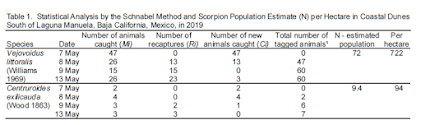
Population density estimation of scorpions in the coastal dunes at Laguna Manuela, Baja California, Mexico


 Baja California in Mexico has been a hotspot for scorpion diversity for many years with more than 60 reported species. But few studies have documented how abundant each species are in this area. 

Natalia Rodríguez-Revelo and Michael Wall have now published a study of the population density of the sccorpions in the Coastal Dunes at Laguna Manuela, Baja California, Mexico. The results showed that Vejovoidus longiunguis (Williams, 1969) Vajovidae), a purported dune specialist, was in extraordinarily large numbers relative to Centruroides exilicauda (Wood, 1863) (Buthidae), a widespread habitat generalist species.

Abstract:
While scorpion fauna of the Baja California Peninsula is well known for diversity, the biology of individual species has been less studied. The objective of the study was to assess abundance of scorpions of the coastal dunes at Laguna Manuela, Baja California, Mexico. In total, 182 scorpions were marked during 4 nights of sampling. Vejovoidus longiunguis (Williams, 1969), a purported dune specialist, was in extraordinarily large numbers relative to Centruroides exilicauda (Wood, 1863), a widespread habitat generalist species. The results contrasted with previous studies of V. longiunguis in different areas of its range.

Reference:
Rodríguez-Revelo N, Wall M. Population Density Estimation of Scorpions in the Coastal Dunes at Laguna Manuela, Baja California, Mexico. Southwestern Entomologist. 2021;46(4):941-6. [Subscription required for full text]

Thanks to Luis Roque for sending this article to me!

16 November, 2021

The identity of Centruroides hoffmanni and a new species of Centruroides from Chiapas, Mexico


Luis de Armas & Rolando Teruel have recently published an article discussion the identity of Centruroides hoffmanni Armas 1996 (Buthidae) in Mexico. This work has also resulted in the description of a new species of Centruroides from Chiapas, Mexico, previously misidentified as C. hoffmanni.

Centruroides concordia Armas & Teruel, 2021

Abstract:
The Mexican scorpion Centruroides hoffmanni Armas, 1996 was described on the basis of a supposed adult female (actually a juvenile) from La Gloria, Arriaga Municipality, southwest of the Chiapas State. In its redescription, this species was also recorded from the southeastern of Oaxaca State. Nevertheless, in the recent revision of the “thorellii” species-group of the genus Centruroides Marx, 1890, a new species from Chiapas was misidentified as C. hoffmanni and, also, an erroneous new diagnosis was given for C. hoffmanni. In the present contribution, this new species is named Centruroides concordia sp. n., and the correct identity of C. hoffmanni is established.

Reference:
de Armas LF, Teruel R. The correct identity of Centruroides hoffmanni Armas, 1996 (Scorpiones: Buthidae), with the description of a new species from Chiapas, Mexico. Euscorpius. 2021(339):1-5. [Open Access]

Family Buthidae

29 October, 2021

Systematics of the ‘thorellii’ clade of Centruroides and the efficacy of mini-barcodes for museum specimens


Museums around world have large collections of scorpions collected in the last centuries and the specimens found in these collections are naturally important in the study of scorpion taxonomy and diversity. 

Today's studies on taxonomy and phylogeny are relying more and more on molecular and genetic tools, and old museum specimens may pose a problems for these tools as they have never been preserved in the collections with these in mind. 

Aaron Goodman and co-workers have recently published an article investigating the efficacy of mini-barcodes combined with longer sequences of the Cytochrome c Oxidase Subunit I (COI) gene in the systematics of scorpions. This method can be used on old, badly preserved museums specimens from complete barcodes cannot be obtained.

The results also support the recognition of nine species of the ‘thorellii’ clade, in accordance with a recent taxonomic revision published by the same authors.

Abstract:
Fragmented and degraded DNA is pervasive among museum specimens, hindering molecular phylogenetics and species identification. Mini-barcodes, 200–300-base-pair (bp) fragments of barcoding genes, have proven effective for species-level identification of specimens from which complete barcodes cannot be obtained in many groups, but have yet to be tested in arachnids. The present study investigated the efficacy of mini-barcodes combined with longer sequences of the Cytochrome c Oxidase Subunit I (COI) gene in the systematics of the arboreal Neotropical ‘thorellii’ clade of Centruroides Marx, 1890 bark scorpions (Buthidae, C.L. Koch 1837), the species of which have proven to be difficult to identify and delimit due to their similar morphology. The phylogeny of 53 terminals, representing all nine species of the clade and representative species belonging to related clades of Centruroides, rooted on Heteroctenus junceus (Herbst, 1800) and based on up to 1078 base pairs of COI and 112 morphological characters, is presented to test the monophyly of the clade and the limits of its component species. The results support the recognition of nine species of the ‘thorellii’ clade, in accordance with a recent taxonomic revision, and highlight the efficacy of mini-barcodes for identifying morphologically similar cryptic species using specimens of variable age and preservation.

Reference:
Goodman AM, Prendini L, Esposito LA. Systematics of the Arboreal Neotropical ‘thorellii’Clade of Centruroides Bark Scorpions (Buthidae) and the Efficacy of Mini-Barcodes for Museum Specimens. Diversity. 2021;13(9):441. [Open Access]

Family Buthidae