Showing posts with label Dominican Republic. Show all posts

16 November, 2021

A remarkable find of two new troglobitic species from the Dominican Republic


Rolando Teruel and co-workers have recently published an article describing two new fully troglomorphic species in the genus Cazierius Francke, 1978 (Diplocentridae) from isolate limestone caves in the Dominican Republic.

Cazierius cayacoa Teruel, Jimenez & de los Santos, 2021

Cazierius ciguayo Teruel, Jimenez & de los Santos, 2021 

There are little information available for the new species as only one specimen has been found of each species, but hopefully further exploration of the cave systems that are assumed to host these interesting species  will reveal more information about them.

Abstract:
Two new species of the Greater Antillean endemic scorpion genus Cazierius Francke, 1978, are herein described from the island of Hispaniola. They were found inside isolate limestone caves in the Dominican Republic and are fully troglomorphic, thus, apparently being strict troglobites that represent the first ever documented for this genus. The present additions raise the number of Hispaniolan species of both Cazierius and the family Diplocentridae Karsch, 1880, to five and ten, respectively.

Reference:
Teruel R, Jimenez C, de los Santos G. The first troglobitic scorpions from Hispaniola, Greater Antilles: two new species of Cazierius Francke, 1978 (Scorpiones: Diplocentridae). Euscorpius. 2021(340):1-9. [Open Access]

Family Diplocentridae

04 November, 2020

A new study on scorpion life history traits and the effect of different feeding regimes


There is not much published on the life history traits in scorpions and especially on the influence of different feeding regimes. Michael Seiter and co-workers have recently published a study investigating the embryonic and postembryonic development in the species Tityus neibae Armas, 1999 (Buthidae) exposed to different feeding regimes. 

The results indicated a strong relationship between different feeding regimes, sex, morphometrics and life stages. Se abstract or article for further details.

Abstract:
Scorpions often experience food shortages, yet information on their baseline nutritional input is lacking. In many life histories, there is a trade-off between adult size and development time that is interrelated with food availability. We present precise data on the influence of two different feeding regimes that affect development in the buthid scorpion Tityus neibae. The results indicate a strong relationship between the treatment group, sex, morphometrics and life stages. The different diet inputs had no influence on the embryonic development or the litter size but had a major effect on the postembryonic development time and on the life stage when individuals reached maturity. No females or males reached maturity by the 4th instar when fed every two weeks and only males that were fed weekly were able to reach maturity by the 4th. Thus, a trade-off in T. neibae males is apparent, since they can reach maturity earlier in life, resulting in an overall smaller body size that may reduce the risk of predation. By contrast, females may have been selected to reach full development with an overall larger body size that results in an increase in the fitness, the number, or the size of the offspring.

Reference:
Seiter M, Mosetig L, Milasowszky N. The trade-off between adult size and development time due to different feeding regimes in the scorpion Tityus neibae. Invertebrate Reproduction & Development. 2020:1-7. [Subscription required for full text]

Thanks to Michael Seiter for sending me their article!

19 February, 2018

Two new speciec of Tityus from Haiti and The Dominican Republic


Rolando Teruel and Gabriel de los Santos have recently published a new article presenting two new species of Tityus C. L. Koch, 1836 (Buthidae) from Hispaniola, Greater Antilles.

Tityus haetianus Teruel & Santos, 2018 (Haiti)

Tityus schrammi Teruel & Santos, 2018 (The Dominican Republic)

Abstract:
Two new species of Buthidae scorpions of the genus Tityus C. L. Koch, 1836 are herein described from the Greater Antillean island of Hispaniola. One of them belongs to the "crassimanus" species-group and is known from an adult pair collected at Massif de la Hotte, in southwestern Haiti. The other belongs to the "quisqueyanus" species-group and is known from a single adult female from a high peak in the Central Range (= Cordillera Central), in northwestern Dominican Republic. Moreover, two fossil taxa from this island are retained as junior synonyms of Tityus geratus Santiago-Blay, 1988†.

Reference:
Teruel R, de los Santos G. Two New Tityus C. L. Koch, 1836 (Scorpiones: Buthidae) From Hispaniola, Greater Antilles. Euscorpius. 2018;257:1-16. [Open Access]

Family Buthidae

27 November, 2017

The scorpions of Hispaniola (Dominican Republic and Haiti)


Gabriel de los Santos and co-workers published an annotated list of the known scorpions from Hispaniola (Dominican Republic and Haiti) in 2016. I just recently learned about this article, hence the late mentioning in the blog. The article is in Spanish.

Abstract:
It is given an annotated list of the known scorpions of Hispaniola (Dominican Republic and Haiti), which belong to three families (Buthidae, Hormuridae, Scorpionidae), eight genera and 46 recent and four fossil species. Buthidae (five genera and 37 living species) is the most diversified family in this Antillean island, being Tityus C. L. Koch, 1836, Microtityus Kjellesvig-Waering, 1966, and Centruroides Marx, 1890, the most diverse and widespread genera with 14, 12 and seven species, respectively. The Dominican Republic (that represents the eastern two-thirds of the island), has 45 species and 36 of them are endemic from the country, whereas Haiti accounts nine species with a single national endemism. Isometrus maculatus (De Geer, 1778) has been introduced in both countries and is the only non-endemic species. This is the only Antillean island which includes representatives of both the Hormuridae family and the fossil fauna (in amber).

Reference:
de los Santos G, de Armas LF, Teruel R. Lista anotada de los escorpiones (Arachnida: Scorpiones) de la Española (República Dominicana y Haití). Novitates Caribaea. 2016;10:1-22. [Open Access]

Thanks to Mack Diamond for informing me about this paper!

22 January, 2016

Two new species from the island of Hispaniola, Dominican Republic


Rolando Teruel and co-workers have recently published two new species from the island of Hispaniola, Dominican Republic.

Centruroides altagraciae Teruel, de Armas & Kovarik, 2015 (Buthidae)

Heteronebo barahonae Teruel, de Armas & Kovarik, 2015 (Scorpionidae)

Abstract:
Two new species of scorpions are describe herein from Dominican Republic, in the Greater Antillean island of Hispaniola. The buthid Centruroides altagraciae n.sp. was found in several localities at the eastern tip of the island (La Altagracia province), whereas the diplocentrine Heteronebo barahonae n.sp. was captured at a single site of the northeastern section of the Bahoruco Range (Barahona province). Both taxa are compared in detail with their closest relatives, with abundant illustrations of habitus, main morphologically diagnostic characters and habitat.

Reference:
Teruel R, de Armas LF, Kovarik F. Two new species of scorpions (Scorpiones: Buthidae, Scorpionidae) from Dominican Republic, Greater Antilles. Revista Iberica de Arachnologia. 2015 (27):13-33.

Thanks to Dr. Teruel for informing me about this paper!

Family Buthidae
Family Scorpionidae

09 April, 2015

A new Centruroides species from The Dominican Republic


Rolando Teruel and co-workers have recently described a new species of Centruroides Marx, 1890 (Butidae) from Southern Hispaniola, The Dominican Republic.

Centruroides lucidus Teruel, Armas & Kovarik, 2015

The new species probably also inhabits Haiti.

Abstract:
We describe herein a new species of buthid scorpions, Centruroides lucidus sp. n., from southwestern Dominican Republic
(Pedernales and Barahona Provinces), in the Greater Antillean island of Hispaniola. It is most similar to Centruroides nitidus
(Thorell, 1876) and Centruroides bani Armas & Marcano, 1987 (both of which occur together with it along the same general
area), against which a very detailed comparison is provided. The new species is fully illustrated with color photos of habitus,
key diagnostic morphological characters, and habitat.

Reference:
Teruel R, De Armas LF, Kovarik F. A New Species of Centruroides Marx, 1890 (Scorpiones: Buthidae) from Southern Hispaniola, Greater Antilles. Euscorpius. 2015 (198):1-18. [Open Access]

Family Buthidae

19 June, 2014

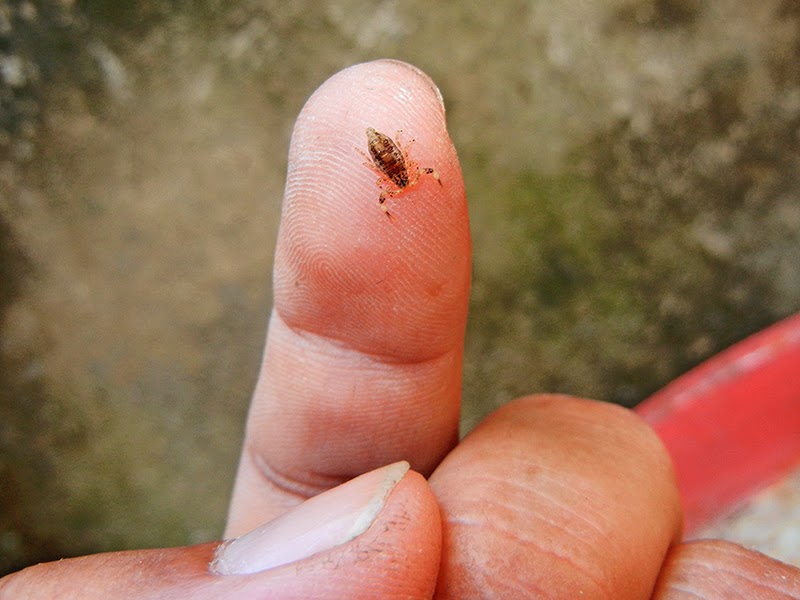
The World's smallest scorpion

Say hello to the smallest scorpion in the world, Microtityus minimus from the Dominican Republic. The scorpion seen in this pictures is actually an adult pregnant female. Photo: Dr. Rolando Teruel (C).

I'm happy to present the smallest scorpion in the world, recently described from the southernmost foothills of the Cordillera Central Mountains in the Dominican Republic by Kovarik & Teruel. The name of the new species is Microtityus minimus Kovarik & Teruel, 2014 (Buthidae). Mature adults in this species are usually not longer than 10 mm.

This species lives in subcoastal desert scrub on gypsum-sandy soil, at an elevation of 160–170 m. Collected specimens  were found hanging to the underside of small limestone rocks half-buried in the dry leaf litter of thorny shrubs and cacti, at the base of hills.

Scorpion enthusiasts are mostly interested in large size, potent venom etc., but incredible small species like this one is also very fascinating.

See original article (free full text) for more pictures of the new species and its habitat.

Thanks to Dr. Rolando Teruel for informing me about his interesting discovery and for sharing this great picture with me and the readers of The Scorpion Files!


17 June, 2014

Three new species from the Dominican Republic

The new species, Microtityus minimus, is probably the smallest scorpion of the world with adult sizes barely exceeding 10 mm.

Frantisek Kovarik and Rolando Teruel have recently published three new species from the Dominican Republic.

Microtityus minimus Kovarik & Teruel, 2014 (Buthidae)

Tityus kindli Kovarik & Teruel, 2014 (Buthidae)

Cazierius neibae Kovarik & Teruel, 2014 (Scorpionidae)

The paper have several color pictures of species and habitats.

Abstract:
We describe herein three new species of scorpions from the Dominican Republic, in the Greater Antillean Island of Hispaniola: Microtityus minimus sp. n. (probably the smallest scorpion in the world from the southernmost foothills of the Cordillera Central Mountains), Tityus kindli sp. n. (from the high peaks of eastern Cordillera Central Mountains), and Cazierius neibae sp. n. (from the southern slope of the Sierra de Neiba Mountains). Additional information is given on their taxonomy, distribution, ecology, and reproductive biology, fully complemented with color photos of live and preserved specimens, as well as their habitat. Figure 20 shows the smallest scorpion female (total length 11.4 mm) photographed with the newborn.

Reference:
Kovarik F, Teruel R. Three New Scorpion Species from the Dominican Republic, Greater Antilles (Scorpiones: Buthidae, Scorpionidae). Euscorpius. 2014 (187):1-27. [Free full text]

Family Buthidae

Family Scorpionidae

03 April, 2013

A fossil Tityus in amber from The Dominican Republic

Wilson Lourenco has recently published another species from specimens discovered in amber. This time a new species of Tityus C. L. Koch, 1836 (Buthidae) had been described in amber from The Dominican Republic. This is an extinct species and is not added to the species list in The Scorpion Files.

Tityus azari Lourenco, 2013
 
Abstract:
Tityus azari sp. n., a new species of fossil scorpion belonging to the genus Tityus C. L. Koch, 1836 is described based on a specimen in amber from the Dominican Republic. Although the new species can be associated with the extant fauna of the Neotropical region, it presents some particular morphological features such as the presence of sharp denticles on the edge of pedipalp fingers. Due to the incompleteness of the specimen it cannot be assigned to any precise extant subgenera. Once again, this discovery attests to a considerable degree of diversity in the Dominican amber-producing forests.

Reference:
Lourenco WR. A new species of Tityus C. L. Koch, 1836 (Scorpiones: Buthidae) from Dominican amber. Euscorpius. 2013 (156):1-5. [Free full text]

06 January, 2013

Revision of Microtityus in the Dominican Republic - Five new species

Luis de Armas and Rolando Teruel have recently published a revision of the genus Microtityus Kjellesvig-Waering, 1966 (Buthidae) in the Dominican Republic. Five new species are described, all of them previously misidentified as other species.

Microtityus barahona Armas & Teruel, 2012
Microtityus lourencoi Armas & Teruel, 2012
Microtityus prendinii Armas & Teruel, 2012
Microtityus reini Armas & Teruel, 2012
Microtityus solegladi Armas & Teruel, 2012

A sixth species was also identified, but not formally named in this paper. In addition, Microtityus starri Lourenco & Huber, 199 was restored as a valid species (previously synonymized with M. rickyi Kjellesvig-Waering, 1966).

On a personal note I will declare that I have a new favorite species in the scorpion world! ;)

Abstract:
The scorpions of the genus Microtityus Kjellesvig-Waering, 1966 of the Dominican Republic are revised, and five new species, all of them previously misidentified, are described; also, a sixth species is identified but not formally named. Diagnoses are emended for the subgenera Microtityus Kjellesvig-Waering, 1966 and Parvabsonus Armas, 1974, and for all the Dominican species. With those additions the number of Dominican species of this genus rises to 11. Microtityus starri Lourenço & Huber, 1999 is restored as a valid taxon, whereas M. ambarensis (Schawaller, 1982) is transferred to the subgenus Parvabsonus.

Reference:
de Armas LF, Teruel R. Revisión del género Microtityus Kjellesvig-Waering, 1966 (Scorpiones: Buthidae) en República Dominicana. Revista Iberica de Arachnologia. 2012 (21):69-88.

A specially thanks to Luis de Armas and Rolando Teruel for naming one of the new species after me and thereby honoring my work with The Scorpion Files project! An additional thanks to Rolando for sending me this paper!

15 September, 2010

A Centruroides eating a terrestrial mollusc

Giraldo Alayon Gracia and Luis de Armas have published a short note with an observation of a specimen of Centruroides nitidus (Thorell, 1876) (Buthidae) preying on a terrestrial mollusc of the species Liguus virgineus (Linnaeus, 1767).

A similar observation have been published from South Africa (Opisthophthalmus carinatus), and this new observation confirms that scorpions are indeed predators that will catch a lot of different prey types.

Abstract:
A young specimen of the terrestrial mollusc Liguus virgineus (Linnaeus, 1767) was preyed upon by the buthid scorpion Centruroldes nitidus (Thorell, 1876). The field observation took place in the municipality of Banica, Elias Pitia province, Dominican Republic.

Reference:
Garcia GA, de Armas LF. Liguus virgineus (Gastropoda: Orthalicidae) depredado por Centruroides nitidus (Scorpiones: Buthidae). Boletin de la SEA. 2010(46):394.

19 August, 2009

A new paper on Rhopalurus abudi from Hispaniola

Lorenzo Prendini and co-workers have recently published a paper on Rhopalurus abudi (Buthidae). The species is redescribed and the male is described for the first time. The authors also report the species form mainland Hispaniola for the first time.

Abstract:
Rhopalurus abudi Armas & Marcano Fondeur 1987 was originally described on the basis of a single female specimen from Isla Saona, La Romana Province, off the southeast coast of the Dominican Republic. The species is redescribed here based on a series of new specimens including 19 adult males and 14 adult females collected at two nearby localities on the eastern side of Parque Nacional del Este, La Altagracia Province, southeastern Dominican Republic. These specimens represent the first records of R. abudi on mainland Hispaniola and the first male specimens of the species to be collected.

Reference:
Prendini L, Esposito LA, Huff JC, Volschenk ES. Redescription of Rhopalurus abudi (Scorpiones, Buthidae), with first description of the male and first record from mainland Hispaniola. Journal of Arachnology. 2009;37 (2):206-24. [Subscription required for fulltext, but free fulltext after one year]

Family Buthidae

10 June, 2009

A new fossil species in the genus Tityus from the Dominican Republic

A new species in the genus Tityus (Buthidae) has been described from a specimen in amber from the Dominican Republic.

Tityus hartkorni Lourenco, 2009 (Buthidae)

Abstract:
Tityus (Brazilotiyus) hartkorni sp. n., a new species of fossil scorpion belonging to the genus Tityus C. L. Koch and to the subgenus Brazilotityus Lourenço, is described from a specimen in amber from the Dominican Republic. The new species is clearly associated with the extant fauna of the Neotropical region. This discovery attests to a considerable degree of diversity in the Dominican amber-producing forests.

Please note that this species will not be listed in The Scorpion Files as I only list extant species.

Reference:
Lourenco WR. A new species of Tityus C. L. Koch, 1836 (subgenus Brazilotityus Lourenco, 2006) from the Dominican amber (Scorpiones: Buthidae). Euscorpius. 2009; (83):1-5. [Free fulltext]

Family Buthidae