25 June, 2014
High altitude scorpions in Cuba
Tomás M. Rodríguez-Cabrera and Rolando Teruel have recently published a review of scorpions found above 800 meters altitude in Cuba.
Abstract:
All findings of scorpions above 800 m altitude in Cuba are herein revised; this contour is seen to be exceeded only by four members of Buthidae: Centruroides anchorellus Armas, 1976, Centruroides baracoae Armas, 1976, Centruroides stockwelli Teruel, 2000, and Rhopalurus junceus (Herbst, 1800). Some of the previous records from the literature are corrected and the upper limit is found to correspond to C. baracoae in eastern Cuba (1,600 m at the source of Palma Mocha River). Also, the occurrence of C. stockwelli is documented at the highest mountain of central Cuba (1,140 m at Pico San Juan, Cienfuegos), as well as new upper records for C. anchorellus (1,362 m on the southern slope of Pico Martí) and R. junceus (1,231 m at Pico El Toldo).
Reference:
Rodríguez-Cabrera TM, Teruel R. On the highest altitudinal occurrences of scorpions in Cuba (Arachnida: Scorpiones). Revista Iberica de Arachnologia. 2014 (24):119-22.
Thanks to Rolando for sending me his paper!
Submitted by
Jan Ove Rein (editor)
på
2:46 PM
0
Comments
Keywords:
Buthidae,
Caribbean,
Centruroides,
Cuba,
distribution,
ecology,
habitat,
Rhopalurus
23 June, 2014
Redescription and corrected distribution of Chactas rubrolineatus
Lourenco & Leguin have recently confirmed the species status of Chactas rubrolineatus Simon, 1880 (Chactidae) after rediscovering the type specimen. A redescription is presented and the species' confirmed distribution is corrected to Brazil.
Abstract:
The type specimen of Chactas rubrolineatus, described by Simon in 1880, was considered lost, or at least mislaid, for long time. After several months of research in the collections of the Muséum national d’Histoire naturelle in Paris, the female type specimen was located in the vial labelled RS-0778. A precise diagnosis of this species and also of several personal notes of E. Simon leads to two new conclusions: (i) Chactas rubrolineatus is a valid species and not a synonym of Chactas vanbenedenii Gervais, 1843, neither of Chactas brevicaudatus (Karsch, 1879); (ii) Chactas rubrolineatus was described by Simon from Rio Içá, which is not located in Ecuador but rather in Brazil. The presence of this species in Ecuador has yet to be proved.
Reference:
Lourenco WR, Leguin E-A. Le véritable statut de l’espèce Chactas rubrolineatus Simon, 1880 (Scorpiones: Chactidae). Revista Iberica de Arachnologia. 2014 (24):87-9.
Thanks to professor Lourenco for sending me his article!
Family Chactidae
Submitted by
Jan Ove Rein (editor)
på
1:39 PM
0
Comments
Keywords:
Brazil,
Chactas,
Chactidae,
distribution,
Ecuador,
redescription,
South America,
taxonomy
A new species in the rare genus Lissothus in Northern Africa
Wilson Lourenco and Salah Eddine Sadine have recently discovered a new species in the rare, North African genus Lissothus Vachon, 1948 from Central Algeria (Buthidae).
Lissothus chaambi Lourenco & Sadine, 2014
This is only the third species in this rarely collected genus, the other two species originating in Libya and Mauritania.
Abstract:
Taxonomic considerations are given for the genus Lissothus Vachon, 1948 (Scorpiones, Buthidae). Two species are currently known, Lissothus bernardi Vachon, 1948 from Libya and Lissothus occidentalis Vachon, 1950 from Mauritania. In this contribution, a new species, Lissothus chaambi sp. n., is described from the desert of Central Algeria. The new species is most closely related to L. bernardi. The geographical distribution of the genus is discussed.
Reference:
Lourenço WR, Sadine SE. A new species of the rare buthid scorpion genus Lissothus Vachon, 1948 from Central Algeria (Scorpiones, Buthidae). Comptes Rendus Biologies. 2014;337(6):416-22.[Subscription required for full text]
Thanks to Dr. Sadine for sending me his paper!
Family Buthidae
Submitted by
Jan Ove Rein (editor)
på
10:11 AM
0
Comments
Keywords:
Africa,
Algeria,
Buthidae,
distribution,
Lissothus,
new species,
taxonomy
20 June, 2014
A new species of Hottentotta from the Hoggar Mountains in Algeria
![]() |
| Hottentotta hoggarensis Lourenco & Leguin, 2014 is probably endemic to the Hoggar Mounatins in Algeria. |
Wilson Lourenco and Elise-Anne Leguin have recently described a new species of Hottentotta Birula, 1908 (Buthidae) from the Hoggar Mountains in Algeria.
Hottentotta hoggarensis Lourenco & Leguin, 2014
Abstract:
A new species of scorpion belonging to the genus Hottentotta Birula, 1908 is described on the basis of a single female specimen collected in the Mountains of Hoggar, southern Algeria. This new species may yet represent another endemic and relict element of the Saharan mountain system. It can also constitute a possible link between the northern and southern Hottentotta populations in Africa. Some comments are also included on the geographical distribution of the genus Hottentotta in Africa.
Reference:
Lourenco WR, Leguin E-A. Une nouvelle espèce d’Hottentotta Birula, 1908 pour le massif du Hoggar en Algérie (Scorpiones, Buthidae); conséquences biogéographiques sur la répartition du genre. Revista Iberica de Arachnologia. 2014 (24):15-8.
Thanks to professor Lourenco for sending me his article!
Family Buthidae
Submitted by
Jan Ove Rein (editor)
på
11:37 AM
0
Comments
Keywords:
Africa,
Algeria,
Buthidae,
distribution,
Hottentotta,
new species,
taxonomy
19 June, 2014
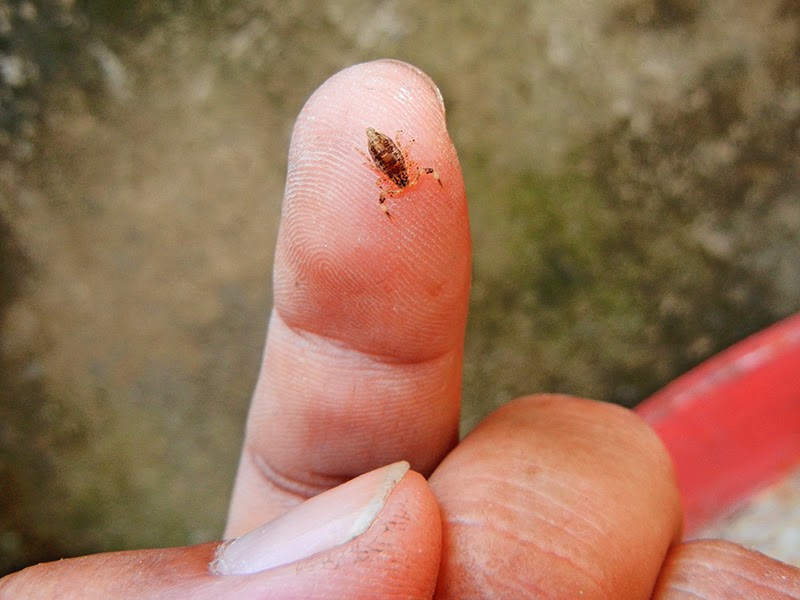
The World's smallest scorpion
I'm happy to present the smallest scorpion in the world, recently described from the southernmost foothills of the Cordillera Central Mountains in the Dominican Republic by Kovarik & Teruel. The name of the new species is Microtityus minimus Kovarik & Teruel, 2014 (Buthidae). Mature adults in this species are usually not longer than 10 mm.
This species lives in subcoastal desert scrub on gypsum-sandy soil, at an elevation of 160–170 m. Collected specimens were found hanging to the underside of small limestone rocks half-buried in the dry leaf litter of thorny shrubs and cacti, at the base of hills.
Scorpion enthusiasts are mostly interested in large size, potent venom etc., but incredible small species like this one is also very fascinating.
See original article (free full text) for more pictures of the new species and its habitat.
Thanks to Dr. Rolando Teruel for informing me about his interesting discovery and for sharing this great picture with me and the readers of The Scorpion Files!
Submitted by
Jan Ove Rein (editor)
på
1:09 PM
0
Comments
Keywords:
anatomy,
Buthidae,
Central America,
Dominican Republic,
Microtityus,
morphology,
popular work
18 June, 2014
Phylogeny of the genus Odontobuthus in Iran
Sara Azghadi and co-workers have recently published a phylogenetic analysis of the Iranian species of the genus Odontobuthus Vachon, 1950 (Buthidae). The validity of the species so far described was confirmed and a new species was identified from the Kerman Province. The new species is not formally described and named in the current publication.
Abstract:
The molecular phylogeny of the genus Odontobuthus Vachon, 1950 (Scorpiones: Buthidae) in Iran was evaluated using two mitochondrial DNA genes, cytochrome c oxidase, subunit I (COI) and 16S ribosomal RNA (16S rRNA). The molecular phylogenetic analyses were performed using Maximum Parsimony, Maximum Likelihood and Bayesian inference methods. The resulting topologies supported two main clades: the clade comprising Odontobuthus doriae, O. bidentatus, and O. tavighiae, and another one which is the O. tirgari clade. The results clearly presented additional support for the taxonomic validity of the recently described species, O. tirgari and O. tavighiae. In addition, the monophyly of two previously described species O. doriae and O. bidentatus was confirmed. According to the data presented here, three taxonomically valid species belonging to the genus Odontobuthus occur in Iran.
Reference:
Azghadi S, Mirshamsi O, Navidpour S, Aliabadian M. Scorpions of the genus Odontobuthus Vachon, 1950 (Scorpiones: Buthidae) from Iran: Phylogenetic relationships inferred from mitochondrial DNA sequence data. Zoology in the Middle East. 2014;60(2):169-79. [Subscription required for full text]
Family Buthidae
Submitted by
Jan Ove Rein (editor)
på
9:59 AM
0
Comments
Keywords:
Asia,
Buthidae,
distribution,
Iran,
Middle East,
Odontobuthus,
phylogeny,
taxonomy
17 June, 2014
Three new species from the Dominican Republic
![]() |
| The new species, Microtityus minimus, is probably the smallest scorpion of the world with adult sizes barely exceeding 10 mm. |
Frantisek Kovarik and Rolando Teruel have recently published three new species from the Dominican Republic.
Microtityus minimus Kovarik & Teruel, 2014 (Buthidae)
Tityus kindli Kovarik & Teruel, 2014 (Buthidae)
Cazierius neibae Kovarik & Teruel, 2014 (Scorpionidae)
The paper have several color pictures of species and habitats.
Abstract:
We describe herein three new species of scorpions from the Dominican Republic, in the Greater Antillean Island of Hispaniola: Microtityus minimus sp. n. (probably the smallest scorpion in the world from the southernmost foothills of the Cordillera Central Mountains), Tityus kindli sp. n. (from the high peaks of eastern Cordillera Central Mountains), and Cazierius neibae sp. n. (from the southern slope of the Sierra de Neiba Mountains). Additional information is given on their taxonomy, distribution, ecology, and reproductive biology, fully complemented with color photos of live and preserved specimens, as well as their habitat. Figure 20 shows the smallest scorpion female (total length 11.4 mm) photographed with the newborn.
Reference:
Kovarik F, Teruel R. Three New Scorpion Species from the Dominican Republic, Greater Antilles (Scorpiones: Buthidae, Scorpionidae). Euscorpius. 2014 (187):1-27. [Free full text]
Family Buthidae
Family Scorpionidae
Submitted by
Jan Ove Rein (editor)
på
10:22 AM
0
Comments
Keywords:
Buthidae,
Cazierius,
Central America,
distribution,
Dominican Republic,
habitat,
Microtityus,
new species,
Scorpionidae,
taxonomy,
Tityus
Subscribe to:
Posts (Atom)