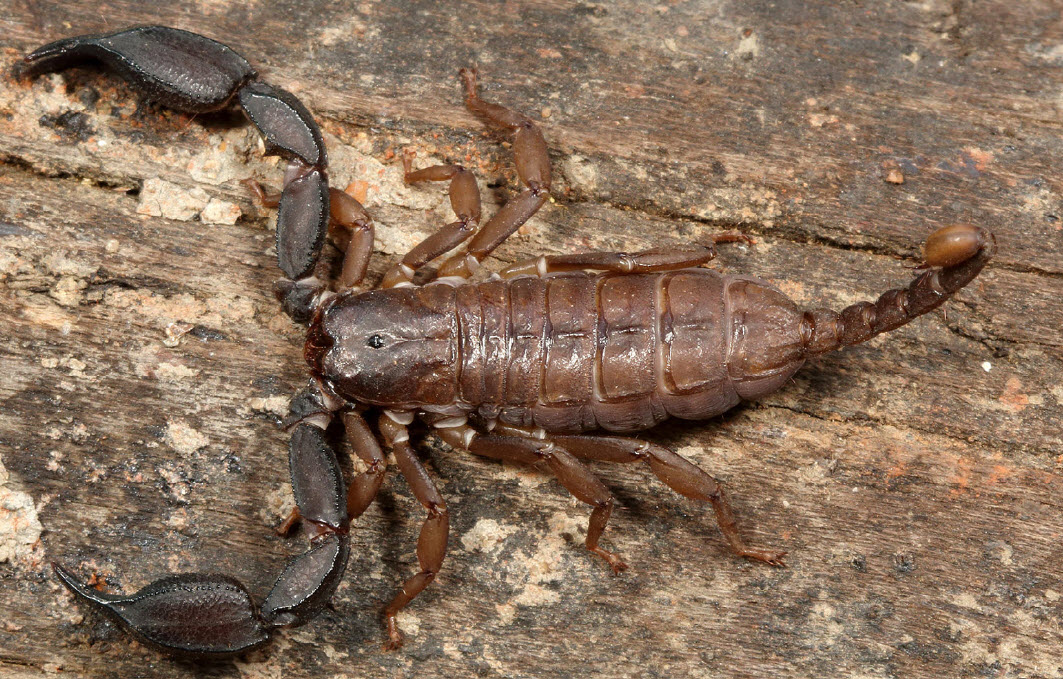
10 June, 2016
Androctonus aeneas restored as a valid species and a new Androctonus from Ethiopia
The taxonomy of the genus Androctonus Ehrenberg, 1828 (Buthidae) is complicated and there have been few attempts to do a complete revision of the genus. In spite of this, there have been several adjustments and addition of new species in the last decade.
In a late 2015 article, Lourenco and co-workers discuss the taxonomical status of the until now synonymized species Androctonus aeneas C. L. Koch, 1839. The result of this investigation is that Androctonus aeneas is restored to species status. Another decision from this investigation is that Androctonus turieli Teruel & Kovarik, 2014 is considered a junior synonym of A. aeneas.
The article also described a new species from the Tigray Province in Ethiopia.
Androctonus tigrai Lourenco, Rossi & Sadine, 2015
Abstract:
New considerations are proposed on some North African species of Androctonus Ehrenberg, 1828. The status of Androctonus aeneas C. L. Koch, 1839 is revaluated and its type locality is confirmed as the area of Oran, in Algeria. Since the two original specimens used both for the description and illustration of A. aeneas are considered lost, one neotype is designated, in order to stabilize the nomenclature within the genus, according to ICZN. New data on the geographical distribution and ecology of A. aeneas are also provided and Androctonus turieli Teruel et Kovařík 2014 is considered as a junior synonym of A. aeneas. Androctonus tigrai sp. n. is also described on the basis of two males and one female collected in the Province of Tigray, in Ethiopia.
Reference:
Lourenco WR, Rossi A, Sadine SE. New data on the genus Androctonus Ehrenberg, 1828 (Scorpiones, Buthidae), with the description of a new species from Ethiopia. Aracnida - Rivista Arachnologica Italiana. 2015;1(5):11-9.
Thank to Gerard Dupre for sending me this article!
Family Buthidae
Submitted by
Jan Ove Rein (editor)
på
10:09 AM
0
Comments
Keywords:
Africa,
Algeria,
Androctonus,
Buthidae,
distribution,
Ethiopia,
new species,
redescription,
restored species,
synonymization,
taxonomy,
Tunisia
09 June, 2016
First molecular phylogeny of scorpions of the family Buthidae from India
As the title implies, as recent article by Vivek Suranse and co-workers presents the first molecular phylogeny of buthid scorpions from India (or more precisely central western India). This is a preliminary study as not all Indian species in Buthidae have been sampled, but the current results confirm the taxonomical placement of many taxa. In addition, the data also add new information and insight on the phylogeny of several taxa and raises questions that need to be looked into in future research. Especially the results for the infamous Hottentotta tamulus Fabricius, 1798 should be further investigated because of its medical significance.
Abstract:
Scorpions of the family Buthidae are widespread species in India. While studies are available on diversity and distribution of Indian buthid scorpions, no information is available on the phylogenetic relationships among the members of the family, within India and Asia in general. In the current study, we provide the first molecular phylogeny of buthid scorpions from central western India based on the mitochondrial cytochrome oxidase subunit I (COI) gene. Our analysis confirms the current placement of the species, previously assigned to Mesobuthus in the genus Hottentotta. However, the analysis also suggests that the member of this genus from India form a monophyletic group distinct from the members of Hottentotta from Africa. Species of Lychas formed a monophyletic group. Although Orthochirus was nested within the larger clade of buthidae comprising genera such as Androctonus, Buthacus, Buthus and Odontobuthus, the exact phylogenetic placement will require more taxonomic sampling of the known genera of Buthidae. We also show that there is a substantial genetic variation among the populations of medically important scorpion species Hottentotta tamulus, and the genetic distance is linearly correlated with the geographical distance between the populations.
Reference:
Suranse V, Sawant NS, Paripatyadar SV, Krutha K, Paingankar MS, Padhye AD, et al. First molecular phylogeny of scorpions of the family Buthidae from India. Mitochondrial DNA Part A DNA mapping, sequencing, and analysis. 2016 Jun 1:1-6. [Subscription required for full text]
Thanks to Carlos Turiel for informing me about this article!
Family Buthidae
Submitted by
Jan Ove Rein (editor)
på
1:59 PM
0
Comments
Keywords:
Asia,
Buthidae,
distribution,
Hottentotta,
India,
Lychas,
Mesobuthus,
molecular biology,
phylogeny,
taxonomy
08 June, 2016
A new Euscorpius species from Western Turkey
Gioele Tropea and Ersen Yagmur have recently described a new species of Euscorpius Thorell, 1876 (Euscorpiidae) from the Sultan Mountains in western Turkey.
Euscorpius sultanensis Tropea & Yagmur, 2016
Abstract:
A new species of scorpion, Euscorpius sultanensis sp. n., is described from the Sultan Mountains (Sultandağ), a short mountain range in Afyonkarahisar, Konya and Isparta provinces in western Turkey.
Reference:
Tropea G, Yagmur EA. A new species of Euscorpius Thorell, 1876 from the Sultan Mountains in western Turkey (Scorpiones: Euscorpiidae). Aracnida - Rivista Arachnologica Italiana. 2016;2(6):32-43.
Family Euscorpiidae
Submitted by
Jan Ove Rein (editor)
på
10:30 AM
0
Comments
Keywords:
Asia,
distribution,
Europe,
Euscorpiidae,
Euscorpius,
new species,
taxonomy,
Turkey
07 June, 2016
Phylogeography and microendemism in Uroctonus in California
Robert Bryson Jr and co-workers have recently published a phylogeographical study looking at microendemism in Uroctonus Thorell, 1876 (Chactidae) in California (USA). Understanding historical processes that generates diversity in an area is important, and the current study suggest tectonic plate rafting, mountain uplift, river drainage formation, and climate-induced habitat fragmentation have all likely played a role in the diversification of Uroctonus in the study area.
Abstract:
The California Floristic Province (CFP) in western North America is a globally significant biodiversity hotspot. Elucidating patterns of endemism and the historical drivers of this diversity has been an important challenge of comparative phylogeography for over two decades. We generated phylogenomic data using ddRADseq to examine genetic structure in Uroctonus forest scorpions, an ecologically restricted and dispersal-limited organism widely distributed across the CFP north to the Columbia River. We coupled our genetic data with species distribution models (SDMs) to determine climatically suitable areas for Uroctonus both now and during the Last Glacial Maximum (LGM). Based on our analyses, Uroctonus is composed of two major genetic groups that likely diverged over two million years ago. Each of these groups itself contains numerous genetic groups that reveal a pattern of vicariance and microendemism across the CFP. Migration rates among these populations are low. SDMs suggest forest scorpion habitat has remained relatively stable over the last 21,000 years, consistent with the genetic data. Our results suggest tectonic plate rafting, mountain uplift, river drainage formation, and climate-induced habitat fragmentation have all likely played a role in the diversification of Uroctonus. The intricate pattern of genetic fragmentation revealed across a temporal continuum highlights the potential of low-dispersing species to shed light on small-scale patterns of biodiversity and the underlying processes that have generated this diversity in biodiversity hotspots.
Reference:
Bryson Jr RW, Savary WE, Zellmer AJ, Bury B, McCormack JE. Genomic data reveal ancient microendemism in forest scorpions across the California Floristic Province. Mol Ecol. 2016;Accepted manuscript online: 30 May 2016. [Subscription required for full text]
Submitted by
Jan Ove Rein (editor)
på
9:25 AM
0
Comments
Keywords:
biogeography,
Chactidae,
distribution,
habitat,
North America,
phylogeny,
phylogeography,
taxonomy,
Uroctonus,
USA
31 May, 2016
Redescription and neotype designation for the Indian scorpion Scorpiops pachmarhicus
Many scorpions were collected and named many years ago, and some of the types for these species were never deposited to a museum collection, or have disappeared during the years. Mirza and Gowande have now collected new specimens of Scorpiops pachmarhicus Bastawade, 1992 (Euscorpiidae) from Madhya Pradesh, India, and a redescrption with neotype designation was recently published.
Abstract:
Scorpiops pachmarhicus Bastawade, 1992 was described based on specimens collected from Pachmarhi, Madhya Pradesh. An expedition to the type locality led to discovery of a population at the type locality which permit us to designate a neotype for the species as types of the species are presently not traceable.
Reference:
Mirza ZA, Gowande G. Neotype Designation for Scorpiops pachmarhicus Bastawade, 1992 (Scorpiones: Euscorpiidae), with Redescription and Notes on the Species. Euscorpius. 2016 (223):1-7. [Open access]
Family Euscorpiidae
Submitted by
Jan Ove Rein (editor)
på
10:40 AM
0
Comments
Keywords:
Asia,
distribution,
Euscorpiidae,
India,
redescription,
Scorpiops,
taxonomy
26 May, 2016
The effect of habitat fragmentation on the scorpion assemblage of a Brazilian Atlantic Forest
Human deforestation of the world's tropical rainforests have resulted in habitat destruction and subsequent habitat fragmentation. Lira and co-workers have now published a study that investigated how fragmentation and habitat structure influenced the scorpion assemblage in a hyperfragmented landscape in the northeast Brazilian Atlantic Forest. Not surprisingly, the authors conclude that fragmentation and habitat quality are determining factors for the assemblage of the scorpion populations in this study.
Abstract:
Habitat fragmentation is a topic widely studied in ecology; however, its effects on the assemblage of the order Scorpiones is less well understood. Aiming to fill this gap, this study assessed the effect of fragmentation on the assemblage of these arachnids in 12 Brazilian Atlantic forest fragments. Five environmental variables were measured (depth and dry mass of litter, understory density, canopy openness, and diameter at breast height of the trees), and the fragment area, vegetation cover, connectivity and elevation assessed. The animals were collected during the dry season and, identified at night with the use of ultraviolet light lamps. The analyzed scorpion assemblage in the landscape was characterized by the species Tityus pusillus, T. stigmurus, T. neglectus, T. brazilae, and Ananteris mauryi, with a maximum of three species cooccurring per fragment. Only the fragment size and the dry mass of litter showed a positive relationship with the composition of scorpions. These results suggest that the habitat of scorpions responds to environmental attributes and landscape metrics at both higher (fragment size) and lower (leaf litter) scales. Our study was able to expand our knowledge of how scorpions respond to habitat changes in the Atlantic Forest. We conclude that fragmentation and
habitat quality are determining factors for the assemblage of these arachnids.
Reference:
Lira AFA, de Araujo VLN, de Souza AM, Rego FNAA, Albuquerque CMR. The effect of habitat fragmentation on the scorpion assemblage of a Brazilian Atlantic Forest. J Insect Conserv. 2016;First online: 14 May 2016. [Subscription required for full text]
Thanks to Andre Lira for sending me their article!
Submitted by
Jan Ove Rein (editor)
på
2:26 PM
0
Comments
Keywords:
Ananteris,
Brazil,
Buthidae,
distribution,
ecology,
habitat,
habitat destruction,
South America,
Tityus
24 May, 2016
Ecology and biogeography of the Romanian scorpion Euscorpius carpathicus
Unlike scorpions from warmer areas, the species in the genus Euscorpius Thorell, 1876 (Euscorpiidae) have to be dapted to a climate ranging from dry, hot summers to cold, snowy winters. In a recently published article, Iulian Gherghel and co-workers provide an updated overview on the distribution of Euscorpius carpathicus (Linnaeus, 1767) and a map of of the climatically suitable areas for the species using occurrence and climatic data. In addition, the overwintering behavioral ecology of the species is discussed.
Abstract:
We present a first analysis of the ecology and potential distribution of Euscorpius carpathicus (Linnaeus, 1767), a scorpion species endemic to southern Romania, and report on the overwintering habitat selection of this species. Using field data, literature review, species distribution modelling, and habitat selection models, we document the broad scale distribution and ecology of E. carpathicus, as well as habitat selection in the foothills of the Curvature Carpathians, including exclusive microhabitat selection of riverine clay banks. In contrast with other species of the genus that inhabit cracks in cliffs or walls, E. carpathicus has adapted to cracks in clay.
Reference:
Gherghel I, Sotek A, Papes M, Strugariu A, Fusu L. Ecology and biogeography of the endemic scorpion Euscorpius carpathicus (Scorpiones: Euscorpiidae): a multiscale analysis. Journal of Arachnology. 2016;44(1):88-91. [Subscription required for full text]
Family Euscorpiidae
Submitted by
Jan Ove Rein (editor)
på
10:51 AM
0
Comments
Keywords:
biogeography,
cold adaption,
distribution,
ecology,
Europe,
Euscorpiidae,
Euscorpius,
habitat,
Romania
Subscribe to:
Posts (Atom)