Showing posts with label reproduction. Show all posts

24 June, 2026

Offspring growth and development in two buthid scorpions from Azerbaijan

Growth and biological development in scorpions vary between species and their habitat, climate and feeding ecology. Nizami E. Novruzov has recently published a laboratory study of the above in the two buthid species Olivierus caucasicus (Nordmann, 1840) and Mesobuthus eupeus (C.L. Koch, 1839) from Azerbaijan. See abstract and article for details.

Abstract:
The main aspects of offspring growth in two scorpion species – Mesobuthus eupeus and Olivierus caucasicus were studied. The entire reproductive cycle – mating, pregnancy of females, birth of the offspring and their growth until adulthood – took place in laboratory conditions. The duration, rate, and intensity of growth, as well as the dynamics of body weight changes and some metric traits during post-embryonic ontogenesis were studied. The growth of young scorpions was uneven, with growth periods of varying lengths: from larva to third molt – an average of 6.2 months, from the fourth molt to the sixth (imago) – an average of 12.6 months (M. eupeus); and an average of 7.7 and 14.1 months (O. caucasicus). By duration of development, M. eupeus nymphs were ahead of O. caucasicus nymphs: on average by 9.2±2.8 days in early post-larval ontogenesis and by 15.0±3.5 days in late post larval ontogenesis. Of the entire growth cycle, 4/5 occurred during molting, the remaining 1/5 occurred in the periods between molting. Species-specific and sex-specific differences in the dynamics of changes in linear characters and body weight were identified. Sexual dimorphism was also evident in faster development, a greater number of molts, and a longer lifespan in females compared to males. Changes in growth rate and intensity tended to increase at the beginning of development and decrease at the end. Nymphs of both species also showed some decrease in growth rate and weight gain during periods of no feeding activity before molting and during periods chronologically corresponding to their natural diapause in the wild.

Reference:
Novruzov NE. Comparative dynamics of offspring growth in Mesobuthus eupeus (C.L. Koch, 1839) and Olivierus caucasicus (Nordmann, 1840) (Scorpiones: Buthidae). Serket. 2026;21(2):158–74. [Open Access]

Thanks to Hisham El-Hennaway for sending me the article! 

18 February, 2026

Differences in pedipalp form and size affect courtship behavior in Tityus species


Differences in male morphology within the same species have been observed in many species. In a recent paper, Lais Pordeus and Andre Lira show that differences in the male pedipalp chela in Tityus pusillus Lourenço, 2013 (Buthidae) are associated with differences in reproductive behavior. Males with "robust" pedipalp chela performed a higher number of reproductive attempts and female manipulations than than males with "gracile" chela.

Interestingly, the reproductive success of the males in the two groups was quite similar.

Abstract:
This study investigates male pedipalp chela dimorphism and its association with reproductive behaviour in the litter-dwelling scorpion, Tityus pusillus. Using geometric morphometrics, two distinct male morphotypes were identified based on pedipalp chela shape: robust and gracile. These morphotypes were associated with measurable variation in courtship behaviour aspects. Males with robust chelae performed a higher number of reproductive attempts and female manipulations than gracile-chela males, although these differences were not statistically significant. Notably, robust-chela males completed courtship significantly faster than gracile-chelae males (8.03 ± 5.14 minutes vs. 18.40 ± 13.84 minutes), measured as the time until mating successful conclusion. Both morphotypes exhibited similar reproductive success rates (37% and 31%, respectively). These results indicate that robust and gracile differ in courtship dynamics, particularly in courtship duration and patterns of female handling. Variation in female resistance during courtship may help explain why male reproductive behaviours vary. This study documents male chela dimorphism in T. pusillus and reports its correlation with variation in courtship behaviour.

Reference:
Pordeus LM, Lira AFA. Dimorphism in male pedipalps affects the reproductive behaviour in the litter-dwelling scorpion Tityus pusillus Pocock, 1893 (Scorpiones: Buthidae). Invertebrate Reproduction & Development. 2026;Published online 17 Feb 2026. [Subscription required for full text]

12 January, 2026

Sexual stings in scorpions - knock-out drug or love potion?


I have taken the liberty to steal the title of Yuqi Reitsema-Wang and co-workers very interesting review article on sexual stings in scorpion that was published recently. Scorpions use their venom and sting for several purposes like defense and prey capturing. Less known is the sexual stings that have been observed as a part of the courtship for several species of scorpions.

The authors give an introduction to this fascinating behavior in scorpions and discuss what is known about the composition of the venom used in sexual stings (venom metering, prevenom, venom heterogeneity and venom plasticity), how do males control the delivery of venom during sexual stings and how do sexual stings affect the females (are they drugged into submission or is the venom a "love potion" encouraging the females to mate?). In addition, the authors also discuss the evolution of sexual stings in scorpions.

The article is open about not having the answers to the mystery of sexual stings and suggest how to further investigate this special behavior in the future.

Abstract:
Conspecific male to female envenomation, though rare, has been documented across venomous taxa. While traditionally interpreted as a coercive mating strategy to enhance male reproductive success and to avoid cannibalism, this explanation may not fully account for the behaviour in scorpions, which exhibit minor sexual size dimorphism and complex courtship rituals. This review explores the possibly multifaceted roles of sexual stinging in scorpions. We highlight potential adaptive strategies, such as venom metering and compositional plasticity, that allow males to subdue females without causing lethal harm. We discuss hypotheses on the evolution of sexual stings, ranging from sexual coercion to chemical seduction and cooperative signalling. Finally, we propose future research directions, including comparative venomics, behavioural assays, and ecological studies, to shed light on the selective pressures that shape this enigmatic behaviour. By integrating insights from physiology, ecology, and evolution, this review advances our understanding of sexual envenomation as a dynamic interplay between conflict and cooperation in scorpion reproductive strategies.

Reference:
Reitsema-Wang Y, Simone Y, Jenner R, Lüddecke T, Herzig V, Krämer J. Sexual stings in scorpions-knock-out drug or love potion? Frontiers in Arachnid Science. 2025;4:1688532. [Open Access]

30 July, 2025

Sex may be risky in Leiurus abdullahbayrami (clickbait title ;)


Mating is sometimes risky in many arachnids, also in scorpions. Often, the female may kill and devour the male in stead of mating with him. Scorpions have an advanced mating dance which sometimes includes sexual stings to reduce the risk of cannibalism, but in some cases mating attempts do not result in a happy ending for the male.

Rami Khashab published earlier this summer a case report with the first observation of sexual cannibalism in the medical important buthid Leiurus abdullahbayrami Yağmur, Koç & Kunt, 2009.

Abstract:
This study presents the first report of sexual cannibalism in the medically significant scorpion Leiurus abdullahbayrami Yağmur, Koç & Kunt, 2009, that was recorded during a herpetological field trip to the semi-desert area in northern Lebanon. It broadens the understanding of sexual cannibalism in scorpions and adds a new prey item to the dietary spectrum of the scorpion.

Reference:
Khashab R. First case of sexual cannibalism in Leiurus abdullahbayrami Yağmur, Koç & Kunt, 2009 (Scorpiones: Buthidae) from Lebanon. Euscorpius. 2025(416):1–4. [Open Access]

17 January, 2025

Does the cuticular wax layer in scorpions have a role in mate and sexual recognition in male Tityus pusillus?


Male and female scorpions need to be able to recognize each others and their "mood" to ensure safe and optimal mating. The mating dance in scorpions is well known and many studies have indicated that chemical substances are involved in mate and sexual recognition.

Hugo R. Barbosa-da-Silva and co-workers have recently published a study investigating the cuticular wax layer (CWL) involvement in mate and sexual recognition in the buthid Tityus pusillus Lourenço, 2013. The study found some evidence that CWL compounds were involved in sexual recognition, but there was noconfirmation that CWL compounds mediate mate recognition in this species. 

Abstract:
Hydrophobic compounds present in the cuticular wax layer (CWL) of terrestrial arthropods protect them from dehydration and are also involved in chemical communication. However, the role of CWL compounds in the behavioral ecology of scorpions has been studied less often, with most investigations focusing on their responses to mechanical stimuli. In this study, we aimed to characterize the CWL composition of Tityus pusillus (Scorpiones, Buthidae) and examine the influence of CWL solvent extracts and movement on intraspecific mate and sexual recognition by males of this species. We analyzed CWL hexane extracts of adult female and male T. pusillus by gas chromatography-mass spectrometry (GC-MS). In paired behavioral tests inside an experimental arena, we exposed adult males to i) live and intact dead conspecific females; ii) intact dead females and females without the CWL (removed with solvent washes); and iii) intact dead males with and without the CWL. Our results showed that CWL extracts of both female and male T. pusillus contained a series of linear alkanes (C21 – C34; > 54 % relative composition), as well as fatty acyls (> 9.5 %) and methyl-branched alkanes (> 9.1 %). Two unassigned C31 monomethyl-branched alkanes were exclusively identified in male CWL extracts (~ 4.7 %), while female samples contained high relative concentrations (> 22.5 %) of sterol derivatives, present only as minor constituents in male samples. Male T. pusillus performed sexually-oriented behavioral acts when paired with both live and dead conspecific females, intact or without the CWL. However, they ignored conspecific dead males. Our results show that CWL compounds have a role in intraspecific sexual recognition by male T. pusillus but only the CWL compounds does not explain mate recognition.

Reference:
Barbosa-da-Silva HR, Pontes WJT, Lira AFA, Navarro DMAF, Salomão RP, Maia ACD. The role of intraspecific mechanical and chemical signaling for mate and sexual recognition in male Tityus pusillus (Scorpiones, Buthidae). Zoology. 2025;168:126235. [Subscription required for full text]

Thanks to André for sending me their article!

24 October, 2024

Survival strategies of first-instar scorplings of Olivierus martensii


Ecdysis (molting, changing skin) is the way that scorpions and many other arthropods grow. This is a risky part of an young scorpions life, especially during the first molts. Yiyuan Guo and co-workers have recently published a study on the strategies used by first-instar scorplings of Olivierus martensii (Karsch, 1879) (Buthidae) to optimize survival (the article use the old name for this species, Mesobuthus martensii). 

The study shows that newborn scorpions exhibit special aggregate molting behavior, which increases their chances of survival. This aggregating behavior makes it easier for the mother scorpion to keep the scorplings on her back, even though this behavior is also observed when scorplings molt away from the mother's back. The cooperative nature of aggregate molting in first-instars combined with staying on the mother's back and in her care is probably an essential role in increasing the survival of the young scorplings.

Abstract:
Ecdysis is a well-known developmental feature among arthropods. Because the aggregate and synchronous molting of first-instar scorpions is markedly different from the common independent molting behavior of older scorpions and most arthropods, knowledge on the biological benefits of the unusual behavior of first-instar scorpions remain limited. Before the molting of newborn scorpions, their mothers exhibited a remarkable ability to efficiently locate the fallen offspring and help them climb onto their back, which was supported by strong maternal behavior because they climbed more swiftly than the 7-day postpartum scorpions. Most newborn scorpions molted and survived on the mother’s back, with a survival rate of approximately 100%, and most newborn scorpions survived via aggregate molting behavior on sand in the absence of mothers (89.83% ± 1.91%). The important role of the mother scorpion was further highlighted in mothers with one to five first-instar scorpions.While all first-instar scorpions individually or reciprocally molted and survived on the mother’s back, only 52.00% ± 7.14% to 79.20% ± 4.24% of newborn scorpions isolated from the mother could individually or reciprocally molt and survive on the sand, and the aggregated states of first-instar scorpions strengthened as their numbers on sand increased before molting. These results highlight collaborative molting as an evolutionary driving force for newborn scorpions. Taken together, both maternal care and collaborative aggregate molting behavior enhanced the survival of first-instar scorpions before and after molting, and these benefits for first-instar scorpions play essential and evolutionary roles in scorpion survival.

Reference:
Guo Y, Li S, Lu S, Wang X, Cao Z, Wu Y. Special Survival Strategy of First-Instar Scorpions Revealed by Synchronous Molting Behavior from Social Facilitation of Maternal Care and Reciprocal Aggregation. Insects. 2024;15(9). [Open Access]

24 September, 2024

Activity patterns of the medical important scorpion Tityus serrulatus in an urban habitat in Brazil


Tityus serrulatus Lutz & Mello, 1922 (Buthidae) is probably the most medical important scorpion in Brazil and South America and one of the main reasons for this is the species' opportunistic life style and its adaption to urban habitats.  

José Brites-Neto and co-workers have recently published a study of the activity patterns and reproduction of a population of Tityus serrulatus in a urban habitat in the state of São Paulo in Brazil (in a cemetery). Increased knowledge of this medical important species' behavior and activity is important for those working to prevent scorpion envenomations when humans and scorpions share the same habitat.

Abstract:
Tityus serrulatus Lutz & Mello (Scorpiones: Buthidae) is a scorpion endemic to Brazil adapted to synanthropic life, colonising and proliferating in the most populous urban areas in the country. Here, we evaluated its activity pattern in an urban cemetery in the municipality of Americana, state of S˜ao Paulo, Brazil. Additionally, we tested the effects of species reproduction and climatic seasons on the activity pattern. The Saudade Municipal Cemetery was sampled between 17:00 and 22:00 h during 455 nights from April 2006 to December 2013. The circular mean and the peak of activity were quantified for the total number of specimens, and for specimens with and without broods. Activity patterns were inferred using a rosette diagram. Circular analysis of variance was used to investigate if activity patterns changed across climatic seasons (wet and dry seasons). A total of 25,969 records (467 specimens with broods) were obtained in the field. The circular mean varied between 19:44 and 19:48 h, and the peak of activity occurred between 18:00 and 20:00 h for all groups. Peaks of activity differed from that recorded under laboratory conditions (between 21:00 and 23:00 h). Activity patterns did not differ for specimens with broods, suggesting that the reproductive condition does not alter the species activity pattern. The activity pattern differed between wet and dry seasons for all specimens and specimens without broods, but differences were small and probably biologically irrelevant, probably because the species tolerates a wide variation in abiotic conditions. Deepening the knowledge of the behaviour activity of T. serrulatus can have practical applications for health surveillance agencies, aiming to increase the effectiveness of scorpion control in urban areas.

Reference:
Brites-Neto J, Willmer JNG, Delciellos AC. Activity pattern of Tityus serrulatus (Scorpiones: Buthidae) in an urban area in the state of Sao Paulo, Brazil. Med Vet Entomol. 2024. [Subscription required full text]

30 July, 2024

Using chemical cues to avoid intraguild predators and to find potential mates


It is well known that scorpions can detect and use chemical cues thanks to chemosensitive hairs on the pectins and on part of the pedipalps. Chemical cues can be used to discover and seek out conspecifics for mating, but also to avoid conspecifics or other scorpions that want to eat you (cannibalism is well documented in scorpions, often larger individuals preying on smaller and larger females may also kill and eat potential suitors).

Welton Dionisio-da-Silva and co-workers published earlier this summer a study of the use of chemical cues in the two Brazilian scorpions Bothriurus rochai Mello-Leitão, 1932 (Bothriuridae) and Jaguajir rochae (Borelli, 1910) (Buthidae). They tested the behavioral response to chemical cues from a heterospecific scorpion, and the response of male individuals (B. rochai and J. rochae) to chemical cues from conspecific females.

The study showed that smaller individuals avoided sites with the "smell" of larges individuals, whiles larger predators preferred the sites with the "smell" of smaller scorpions. In addition, males of both species trailed the chemical cues of females. 

According to the authors, this is the first evidence of a scorpion species detecting and hunting a heterospecific scorpion through chemical cues.

Abstract:
Chemical perception is essential among arthropods for mate recognition, prey search, and predator avoidance, especially for solitary predators which are often aggressive. Such mechanisms may be intensified in environments like the Caatinga, a seasonally dry tropical forest in Brazil, characterized by low habitat complexity and high seasonal variation. Thus, we investigated chemical perception between two scorpion species from this environment, involved in intraguild competition. Experiments assessed their response to chemical cues from prey, predators, and potential mates. We use Y-mazes to test the time spent by the scorpions between Y-arms with or without a given substrate-borne chemical cue (site preference) and the number of active individuals during trials (presence of activity). Scorpions’ activity was not influenced by chemical stimuli, although they clearly exhibit site preferences. The smaller predators avoided sites with the larger species’ chemical cues, while the larger predators preferred sites with the smaller species’ cues. Additionally, both species trailed female chemical cues. These findings suggest a dual-oriented arms race where prey and predator modulate their behaviour to avoid and hunt heterospecifics, respectively. This study provides the first evidence of a scorpion using chemical cues to detect a heterospecific scorpion and highlights the importance of this trait in arachnids.

References:
Dionisio-da-Silva W, Araujo Rocha-da-Silva KL, Veloso HMG, DaSilva MB. Hide and seek: chemical cues drive site preference among potential mates and intraguild competitors. Biological Journal of the Linnean Society. 2024:blae058. [Subscription required for full text]

Thanks to Welton Dionisio-da-Silva for sending me their article!


07 May, 2024

Pushy scorpion boys get more scorpion girls


Sorry for the tabloid headline. ;)

Scorpion females have a greater investment in the offspring than males and because of this are selected to be more picky when it comes to allowing males to mate. And an unwilling scorpion female is no joke, she can both push and sting an unwanted male. 

Milena Moreira and co-workers recently published a study on the sexual receptivity of female Tityus pusillus Pocock, 1893 (Buthidae) from Brazil in respone to eager males' courtship attempts. As expected, the females generally behaved aggressive towards flirting males, but in spite of this, the persistence of the male had a positive effect in courtship probability. So "pushy" and males actually had a greater chances of successful mating. One theory that might explain the female behavior is that the ability to overcome the aggressive behavior of females can be an indication of the quality of males.

It has to be added that the willingness of the females also was linked to the reproductive season indicating that also environmental factors may play a significant role in the males' success. 

Abstract:
Due to the high reproductive investment, females are the decisive sex when making decisions about whether or not to reproduce. Generally, female scorpions display aggressive sexual behavior in response to male reproductive advances when they are not receptive. However, female receptivity can vary over time, depending on environmental factors favorable to reproduction Thus, the current study aimed to examine the correlation between the number of reproductive attempts by male Tityus pusillus scorpion and mating success over time, considering the female's behavioral response. Behavioral analyses were monthly conducted on 150 T. pusillus field-caught pairs over a five-month period. Our results indicate that despite females reacting aggressively to male advances, the persistence of the male has a positive effect in courtship probability. Furthermore, we observed variations in female behavior throughout the studied period, suggesting that female receptivity might be linked to the reproductive season. Therefore, environmental factors may play a significant role in regulating scorpion reproduction in Neotropical forests.

Reference:
Moreira MOM, Moura GJB, Lira AFA. Sexual receptivity of females on Neotropical scorpion Tityus pusillus Pocock, 1893 in response to male reproductive advances. Biologia. 2024; Published Online 30.04.24. [Open Access]

19 April, 2023

All you need to know about the medical important buthid Tityus obscurus from Brazil and French Guiana


South America hosts a number of medical important scorpions, mainly in the genus Tityus C. L. Koch, 1836 (Buthidae) and knowledge about the biology and distribution of these species is important so the we can prevent and reduce the negative impact scorpions have on the human population.

Jonas Gama Martins and several co-workers have put together "a review" summing up most of the knowledge that is available for Tityus obscurus (Gervais, 1843). This species is distributed in Brazil and French Guiana and is known to cause both. mild, moderate and serious symptoms in humans. 

The present study sums up information about taxonomy, distribution, habitat, epidemiology of sting cases, reproduction for this species. Treatment of sting cases is also discussed and especially the challenges of producing an effective anti-venom for this species.

Abstract:
Tityus obscurus has caused mild, moderate and severe accidents of medical relevance in the eastern Brazilian Amazon and French Guiana. Tityus obscurus has sexual dimorphism although males and females have uniform black coloration. In the Amazon, one of the habitats of this scorpion is seasonally flooded forests (igap´os and v´arzeas). However, most stings occur in terra firme forest areas (non-flooded region), where most rural communities are located. Adults and children stung by T. obscurus may experience an “electric shock” sensation for more than 30 h after the sting. Our data shows that people inhabiting remote forest areas, including rubber tappers, fishermen and indigenous people, with no access to anti-scorpion serum, use parts of native plants, such as seeds and leaves, against pain and vomiting caused by scorpion stings. Although there is a technical effort to produce and distribute antivenoms in the Amazon, many cases of scorpion stings are geographically unpredictable in this region, due to the lack of detailed knowledge of the natural distribution of these animals. In this manuscript, we compile information on the natural history of T. obscurus and the impact of its envenoming on human health. We identify the natural sites that host this scorpion in the Amazon, in order to warn about the risk of human envenoming. The use of specific antivenom serum is the recommended treatment for accidents involving venomous animals. However, atypical symptoms not neutralized by the available commercial antivenom are reported in the Amazon region. Facing this scenario, we present some challenges to the study of venomous animals in the Amazon rainforest and possible experimental bottlenecks and perspectives for establishing a method aimed at producing an efficient antivenom.

Reference:
Martins JG, de Castro Figueiredo Bordon K, Moreno-González JA, de Almeida BRR, Pardal PPO, Lira AFdA, et al. On the noxious black Amazonian scorpion, Tityus obscurus (Scorpiones, Buthidae): Taxonomic notes, biology, medical importance and envenoming treatment. Toxicon. 2023;228:107125. [Subscription required for full text]

Family Buthidae

21 February, 2023

Non-aggressive competition in Srilankametrus yaleensis and a review of other types of agonistic behavior in scorpions


Competition happens in scorpions, both between species and within the same species. The cause of competition can be food, territory, hiding places, mates etc. As with many other animals, competition and other types of encounters do not have to be aggressive and cause damage.

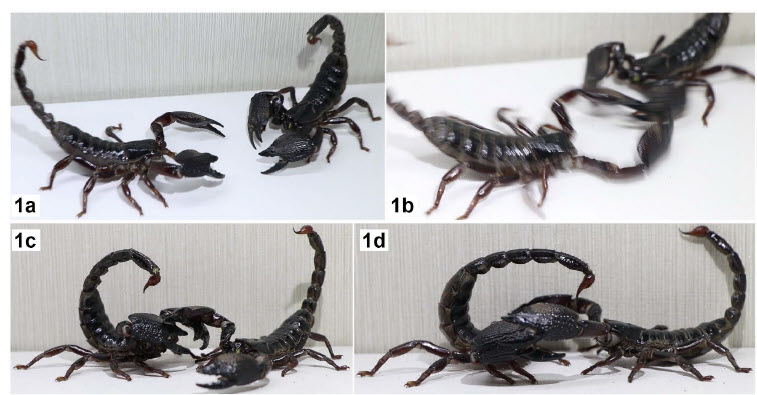
Victoria Tang has recently published an article describing non-aggressive physical combat between adult males of Srilankametrus yaleensis (Kovařík et al., 2019) (Scorpionidae). The article also list other known examples of agonistic behaviors (intraguild or antipredatory) observed in scorpions.

The article is illustrated with many pictures illustration the different types of agonistic behavior. Video documentation can also be found in the supplemental materials.

Abstract:
A peculiar intraspecific agonistic behavior involving a non-aggressive physical combat is reported between the adult males of Srilankametrus yaleensis (Kovařík et al., 2019) (Scorpionidae: Heterometrinae). The adult males were observed to resort to a ritualized and relatively gentle way for strength demonstration. The combat is characterized by lateral spreading of pedipalps, chelicerae-to-chelicerae collision, and entanglement of metasomal segments. This behavior is hereby considered a form of an intrasexual combat defined as the “arm-span competition”. It is hypothesized to be beneficial for solving territorial and/ or sexual competitions while avoiding unnecessary mortality which could pose adverse impact to the natural populations. Other Heterometrinae species that possess sexually dimorphic, elongate pedipalps in males were also found to display similar behavior. This may account for at least one potential reason for the evolution of such sexual dimorphism. Finally, this study supplements several other agonistic behaviors (intraguild or antipredatory) observed in scorpions, with special attention to the family Scorpionidae. Three basic types of behavior are defined for this family: aggressive response, shielding response, and armspan competition. These types of behavior may have implications for the evolution of this family.

Reference:
Tang V. Non-aggressive competition between males of Srilankametrus yaleensis (Kovařík et al., 2019)(Scorpionidae), and other types of agonistic behavior observed in scorpions. Euscorpius. 2023;2023(368):1-17. [Open Access]

27 October, 2022

Fitness differences between parthenogenetic litters of the parthenogenetic scorpion Tityus stigmurus


We often think that parthenogenetic reproduction produces clones that are identical in most ways. But there are non-genetical factors that may cause variations even though the organism is living in the same, stable environment. One example of this is maternal age's impact on different parthenogenetic litters.

Welton Dionisio-da-Silva and co-workers have recently pulished a study on non-Mendelian variation on parthenogenetic litters in the medical important species Tityus stigmurus (Thorell, 1876) (Buthidae). Their results indicate that T. stigmurus females allocated nutrient resources to maximize litter size rather than developmental fitness in subsequent litters. See abstract and article for more details.

I can add that knowledge of reproduction and life history of this scorpion is important as it is a medical important species that thrive in urban areas with high risk of human contact. 

Abstract:
Clonal lineages in similar environments may be influenced by non-Mendelian inheritance, such as maternal age effects and developmental instabilities. These mechanisms may affect the developmental fitness of parthenogenetic litters. In this study, the scorpion Tityus stigmurus (Thorell, 1876) was used to analyze the effects of non-Mendelian variation on parthenogenetic litters. A total of 75 juveniles from five females were reared under the same controlled conditions, while their development was observed and evaluated through differences in offspring fitness traits (litter size, prosoma size, developmental time, and mortality) between the litters. First and second litters had a similar litter size, although second litters exhibited longer developmental time in the early instar stages (second and third) than first litters. These results indicate that T. stigmurus females allocated nutrient resources to maximize litter size rather than developmental fitness in subsequent litters. Differences in developmental time found in early instars but not in late instars may have occurred as a result of stochastic developmental variations in young individuals. Such variation in duration of development has the potential to influence survival of juveniles in natural environments because individuals that grow faster may avoid large predators and consume larger prey, compared to those that do not.

Reference:
Dionisio-da-Silva W, Albuquerque CMR, Lira AFA. Fitness differences between parthenogenetic litters of the synanthropic scorpion Tityus stigmurus (Scorpiones: Buthidae). Animal Biology. 2022;72:435-46. [Subscription required for full text]

Thanks to Welton Dionisio-da-Silva for sending me their article!

20 October, 2022

Has male Euscorpius scorpions "date drugs" in their venom?


Differences in the venom composition of scorpions have been reported for many tears, both within the same species and between species. In addition, different venom types have been related to different purposes (e.g. the findings of prevenom in some species). 

Sex-specific differences in venom composition have been demonstrated for several arthropod taxa(e.g. in spiders where males of the infamous Sydney funnel web spider has a venom lethal to humans, while the female venom is not dangerous). Less is known about this in scorpions, but many species use sexual stings during courship and it has been suggested that the male venom used for this may sedate females to make them less aggressive.

Jonas Krämer and co-workers have recently published an interesting study analyzing the venom composition of male, female and juvenile Euscorpius italicus (Herbst, 1800) (Euscorpiidae). This species uses sexual sting during courtship. Their study shows that the male venom has marked differences in venom composition from females and juveniles. The authors suggest that this may cause a reduced toxic effect on females during the sexual sting. Other suggested effects may be a reduced agggressivity in females and also physiological effects that improove the success of the mating.

More studies are necessary to understand more about this fascinating connection between venom and courtship behavior.

Abstract:
In the animal kingdom, intraspecific variation occurs, for example, between populations, different life stages, and sexes. For venomous animals, this can involve differences in their venom composition. In cases where venom is utilized in the context of mating, the differences in composition might be driven by sexual selection. In this regard, the genus Euscorpius is a promising group for further research, as some of these scorpions exhibit a distinct sexual dimorphism and are known to perform a sexual sting during mating. However, the venom composition of this genus remains largely unexplored. Here, we demonstrate that Euscorpius italicus exhibits a male-specific venom composition, and we identify a large fraction of the substances involved. The sex specificity of venom peptides was first determined by analyzing the presence/absence patterns of ion signals in MALDI-TOF mass spectra of venom samples from both sexes and juveniles. Subsequently, a proteo-transcriptomic analysis provided sequence information on the relevant venom peptides and their corresponding precursors. As a result, we show that several potential toxin precursors are down-regulated in male venom glands, possibly to reduce toxic effects caused to females during the sexual sting. We have identified the precursor of one of the most prominent male-specific venom peptides, which may be an ideal candidate for activity tests in future studies. In addition to the description of male-specific features in the venom of E. italicus, this study also includes a general survey of venom precursors in this species.

Reference:
Kramer J, Pommerening R, Predel R. Equipped for Sexual Stings? Male-Specific Venom Peptides in Euscorpius italicus. Int J Mol Sci. 2022;23(19). [Open Access]

20 September, 2022

Research on the impact of constipation on scorpion sex life win The 2022 Ig Nobel Prize in biology


Do you remember my blog post in June about articles on the costs of autotomy (tail loss) in scorpions? The authors behind these articles, Solimary García-Hernández and Glauco Machado, have now won The 2022 Ig Nobel Prize in biology. 

 According to the price homepage, "The Ig Nobel Prizes honor achievements that make people LAUGH, then THINK. The prizes are intended to celebrate the unusual, honor the imaginative — and spur people’s interest in science, medicine, and technology".

Studying how constipation affects the sex life of scorpions has probably raised a few eye browes and I understand why they got this world famous prize. I guess this is probably the first Ig Nobel Prize to scorpion researchers.

Congratulations!

Reference:
Ig® Nobel Prize Winners 2022. Available from: https://improbable.com/ig/winners/ [Cited: 20.09.22]

04 August, 2022

An update on the infamous, medical important buthid Tityus serrulatus from Brazil


Among the most dangerous scorpions in the word, the genus Tityus C. L. Koch, 1836 (Buthidae) from South America has some of the most potent species. Bad guy number one in the genus is probably the Brazilian species Tityus serrulatus Lutz & Mello, 1922. The species is well known for its medical potency, but also for its rapid geographical expansion, occurrence in urban habitats and for its large populations of asexual (parthenogentic) members.

Wilson Lourenco has recently published an update on the historical, geographical and ecological aspects connected to this important species. The article also discuss the status of other species in the genus.

Abstract:
A synopsis on the historical, geographical and ecological aspects related to the most conspicuous scorpion species of the genus Tityus known from Brazil is proposed. Tityus serrulatus Lutz & Mello, 1922 was described precisely one century ago, nevertheless many questions related to its ecological adaptations and geographical expansion remain without a precise response. This species, well known for its infamous reputation of noxious species, is also known for its capacity to reproduce asexually, by parthenogenesis. Although the individuals of a given population are considered clones, a new hypothesis could  suggest the occurrence of mutations within isolated individuals, leading to distinct subpopulations that could present better phenotypic performances in ecological habitats distinct from those of the original area of distribution of the species.

Reference:
Lourenço WR. Back to Tityus serrulatus Lutz & Mello, 1922 (Scorpiones: Buthidae): new comments about an old species. J Venom Anim Toxins Incl Trop Dis. 2022;28:e20220016. [Open Access]

Family Buthidae

23 June, 2022

New information about the costs of autotomy (tail loss) in scorpions


I have previously reported about the facinating discovery of autotomy of the cauda (tail) as an anti-predatory behavior in the scorpion Ananteris mauryi Lourenco, 1982 (Buthidae). The cauda contains important parts of the scorpion's nervous, circulatory and digestive systems, and of course the very important sting and the venom glands. The tail doesn't regenerate and an automized scorpion will eventually die from constipation (but can survive for several months befor it die).

I was recently made aware of three papers authored by Solimary García-Hernandez and Glauco Machado presenting research into the cost of autotomy (tail loss) in scorpions. One article stufy the effect of autotomy on predation success, the second article adresses short- and long-term consequences on locomotor performance of male and female sorpions with tail loss, and finally the third article studies the effects of autotomy on reproductive sucess.

To sum up, tail loss in scorpions has negative effects prey capture, exposure to predators, and reproductive success, but the size of the effects differ between the sexes. The reduction of reproductive succcess was much more dramatic for females than for males. For details on the results and conclusion I refer to the abstracts below.

Abstracts:

Paper1:
Predation success depends on factors such as hunger, prey size, prey availability and intensity of competition. A neglected factor that may also influence predation success is the proper function of morphological traits related to prey search, capture and manipulation. Injuries that compromise the functionality of these morphological traits may reduce predation success. In many invertebrates, autotomy can compromise predation success because the detached body part may be crucial for hunting. However, empirical evidence linking autotomy and predation success is relatively scarce. We filled this gap using the scorpion Ananteris balzani, which autotomizes the last abdominal segments, known as the ‘tail’. This is a unique form of autotomy as ‘tail’ autotomy implies the loss of the stinger, an organ used for venom inoculation, which is the main form of large prey subjugation. Using a paired experimental design, we found that for both small and large prey, subduing success was higher when individuals were intact than when they were autotomized. After autotomy, subduing success of male scorpions decreased
from 90% to 17% for small prey and from 47% to 1% for large prey. Subduing success of female scorpions after autotomy decreased from 98% to 93% for small prey and from 97% to 70% for large prey. Autotomized individuals took longer than intact individuals to subdue both small and large prey, but the effect size was higher for large prey. Considering that the tail does not regenerate, autotomized individuals (especially males) will experience a lifelong reduction in trophic niche breadth because their diet will be mostly composed of small prey. Moreover, autotomized individuals probably move more to enhance the likelihood of finding small prey, which may increase their exposure to predators and consequently the costs related to tail loss.

Paper 2:
In many taxa, individuals voluntarily detach a body part as a form to increase their chances of escaping predation. This defense mechanism, known as autotomy, has several consequences, such as changes in locomotor performance that may affect fitness. Scorpions of the genus Ananteris autotomize the “tail”, which in fact corresponds to the last abdominal segments. After autotomy, individuals lose nearly 25% of their body mass and the last portion of the digestive tract, including the anus, which prevents defecation and leads to constipation, because regeneration does not occur. Here, we experimentally investigated the short- and long-term effects of tail loss on the locomotor performance of Ananteris balzani. In a short-term experiment, the maximum running speed (MRS) of males and females did not change after autotomy. Moreover, the relative mass of the lost tail did not affect the change in MRS after autotomy. In a long-term experiment, autotomy had a negative effect on theMRS of males, but not of females. Autotomized over-fed individuals suffered from severe constipation but were not slower than autotomized normally fed individuals. In conclusion, tail loss has no immediate effect on the locomotor performance of scorpions. The long-term decrease in the locomotor performance of autotomized males may impair mate searching. However, because death by constipation takes several months, males have a long time to find mates and reproduce. Thus, the prolonged period between autotomy and death by constipation is crucial for understanding the evolution of one of the most extreme cases of autotomy in nature.

Paper 3:
The ability to detach a body part in response to a predation attempt is known as autotomy, and it is perhaps the most
intensively studied form of nonlethal injury in animals. Although autotomy enhances survival, it may impose reproductive costs on both males and females. We experimentally investigated how autotomy affects the reproductive success of males and females of a scorpion species. Individuals of Ananteris balzani autotomize the last abdominal segments (the tail), losing the anus and leading to lifelong constipation, since regeneration does not occur. Although the male tail is used during courtship and sperm transfer, autotomy has no effect on male mating success. The combined effect of increased mortality and reduced fecundity resulted in autotomized females producing nearly 35% fewer offspring than intact females. In conclusion, the negative effects of tail autotomy are clearly sex dependent, probably because the factors that influence reproductive success in males and females are markedly different.

References:

Paper1:
García-Hernández S, Machado G. ‘Tail’ autotomy and consequent stinger loss decrease predation success in scorpions. Anim Behav. 2020;169:157-67. [Subscription required for full text]

Paper 2:
Garcia-Hernandez S, Machado G. Short- and long-term effects of an extreme case of autotomy: does 'tail' loss and subsequent constipation decrease the locomotor performance of male and female scorpions? Integr Zool. 2021;Accepted Manuscript:1-17. [Subscription required for full text]

Paper 3:
García-Hernández S, Machado G. Fitness implications of nonlethal injuries in scorpions: Females, but not males, pay reproductive costs. Am Nat. 2021;197(3):379-89. [Open Access]

Thanks to Solimary García-Hernandez for sending me their articles on this interesting topic!

14 January, 2022

Courtship behavior of the parthenogenetic scorpion Tityus stigmurus from Brazil


Most scorpions have sexual reproduction, but a few species seem to have parthenogensis as the main method for reproduction and in these species males are rare. We know very little about the courtship behavior in the species that can reproduce by either method.

Stênio Foerster and co-workers have recently published a study of the courtship repertoire of the Brazilian, parthenogenetic scorpion Tityus stigmurus (Thorell, 1876) (Buthidae), which have sexual populations distributed throughout northeastern Brazil.

Overall, the reproductive repertoire of T. stigmurus was similar to that of other non-parthenogentic scorpions.

Abstract:
Scorpions can adopt different reproductive strategies (e.g., sexual or parthenogenesis) depending on the environmental conditions. In this study, we described the courtship repertoire of the parthenogenetic scorpion Tityus stigmurus, a species with inconspicuous sexual populations distributed throughout northeastern Brazil. Specimens of both sexes (10 male, 10 female) were obtained from field expeditions in three locations in northeastern Brazil and were paired under laboratory conditions in an intrapopulation design. All observations were conducted at night using red light positioned above an experimental arena. From the 10 courtship interactions observed in this study, only one pair successfully completed the reproductive repertoire that included the insemination process. The incomplete interactions were abruptly terminated by the females immediately after deposition of the spermatophore. Overall, the reproductive repertoire of T. stigmurus was similar to that of other scorpions, especially its congeners, possibly because this reproductive behavior emerged at a basal point in the evolution of scorpions. The acquisition of new insights into the reproductive biology of different scorpion species may improve the theoretical background for applications ranging from evolutionary biology to public health strategies.

Reference:
Foerster SIA, Dionisio-da-Silva W, dos Santos AB, de Albuquerque CMR, de Araújo Lira AF. Notes on the courtship behavior of the parthenogenetic scorpion Tityus stigmurus. Acta Arachnologica. 2021;70(2):83-6. [Open Access]

Thanks to Andre Lira for sending me their article!

15 October, 2021

All you need to know about scorpions of medical importance in Brazilian Amazonas: Epidemiology, medical important species, venom, distribution, habitat and much more


Scorpions are a health problem in many parts of the world and Brazil is one of the world's hotspots in this regard. Knowledge of taxonomy (species diversity and who are dangerous or not), distribution, habitat preferences, ecology, venom and reproduction (how fast can a population grow and spread) is essential for preventing sting accidents and scorpionism.

Jonas Gama Martins and co-workers have recently published a very thorough and interesting review on most aspects concerning scorpions of medical importance in Brazilian Amazonas. This article will be an important tool for scientists, health personnel, public agencies and others working with scorpionism in Brazil and in the world.

Abstract:
Scorpionism is a relevant medical condition in Brazil. It is responsible for most accidents involving venomous animals in the country, which leads to severe symptoms that can evolve to death. In recent years, an increase of almost 50% in the incidence of scorpionism has been observed in the Northern Region, where the highest severity of envenoming has been notified since the beginning of the 21st century. This review aims to provide an in-depth assessment of public data and reports on symptoms and epidemiology of envenoming, ecological aspects of scorpions, and characterization of venoms and toxins to access the gaps that need to be filled in the knowledge of the scorpion species of medical importance from the Brazilian Amazon. A systematic search using the string words “Amazon” and “scorpion” was performed on 11 databases. No restriction on date, language or status of the publication was applied. Reports not related to the Brazilian Amazon were excluded. Therefore, 88 studies remained. It is shown that populations of scorpions of medical importance, even of the same species, may present significant toxic variations peculiar to some regions in the Brazilian Amazon, and commercial scorpion antivenoms were not able to shorten the intensity and duration of neurological manifestations in patients stung by T. silvestris, T. apiacas or T. obscurus. It is also highlighted that the toxins responsible for triggering these alterations have not been elucidated yet and this is a fruitful field for the development of more efficient antivenoms. Furthermore, the geographic distribution of scorpions of the genus Tityus in the Brazilian Amazon was revised and updated. The cumulative and detailed information provided in this review may help physicians and scientists interested in scorpionism in the Brazilian Amazon.

Reference:
Martins JG, Santos GC, Procópio REL, Arantes EC, Bordon KCF. Scorpion species of medical importance in the Brazilian Amazon: a review to identify knowledge gaps. J Venom Anim Toxins Incl Trop Dis. 2021;27:e20210012. [Open Access]

Thanks to Jonas Gama Martins for sending me their article!

25 June, 2021

New knowledge on the rare scorpion Cryptoiclus rodriguezi from Cuba


Rolando Teruel has just published an article with new information on the rare, endemic scorpion Cryptoiclus rodriguezi Teruel & Kovarik, 2012 (Diplocentridae) from Cuba. Updated morphological descriptions and data on distribution, habitat, ecology and reproduction are presented.

Abstract:
The adult male of Cryptoiclus rodriguezi Teruel & Kovarik, 2012, is herein described and illustrated in detail. It represents both the single species of its genus and one of the most seldom-collected , endemic scorpions from Cuba. Its generic diagnosis is emended and new data on its morphological, morphometric and meristic variability are contributed on the basis of the type and 28 additional specimens. Abundant information on its ecology and reproduction are given and its geographic distribution is updated with new records, including the first from Maisi municipality. Despite this, both the genus and the species remain known only from a reduced area in northeastern Guantanamo Province.

Reference:
Teruel R, Rodriguez-Cabrera TM. La subfamila Diplocentrinae (Scorpiones: Diplocentridae) en Cuba. Septima parte: complementos a la descripcion de Cryptoiclus rodriguezi Teruel & Kovarik, 2012. Boletin de Grupo de Sistematica y Ecologia de Artropodos Caribeños. 2021(8):1-23.

Thanks to Rolando for sending me his article!

Family Diplocentridae

11 May, 2021

Sexual stings in scorpion courtship are not just rituals


Sexual stings during courtship is probably one of the most fascinating behavior in scorpions. This has been documented in many species, but so far it has not been proven the the male actually penetrate the skin of the female  and if venom is injected. Some authors have characterized this behavior as "a ritual". 

Laura Olguin-Perez and co-workers have recently published a very interesting study on sexual sting in Megacormus gertschi Diaz-Najera, 1966 (Euscorpiidae). The confirm that the male penetrate the female repeatedly in the pedipalp tibia-patella intersegmental membrane just before the promenade a deux part of the courtship starts. They also confirm for the first time that the male actually injects venom into the female during the sexual stinging. Interestingly, the authors also demonstrate that the venom composition in males and females differs.

The combination of these results provide evidence that the sexual sting in scorpion courtships are more than a ritualistic behavior, but seem to have a direct role to ensure a successful courtship and mating. More research is needed to unravel the proximate effects the male venom injection has on the females and their behavior against the male.

Abstract:
The males of the Mexican species Megacormus gertschi Diaz-Najera, 1966 (Scorpiones: Euscorpiidae: Megacorminae) sting the female repeatedly in the pedipalp tibia-patella intersegmental membrane (TPIM) during the initiation of the promenade a deux. It has been suggested that the male’s venom introduced during this ‘‘sexual sting’’ behavior could generate some sedative effect and reduce the possibility of being cannibalized by the female. However, this is unsupported by evidence regarding venom transference. Here, we provide evidence of perforation of the TPIM by the male aculeus and venom transfer during sexual sting performance. We also provide the first venom characterization of this species and show that it has a sexually dimorphic composition. These results, in combination with observations that the sexual sting is displayed in successful matings with non-defensive females, lead us to consider the pre-insemination sexual stinging as a non-genitalic sexual interaction with a potential role as a courtship element.

Reference:
Olguin-Perez L, Francke OF, Carbajal-Saucedo A. Evidence of piercing and sexual differences in venom composition in a sexual stinging scorpion (Scorpiones: Euscorpiidae). J Arachnol. 2021;49:98-107. [Open Access]

Thanks to Oscar Francke for sending me their article!