Showing posts with label new genus. Show all posts

16 August, 2024

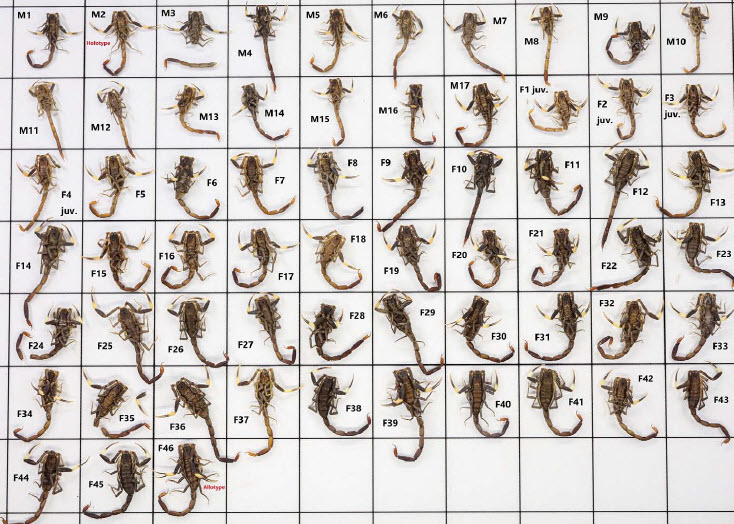
A new genus and three new species in the family Scorpionidae from Jordan


Bassam Abu Afifeh and co-workers recently published a revision of the genus Scorpio Linnaeus, 1758 (Scorpionidae) in Jordan. The widespread genus had only one species for many decades, but were poorly studied. In recent years the genus has been studies by several authors and many new species have been described, conforming previous suspicions that Scorpio maurus Linné, 1758 was a species complex hiding many cryptic species. 

The revision of the Scorpio from Jordan has resulted in a new genus and three new species.

Jordanius Afifeh, Yagmur, Al-Saraireh & Amr, 2024 (new genus)

Jordanius maysaraensis Afifeh, Yagmur, Al-Saraireh & Amr, 2024 (new species)

Scorpio jordanensis Afifeh, Yagmur, Al-Saraireh & Amr, 2024 (new species)

Scorpio wahbehi Afifeh, Yagmur, Al-Saraireh & Amr, 2024 (new species)

Jordanius granulomanus (Al-Saraireh, Yagmur, Afifeh & Amr, 2023) is transferred to the new genus from Scorpio.

In addition, Scorpio propinquus (Simon, 1872) is considered nomen dubium.

The article has an identification key for the Scorpionidae taxa found in Jordan. 

Abstract:
Several new Scorpio populations are studied from various habitats in Jordan, including specimens previously identified as Scorpio kruglovi Birula, 1910 and S. fuscus (Ehrenberg, 1829). A new scorpionid genus, Jordanius gen. n. is described, mainly differentiated from the genus Scorpio Linnaeus, 1758 by the elongation and heavy patterns of granulation of chela manus, and granulated chela fingers. Scorpio granulomanus Al-Saraireh et al., 2023 is transferred to the new genus, and Jordanius maysaraensis gen. et sp. n. is described. Also, Scorpio jordanensis sp. n. and S. wahbehi sp. n. are described. Detailed redescriptions and illustrations of S. palmatus (Ehrenberg, 1828) and S. fuscus (Ehrenberg, 1829) are given. A neotype of S. palmatus from Alexandria, Egypt and a neotype of S. fuscus from Lebanon are designated. A key to the family Scorpionidae in Jordan and comments on dubious or incorrect records from Jordan are provided. Lastly, S. propinquus is suggested as nomen dubium.

Reference:
Afifeh BA, Yagmur EA, Al-Saraireh M, Amr Z. Revision of the genus Scorpio in Jordan, with a description of a new genus and three new species (Scorpiones: Scorpionidae). Euscorpius. 2024(391):1-66. [Open Access]

Family Scorpionidae

22 April, 2024

Two new buthid genera from Somaliland


Frantisek Kovarik has recently described two new genera in the Buthidae family from Somaliland.

Sahil Kovarik, 2024 (new genus)

Sahil elmi Kovarik, 2024 (new species)

Sanaag Kovarik, 2024 (new genus)

Sanaag maidensis (Kovarik, Lowe, Just, Awale, Elmi & Stahlavsky, 2018) (new combination - previously in the genus Gint Kovarik, Lowe, Pliskova & Stahlavsky, 2013)

Abstract:
Two new monotypic buthid genera are described: Sanaag gen. n. and Sahil gen. n. from Somaliland, both belonging to the ‘Buthus’ group. Sanaag gen. n. (type species Gint maidensis Kovařík et al., 2018) differs from Gint Kovařík et al., 2013 in the structure of its hemispermatophore, which has a large, tall, subtriangular hook-like basal lobe, and in the shape of its telson which is rather bulbous. Sahil gen. n. (type species Sahil elmii sp. n.) differs from all morphologically similar small-sized genera of the Horn of Africa in having the ventral aspect of cheliceral fixed finger with two denticles, and the movable finger of the pedipalp with 7 subrows of denticles.

Reference:
Kovarik F. Scorpions of the Horn of Africa (Arachnida, Scorpiones) Part XXXI. Two new genera from Somaliland: Sanaag gen. n. and Sahil gen. n. (Buthidae). Euscorpius. 2024(386):1-11. [Open Access]

Family Buthidae

14 April, 2023

A new buthid genus and species from China


Victora Tang and co-workers have recently published an extensive study describing a new genus and species from Xizang (Tibet), China. 

Langxie Tang, Jia & Liu, 2023

Langxie feti Tang, Jia & Liu, 2023

The new species seems to be extremely abundant in the region.

I would like to compliment the authors for this work, which was completed despite of major challenges!

Abstract:
A new monotypic genus, Langxie gen. n., is described from Xizang (Tibet), China. The new genus shares an important morphological character with Afrolychas Kovařík, 2019: absence of external accessory denticles (EADs) along the sixth row of median denticles (MDs) on the pedipalp movable finger. Langxie gen. n. is different from Afrolychas in the following aspects: loss of EAD near the proximally enlarged MD within each row (i. e., loss of all EAD on the movable finger; this also distinguishes the new genus from other related genera in the “(Ananteris + Isometrus)” clade (Štundlová et al., 2022)), subaculear tubercle armed with or without a secondary tubercle dorsally, immaculate color pattern, more slender appendages and metasoma, and less sexually dimorphic pectines. Langxie gen. n. further differs from another geographically close genus, Himalayotityobuthus Lourenço, 1997, by the presence of highly developed pectinal fulcra (vs. absent in Himalayotityobuthus), six rows of MDs on the pedipalp movable finger (vs. 7–8 in Himalayotityobuthus) and five pairs of lateral ocelli (vs. 3 in Himalayotityobuthus). The new species, Langxie feti sp. n., is small and slender, exhibiting no obvious sexual dimorphism in pedipalp and metasoma, but the sexes are visibly different in the relative size of median ocelli and coarseness of carapacial granulation. Lattice microstructures are prominently developed on its cuticle.

Reference:
Tang V, Jia Q, Liu L. A new monotypic genus and species from China, Langxie feti gen. et sp. n. (Scorpiones: Buthidae). Euscorpius. 2023(370):1-101. [Open Access]

Family Buthidae


12 September, 2022

A phylogenetic study of the family Iuridae reveals three new genera


The family Iuridae are mainly found in Turkey and Greece and contains some of the largest scorpions in Europe. There have been some studies of this family in the recent years, but in a recent article Aristeidis Parmakelis and co-workers have conducted a phylogenetic analysis of the family and based on this suggested several taxonomic decisisons.

The subfamily Calchinae Birula, 1917 is raised from synonymy with Iurinae Thorell, 1876.

The three new genera are described (listed with the taxa assiciated with them):

Anatoliurus Parmakelis, Dimitriadou, Gkigkiza, Karampatsou, Stathi, Fet, Yağmur & Kovařík, 2022.

A. kraepelini (von Ubisch, 1922 (Turkey: Antalya, Isparta, Konya, Karaman, Mersin, and Muğla Provinces; Greece: Megisti (Kastelorizo) Island.

A. kumlutasi (Yagmur, Soleglad, Fet & Kovarik 2015) (Turkey: Hıdırellez Cave in Antalya).

Letoiurus Parmakelis, Dimitriadou, Gkigkiza, Karampatsou, Stathi, Fet, Yağmur & Kovařík, 2022.

L. rhodiensis (Soleglad, Fet, Kovarik & Yagmur, 2012) (Greece: Rhodes Island; Turkey: Muğla Province.

Metaiurus Parmakelis, Dimitriadou, Gkigkiza, Karampatsou, Stathi, Fet, Yağmur & Kovařík, 2022.

M. kadleci (Kovarik, Fet, Soleglad & Yagmur, 2010) (Turkey: Antalya and Mersin Provinces).

M. stathiae (Soleglad, Fet, Kovarik & Yagmur, 2012) (Greece: Karpathos Island). 

Abstract:
Iuridae is a family of scorpions that exhibits a highly complex biogeographic and taxonomic history. Iuridae taxa are mainly found in Turkey and Greece, whereas a single species is found in northern Iraq. Several taxonomic revisions have been conducted on this family that initially comprised two genera. The latest taxonomic review, based on morphological and anatomical features, raised the number of Iuridae genera to four, and the number of species to 14.

Sequence data from three molecular markers (COX1, 16S rDNA, ITS1) originating from numerous Iuridae taxa were analyzed within a phylogenetic framework. Divergence time-estimate analyses, species delimitation approaches and estimation of ancestral areas were implemented in order to: (1) reconstruct the phylogenetic relationships of the Iuridae taxa, (2) evaluate the morphological classifications, and (3) obtain insights into the biogeographic history of the family in the East Mediterranean.

The multi-locus phylogeny clearly confirms an ancient division into two clades, Calchinae and Iurinae. Ancient patterns of isolation and dispersal are revealed. Both subfamilies are largely confined to the Anatolian peninsula and its few coastal islands; only the most derived genus Iurus has dispersed westward to Crete and Peloponnese. Based on our findings, three new genera of Iurinae (Metaiurus, Anatoliurus, and Letoiurus) are established. The genus Neocalchas emerges as one of the most ancient scorpion clades, with divergence time about 27 mya.

Reference:
Parmakelis A, Dimitriadou D, Gkigkiza E, Karampatsou L, Stathi I, Fet V, et al.  The evolutionary history of the relict scorpion family Iuridae of the eastern Mediterranean. Mol Phylogenet Evol. 2022:107622. [Subscription required for full text]

Thanks to Gerard Dupre for sending me this article!

Family Iuridae

29 June, 2022

New fossil scorpion taxa


I have learned about two new articles on scorpion fossil taxa. The Scorpion Files only includes extant taxa, but here are the new fossil taxa reported in the two articles cited below.

New family:

Protochactidae Lourenço, Magnani & Stockar, 2022

New genus:

Protochactas Lourenço, Magnani & Stockar, 2022

New species:

Protochactas furreri Lourenço, Magnani & Stockar, 2022 (Limestone, Southern Alps)

Chaerilobuthus brandti Lourenço, 2022 (Amber, Myanmar)

Abstract:

Paper 1:
One new family, genus, and species of fossil scorpion are described from the Meride Limestone (Ladinian, Middle Triassic) of Monte San Giorgio (Southern Alps). This new discovery brings further evidence for the recovery of terrestrial forms of scorpions, following the Late-Permian mass extinction. The new fossil family proposed at present can, once again, be classified within extant familial groups; in this case the superfamily Chactoidea (sensu Lourenço). These results reinforce the proposition that modern scorpions may belong to lineages present at least for 240 Myr.

Paper 2:
A further new species of fossil scorpion belonging to the genus Chaerilobuthus Lourenço & Beigel, 2011 is described from Early Cretaceous Burmite. Chaerilobuthus brandti Lourenço sp. n., is the 12th species to be described for this genus confirming its speciose character. The new species equally shows quite distinct characters when compared to the previous known species, confirming therefore the existence of an important morphological variability within Chaerilobuthus.

References:

Paper 1:
Magnani F, Stockar R, Lourenço WR. A new family, genus and species of fossil scorpion from the Meride Limestone (Middle Triassic) of Monte San Giorgio (Switzerland). Faunitaxys. 2022;10(24):1-7. [Open Access]

Paper 2:
Lourenço WR, Velten J. The remarkable variability of the genus Chaerilobuthus Lourenço & Beigel, 2011 (Scorpiones: Chaerilobuthidae) and description of a new species from Early Cretaceous Burmite. Faunitaxys. 2022;10(10):1-6. [Open Access]

Thanks to Nicolas Machiavel for informing me about these two articles!

24 May, 2022

A new genus and species in the enigmatic family Pseudochactidae from China


The family Pseudochactidae Gromov, 1998 consisted for many year of only one genus and one species. In recent years a few more genera and species have been described, many from isolated areas. Victoria Tang has now described a new genus and species from the Yunnan Province of China, greatly increasing the distribution of this family.

Qianxie Tang, 2022

Qianxie solegladi Tang, 2022

The new species seems to be found only above ground and it exhibits no troglomorphism, which is different from its presumed sister genus, Troglokhammouanus Lourenço, 2007.

Abstract:
A new monotypic genus belonging to the basal scorpion family Pseudochactidae Gromov, 1998, Qianxie solegladi gen et. sp. n., is described from Yunnan Province of China. The family is recorded from China for the first time, vastly extending its known geographic range. The new genus shares morphological characters with both Pseudochactas Gromov, 1998 and Troglokhammouanus Lourenço, 2007. It differs from Pseudochactas and is similar to Troglokhammouanus in the shapes of anterior and posterolateral carapace margins, form of the circumocular sutures, distance between median ocelli, development of dorsoventral projection of patella, length of tarsal spinules, recurvature of the lateral margins and concavity of the surface of the sternum. It is similar to Pseudochactas in the degree of carapace granulation, pedipalp manus carination, secondary accessory and retroventral carinae of the chela manus, numbers of lamellae and teeth on the pectines, development of the median lateral carinae of metasomal segments III–IV and ventromedian carina of metasomal segment V. The new genus is hypothesized to be more closely related to Troglokhammouanus than to Pseudochactas and is placed in the subfamily Troglokhammouaninae.

References:
Tang V. A new scorpion genus and species from China, Qianxie solegladi gen. et sp. n. (Scorpiones: Pseudochactidae). Euscorpius. 2022(351):1-19. [Open Access]

Family Pseudochactidae

12 October, 2021

A review of the enigmatic family Pseudochactidae and troglobitism/troglomorphism in scorpions


Most scorpion researchers agree that the most remarkable scorpion discovery in the last century was the discovery of the very special scorpion Pseudochactas ovchinnikovi Gromov, 1998 in a remote, mountainous region of southeastern Uzbekistan and southwestern Tajikistan. This species "gave birth" to the family Pseudochactidae. Later one more species in the genus was discovered and the family was further increased two more genera with a few more species. Most of the latter are cavernicolous (found in caves), but not all of them have troglomorphisms like reduced eyes and pigmentation. All of the species in the family are rare and have a relictual distribution.

Lorenzo Prendini and co-workers have now conducted a thorough review of the family Pseudochactidae. Based on morphological and phylogenetical analysis they have concluded the following:

New subfamily:

 Troglokhammouaninae Prendini, Ehrenthal & Loria, 2021.

New genus:

Aemngvantom  Prendini, Ehrenthal & Loria, 2021.

New species:

Aemngvantom thamnongpaseuam Prendini, Ehrenthal & Loria, 2021.

New combination:

Aemngvantom lao (Lourenço, 2012).

Synonymizations:

Troglokhammouanus louisanneorum Lourenço, 2017 is synonymized with  Troglokhammouanus steineri Lourenço, 2007.

Vietbocap thienduongensis Lourenço and Pham, 2012 is synonymized with Vietbocap canhi Lourenço & Pham, 2010.

Vietbocap aurantiacus Lourenço et al., 2018 is synonymized with Vietbocap canhi Lourenço & Pham, 2010.

Vietbocap Vietbocap quinquemilia Lourenço et al., 2018 is synonymized with Vietbocap canhi Lourenço & Pham, 2010.

The family consists now of three subfamilies, four genera and six species. The article has revised descriptions of all species, pictures and habitat information with conservation status. An identification key for the family is also provided.

The article also provide a review of the global diversity of cavernicolous, troglomorphic and troglobitic scorpions and an ecological key to the classification of this kind of scorpions is also presented. 

Abstract:
The first integrative systematic revision of the relictual Asian scorpion family Pseudochactidae Gromov, 1998, making use of an unprecedented collection of material acquired during several expeditions to most of the type localities, is presented. The subfamilies, genera and species of Pseudochactidae are revised based on a phylogenetic analysis of 140 morphological characters and 8608 nucleotide base pairs of concatenated DNA sequence from two nuclear and three mitochondrial gene loci, and a multivariate statistical analysis of 22 ratios and 8 counts for 60 specimens. Three subfamilies, four genera and six species are recognized in the family. Troglokhammouaninae, subfam. nov., is created to restore the monophyly of the nominotypical subfamily Pseudochactinae Gromov, 1998. Aemngvantom, gen. nov., is created to accommodate Aemngvantom lao (Lourenço, 2012), comb. nov., and Aemngvantom thamnongpaseuam gen. et sp. nov. Four new synonyms are presented: Troglokhammouanus louisanneorum Lourenço, 2017 = Troglokhammouanus steineri Lourenço, 2007, syn. nov.; Vietbocap thienduongensis Lourenço and Pham, 2012 = Vietbocap canhi Lourenço and Pham, 2010, syn. nov.; Vietbocap aurantiacus Lourenço et al., 2018 = V. canhi, syn. nov.; Vietbocap quinquemilia Lourenço et al., 2018 = V. canhi, syn. nov. Revised diagnoses of the subfamilies, genera and species, with comparative images, a key and distribution maps are provided, along with a summary of available data on ecology and conservation status, where applicable. Among the Southeast Asian pseudochactids, all of which appear to be obligately cavernicolous, the three species of Vietbocapinae Lourenço, 2012, are highly troglomorphic whereas the sole species of Troglokhammouaninae is barely so. Applying recently revised definitions of the Schiner-Racovitza system for the classification of subterranean organisms, only Vietbocapinae can be considered troglobitic. The global diversity of cavernicolous, troglomorphic and troglobitic scorpions is similarly revisited and a key to ecological classification of cavernicolous and troglomorphic scorpions presented. The world totals of troglomorphic vs. troglobitic scorpions are currently 58 vs. 28 species, in 29 vs. 17 genera and 15 vs. 13 families, respectively.

Reference:
Prendini L, Ehrenthal VL, Loria SF. Systematics of the relictual Asian scorpion family Pseudochactidae Gromov, 1998, with a review of cavernicolous, troglobitic, and troglomorphic scorpions. Bulletin of the American Museum of Natural History. 2021(453):1-149. [Open Access]

Thanks to Matt Simon for informing me about this article!

Family Pseudochactidae

22 January, 2021

A new genus and species from Pakistan


Graeme Lowe and Frantisek Kovarik have recently described a new genus with one species from northern Pakistan. 

Fetilinia Lowe & Kovarik, 2021

Fetilinia dentator Lowe & Kovarik, 2021

Abstract:
We describe from northern Pakistan a new buthid genus Fetilinia gen. n., monotypic with type species F. dentator sp. n., belonging to the Palaearctic ‘Buthus’ group. It bears some similarities to Kraepelinia Vachon, 1974, in having enlarged metasomal dentition, and to Orthochirus Karsch, 1891, and related genera in having a trapezoidal carapace and small abbreviated pedipalps.

Reference:
Lowe G, Kovarik F. Fetilinia dentator gen. et sp. n. from Pakistan (Scorpiones: Buthidae). Euscorpius. 2021(328):1-10. [Open Access]

 Family Buthidae

18 November, 2020

Systematic revision of the Asian Forest Scorpions (Heterometrinae simon, 1879) with many taxonomical changes in the family Scorpionidae


As I posted in a previous blog post, Lorenzo Prendini and Stephanie Loria published a huge systematic revision of the Asian Forest Scorpions (Heterometrinae Simon, 1879) in October. This revision is mainly focused on the genus Heterometrus Ehrenberg, 1828  which is split into several new genera, but has also taxonomical decisions for other taxa in Scorpionidae.

Here are some of the main higlights from this impressive work.

Rugodentidae Bastawade et al., 2005 is raised to family status (from subfamily status) including the genus Rugodentus Bastawade et al., 2005.


Pandinopsis Vachon, 1974. Raised to genus status.


Pandipalpus Rossi, 2015. Raised to family status.


Chersonesometrus Couzijn, 1978. Raised to genus status.

Chersonesometrus bastawadei
Prendini & Loria, 2020. New species from India.

Chersonesometrus hendersoni
Prendini & Loria, 2020. New species from India.

Chersonesometrus nathanorum Prendini & Loria, 2020. New species from India.

Chersonesometrus shivashankari Prendini & Loria, 2020. New species from India.


Deccanometrus Prendini & Loria, 2020. New genus.

Deccanometrus obscurus
(Couzijn, 1981). Raised to species status.


Gigantometrus Couzijn, 1978. Raised to genus status.


Javanimetrus Couzijn, 1981. Raised to genus status.


Sahyadrimetrus Prendini & Loria, 2020. New genus.

Sahyadrimetrus mathewi Prendini & Loria, 2020. New species from India.

Sahyadrimetrus rugosus (Couzijn, 1981). Raised to species status.

Sahyadrimetrus tikaderi Prendini & Loria, 2020. New species from India.


Srilankametrus Couzijn, 1981. Raised to genus status.

Srilankametrus couzijni
Prendini & Loria, 2020. New species from India.

Srilankametrus pococki Prendini & Loria, 2020. New species from Sri Lanka.

There are also several new combinations (species transferred from Heterometrus to one of the new genera) and synonymizations for many species in this article. I will refer to the abstract and appendix 4 (p. 479) in the article for a list of these as it will be too extensive  to list all of these here. Also check out the Scorpionidae family page to see the alle the new taxa and their content.

The article has several identification key for the relevant taxa in Scorpionidae.

Abstract:
[Due to lack of time I have omitted italics for species and genus names as this had to be done manually]
The genera and species of the Asian forest scorpions (Scorpionidae Latreille, 1802) are revised  based on a phylogenetic analysis of 186 morphological characters and 4188 base pairs of concatenated DNA sequence from three mitochondrial loci and two nuclear loci. Revision of the Asian  scorpionids required a critical reappraisal of the suprageneric classification of Scorpionidae, on  the basis of which the monotypic Indian scorpionoid genus, Rugodentus Bastawade et al., 2005, stat.  rev., and its type species, Rugodentus keralaensis Bastawade et al., 2005, stat. rev., are  revalidated, and subfamily Rugodentinae Bastawade et al., 2005, revalidated and elevated to the  rank of fam- ily, Rugodentidae Bastawade et al., 2005, stat. nov. et stat. rev.; Heterometrinae  Simon, 1879, stat. nov., and Opistophthalminae Rossi, 2016, stat. nov., are elevated to the rank of  subfamily; Pandi­ nopsis Vachon, 1974, stat. nov., and Pandipalpus Rossi, 2015, stat. nov., are  elevated to the rank of genus, resulting in two new combinations: Pandinopsis dictator (Pocock,  1888), comb. nov., and Pandipalpus viatoris (Pocock, 1890), comb. nov.; and 10 new synonyms are  presented: Pandinopsini Rossi, 2016 = Pandininae Thorell, 1876, syn. nov.; Protophthalmini Rossi,  2016 = Opistoph- thalminae Rossi, 2016, syn. nov.; Protophthalmus Lawrence, 1969 = Opistophthalmus  C.L. Koch, 1837, syn. nov.; Pandinoides (Dunlopandinoides) Rossi, 2016 = Pandinoides Fet, 2000,  syn. nov.; Pandinurus (Pandicaporiaccous) Rossi, 2015 = Pandiborellius Rossi, 2015, syn. nov.;  Buthus defensor C.L. Koch, 1837 = Pandinurus gregoryi (Pocock, 1896), syn. nov.; Buthus heros C.L. Koch, 1837 = Pandinurus exitialis (Pocock, 1888), syn. nov.; Pandinus lowei Kovařík, 2012 = Pandipalpus viatoris  (Pocock, 1890), syn. nov.; Pandinurus (Pandipalpus) pygmaeus Rossi, 2015 = Pandipalpus viatoris  (Pocock, 1890), syn. nov.; Pandinus intermedius Borelli, 1919 = Pandinurus citernii (Borelli,  1919), syn. nov. The following revisions are implemented to the classification of the Asian forest scorpions (Heterometrinae). Three former subgenera of Heterometrus Ehrenberg, 1828 are revalidated  and elevated to the rank of genus: Chersonesometrus Couzijn, 1978, stat. nov. et stat. rev.;  Javanimetrus Couzijn, 1981, stat. nov. et stat. rev.; and Srilankametrus Couzijn, 1981, stat. nov.  et stat. rev. One subgenus is elevated to the rank of genus: Gigantometrus Couzijn, 1978, stat.  nov. Two new genera and eight new species are described: Deccanometrus, gen. nov.; Sahyadrimetrus,  gen. nov.; Cher­ sonesometrus bastawadei, sp. nov.; Chersonesometrus hendersoni, sp. nov.;  Chersonesometrus natha­ norum, sp. nov.; Chersonesometrus shivashankari, sp. nov.; Sahyadrimetrus mathewi, gen. et sp. nov.; Sahyadrimetrus tikaderi, gen. et sp. nov.; Srilankametrus couzijni, sp.  nov.; Srilankametrus pococki, sp. nov. Heterometrus sensu stricto is restricted to eight species of  the nominotypical subgenus, all other species, formerly placed in Heterometrus, are transferred to  appropriate genera, five species are revalidated, and two subspecies elevated to the rank of  species, resulting in 28 new combinations: Chersonesometrus beccaloniae (Kovařík, 2004), comb.  nov.; Chersonesometrus fulvipes (C.L. Koch, 1837), comb. nov.; Chersonesometrus madraspatensis  (Pocock, 1900), comb. nov.; Chersonesometrus pelekomanus (Couzijn, 1981), comb. nov. et stat. rev.;  Chersonesometrus tristis (Henderson, 1919), comb. nov.; Chersonesometrus wroughtoni (Pocock, 1899),  comb. nov.; Deccanometrus bengalensis (C.L. Koch, 1841), comb. nov.; Deccanometrus latimanus  (Pocock, 1894), comb. nov.; Deccanometrus liurus (Pocock, 1897), comb. nov.; Deccanometrus obscurus  (Couzijn, 1981), comb. et stat. nov.; Dec­ canometrus phipsoni (Pocock, 1893), comb. nov.;  Deccanometrus ubicki (Kovařík, 2004), comb. nov.; Deccanometrus xanthopus (Pocock, 1897), comb.  nov.; Gigantometrus swammerdami (Simon, 1872), comb. nov.; Gigantometrus titanicus (Couzijn, 1981),  comb. nov. et stat. rev.; Heterometrus glaucus (Thorell, 1876), comb. nov. et stat. rev.;  Heterometrus laevigatus (Thorell, 1876), comb. nov. et stat. rev.; Heterometrus silenus (Simon,  1884), comb. nov. et stat. rev.; Javanimetrus cyaneus (C.L. Koch, 1836), comb. nov.; Sahyadrimetrus  barberi (Pocock, 1900), comb. nov.; Sahyadrimetrus kanarensis (Pocock, 1900), comb. nov.;  Sahyadrimetrus rugosus (Couzijn, 1981), comb. et stat. nov.; Sahyadrime­ trus scaber (Thorell,  1876), comb. nov.; Srilankametrus caesar (C.L. Koch, 1841), comb. nov. et stat. rev.;  Srilankametrus gravimanus (Pocock, 1894), comb. nov.; Srilankametrus indus (DeGeer, 1778), comb. nov.; Srilankametrus serratus (Pocock, 1900), comb. nov; Srilankametrus yaleensis (Kovařík et al., 2019), comb. nov. Twenty-seven new synonyms are presented: Scorpio leioderma Dufour, 856 = Sahyadrimetrus scaber (Thorell, 1876), syn. nov.; Palamnaeus costimanus var. β borneensis Thorell, 1876 = Heterometrus longimanus (Herbst, 1800), syn. nov.; Palamnaeus liophysa Thorell, 1888 = Heterometrus longimanus (Herbst, 1800), syn. nov.; Palamnaeus oatesii Pocock, 1900 = Heterometrus petersii (Thorell, 1876), syn. nov.; Palamnaeus swammerdami flavimanus Pocock, 1900 = Gigantometrus swammerdami (Simon, 1872), syn. nov.; Heterometrus liophysa var. madoerensis Kopstein, 1921 = Heterometrus glaucus (Thorell, 1876), syn. nov.; Heterometrus laevifrons Roewer, 1943 = Heterometrus glaucus (Thorell, 1876), syn. nov.; Heterometrus (Chersonesometrus) granulomanus Couzijn, 1981 = Srilankametrus caesar (C.L. Koch, 1841), syn. nov.; Heterometrus (Heterometrus) liophysa separatus Couzijn, 1981 = Heterometrus glaucus (Thorell, 1876), syn. nov.; Heterometrus (Heterometrus) liophysa spartanicus Couzijn, 1981 = Heterometrus glaucus (Thorell, 1876), syn. nov.; Heterometrus (Heterometrus) longimanus bengkalitensis Couzijn, 1981 = Heterometrus longimanus (Herbst, 1800), syn. nov.; Heterometrus (Heterometrus) longimanus marmoratus Couzijn, 1981 = Heterometrus longimanus (Herbst, 1800), syn. nov.; Heterometrus (Heterometrus) petersii mindanaensis Couzijn, 1981 = Heterometrus silenus (Simon, 1884), syn. nov.; Heterometrus (Heterometrus) spinifer solitarius Couzijn, 1981 = Heterometrus spinifer (Ehrenberg, 1828), syn. nov.; Heterometrus (Srilankametrus) indus laevitensus Couzijn, 1981 = Srilankametrus indus (DeGeer, 1778), syn. nov.; Heterometrus (Heterometrus) keralaensis Tikader and Bastawade, 1983 = Sahyadrimetrus rugosus (Couzijn, 1981), syn. nov.; Heterometrus cimrmani Kovařík, 2004 = Heterometrus laevigatus (Thorell, 1876), syn. nov.; Heterometrus mysorensis Kovařík, 2004 = Chersonesometrus tristis (Henderson, 1919), syn. nov.; Heterometrus nepalensis Kovařík, 2004 = Deccanometrus bengalensis (Pocock, 1900), syn. nov.; Heterometrus rolciki Kovařík, 2004 = Sahyadrimetrus scaber (Thorell, 1876), syn. nov.; Heterometrus sejnai Kovařík, 2004 = Javanimetrus cyaneus (C.L. Koch, 1836), syn. nov.; Heterometrus tibetanus Lourenço et al., 2005 = Deccanometrus bengalensis (Pocock, 1900), syn. nov.; Heterometrus liangi Zhu and Yang, 2007 = Heterometrus silenus (Simon, 1884), syn. nov.; Heterometrus telanganaensis Javed et al., 2010 = Deccanometrus xanthopus (Pocock, 1897), syn. nov.; Heterometrus atrascorpius Mirza et al., 2012 = Chersonesometrus beccaloniae (Kovařík, 2004), syn. nov.; Heterometrus minotaurus Plíšková et al., 2016 = Heterometrus laevigatus (Thorell, 1876), syn. nov.; Heterometrus bastawadei Rossi, 2016 = Rugodentus keralaensis Bastawade et al., 2005, syn. nov. Another 25 synonyms by previous authors are confirmed, for a total of 51 synonyms in subfamily Heterometrinae. Revised diagnoses with comparative images, and a key and distributional atlas of the genera and species are provided, along with a summary of available data for their ecology and conservation status, where applicable.

Reference:
Prendini L, Loria SF. Systematic revision of the Asian Forest Scorpions (Heterometrinae simon, 1879), revised suprageneric classification of Scorpionidae latreille, 1802, and revalidation of Rugodentidae Bastawade et al., 2005. Bulletin of the American Museum of Natural History. 2020(442):1-480. [Open Access]

Thanks to Gerard Dupre for sending me this article.

Family Scorpionidae

02 March, 2020

Remarkable cave scorpion finding in Sardinia reveals new genus and species


Sometimes you get surprise by remarkable scorpions findings and this time it is actually in Europe. Gioele Tropea and Carlo Onnis recently published an article describing the finding of a new genus and species in a cave system in Sardinia (Italy). I'm thrilled that there are still hidden scorpion gems like this around!

Sardoscorpius Tropea & Onnis, 2020 (new genus)

Sardoscorpius troglophilus Tropea & Onnis, 2020 (new species)

As the name implies, the new species has been only collected inside two natural caves. Interestingly, the new scorpion lacks marked adaptations to the life in caves like missing eyes, reduced pigmentation etc. Sardoscorpius has not been found outside the cave system and seems to prefer a troglobitc life style despite missing traditional cave dwelling characteristics.

The new species looks very much like the troglomorphic (eutroglophile) Belisarius Simon, 1879 found in and outside caves in the Pyrenees, in Spain and France, except for having well developed eyes. And this species is actually Sardoscorpius' closest relative. Belisarius has so far been placed in the family Troglotayosicidae together with the genus Troglotayosicus Lourenço, 1981, but the taxonomic position of these genera are unclear. Until further investigations, Tropea & Onnis have chosen to elevate Belisariidae Lourenco, 1998 to family status and include Belisarius and Sardoscorpius in this family.

Abstract:
A remarkable discovery in the Italian scorpion fauna is herein presented with the description of a new scorpion genus and species from Sardinia, Sardoscorpius troglophilus gen. n. et sp. n., known only from natural caves. It is related to the Pyrenean relict endogean genus Belisarius Simon, 1879, and placed in the family Belisariidae Lourenço, 1998 stat. n., which is here elevated to family status. With this description, a member of Belisariidae stat. n. is registered for the first time in Italy. At the moment, the Italian fauna of scorpions includes three families (Belisariidae stat. n., Buthidae and Euscorpiidae), five genera (Buthus, Alpiscorpius, Euscorpius, Tetratrichobothrius and Sardoscorpius gen. n.) and 23 species. The new taxon is the first and only endemic scorpion genus found in Italy.

Reference:
Tropea G, Onnis C. A remarkable discovery of a new scorpion genus and species from Sardinia (Scorpiones: Chactoidea: Belisariidae). Arachnida - Rivista Aracnologica Italiana. 2020;VI(XXVI):3-25.

Thanks to Gioele Tropea for sending me this very interesting article!

Family Belisariidae


21 January, 2020

Fossil of oldest scorpion known to science discovered


Scorpions have been around for a long time and researchers think they were among the first animals to become terrestrial. There is a debate going on whether these old scorpion ancestors were living in water or developed on land. Some think the latter, and that the water living species found developed later.

Andrew J. Wendruff and co-workers have discovered a 430 million years old preserved fossil scorpion from the Waukesha Biota (early Silurian, ca. 437.5–436.5 Ma) of Wisconsin, USA. This is the oldest scorpion fossil ever found. In their interesting article the authors discuss whether Parioscorpio venator, which is the name of grand, grand, grand .........father of today's scorpions, lived on land or in water. Their conclusion is that it probably could live in both environments, similar to today's horseshoe crabs.

Abstract:
Scorpions are among the first animals to have become fully terrestrialised. Their early fossil record is limited, and fundamental questions, including how and when they adapted to life on land, have been difficult to answer. Here we describe a new exceptionally preserved fossil scorpion from the Waukesha Biota (early Silurian, ca. 437.5–436.5 Ma) of Wisconsin, USA. This is the earliest scorpion yet reported, and it shows a combination of primitive marine chelicerate and derived arachnid characteristics. Elements of the circulatory, respiratory, and digestive systems are preserved, and they are essentially indistinguishable from those of present-day scorpions but share similarities with marine relatives. At this early point in arachnid evolution, physiological changes concomitant with the marine-to-terrestrial transition must have occurred but, remarkably, structural change in the circulatory or respiratory systems appear negligible. Whereas there is no unambiguous evidence that this early scorpion was terrestrial, this evidence suggests that ancestral scorpions were likely capable of forays onto land, a behavior similar to that of extant horseshoe crabs.

Reference:
Wendruff AJ, Babcock LE, Wirkner CS, Kluessendorf J, Mikulic DG. A Silurian ancestral scorpion with fossilised internal anatomy illustrating a pathway to arachnid terrestrialisation. Sci Rep. 2020;10(1):14.  [Open Access]

14 October, 2019

A revision of the buthid genera Lychas, Mesobuthus, and Olivierus with several taxonomic changes


Frantisek Kovarik has published a revision of the genus-level taxonomy of Lychas C.L. Koch, 1845 (sensu lato) and Mesobuthus Vachon, 1950 (sensu lato) (Buthidae). This study presents the following taxonomical changes:

New genera:

Aegaeobuthus Kovarik, 2019 (4 species transferred from Mesobuthus Vachon, 1950).

Afrolychas Kovarik, 2019 (2 species transferred from Lychas C. L. Koch, 1845).

Janalychas Kovarik, 2019 (7 species transferred from Lychas C. L. Koch, 1845).

Spelaeolychas Kovarik, 2019 (1 species transferred from Lychas C. L. Koch, 1845).

See the Buthidae family page for information about which species that belongs to the different genera.

Olivierus Farzanpay, 1987 (Raised from synonymy with Mesobuthus. 18 species transferred from Mesobuthus. See the Buthidae family page for information about which species that belongs this genus).

Olivierus hainanensis (Birula, 1904) (Raised from synonymy and transferred from Mesobuthus).

New species:

Mesobuthus afghanus (Pocock, 1889) (Previous status M. eupeus afghanus Pocock, 1889).

Mesobuthus bogdoensis (Birula, 1896), (Previous status M. eupeus bogdoensis Birula, 1896).

Mesobuthus haarlovi Vachon, 1959, (Previous status M. eupeus haarlovi Vachon, 1959).

Mesobuthus iranus (Birula, 1917), (Previous status M. eupeus iranus Birula, 1917).

Mesobuthus mongolicus (Birula, 1912), (Previous status M. eupeus mongolicus Birula, 1912).

Mesobuthus persicus (Pocock, 1899), (Previous status M. eupeus persicus Pocock, 1899).

Mesobuthus thersites (C. L. Koch, 1839), (Previous status M. eupeus thersites C. L. Koch, 1839).

See article for more details.

Abstract:
The diagnostic characters are reassessed and defined for the genera Lychas C. L. Koch, 1845, Mesobuthus Vachon, 1950, and Olivierus Farzanpay, 1987 (the latter is restored from synonymy with Mesobuthus). Four new genera are described: Aegaeobuthus gen. n. (type species Buthus gibbosus Brullé, 1832), Afrolychas gen. n. (type species Isometrus burdoi Simon, 1882), Janalychas gen. n. (type species Lychas srilankensis Lourenço, 1997), and Spelaeolychas gen. n. (type species Isometrus hosei Pocock, 1891). Type species are designated for subgenera Lychas (Distotrichus) Tikader & Bastawade, 1983 (type species Isometrus nigristernis Pocock, 1899), Lychas (Alterotrichus) Tikader & Bastawade, 1983 (type species Scorpio mucronatus Fabricius, 1793), and Lychas (Endotrichus) Tikader & Bastawade, 1983 (type species Isometrus scaber Pocock, 1893). All these three subgenera are now in synonymy with Lychas C. L. Koch, 1845. Lychas kaimana Lourenço, 2011 is synonymized with Lychas shelfordi (Borelli, 1904). Taxonomic position of Lychas timorensis Lourenço, 2018, which is a member of Lychas variatus (Thorell, 1876) complex, is discussed. The species and subspecies of Mesobuthus Vachon, 1950 are discussed, with seven subspecies elevated to species level: Mesobuthus afghanus (Pocock, 1889), stat. n., M. bogdoensis (Birula, 1896), stat. n., M. haarlovi Vachon, 1959, stat. n., M. iranus (Birula, 1917), stat. n., M. mongolicus (Birula, 1912), stat. n., M. persicus (Pocock, 1899), stat. n., and M. thersites (C. L. Koch, 1839), stat. n. Taxonomic changes are supported by 182 figures including the first published photographs of the syntypes of Olivierus hainanensis (Birula, 1904), stat. n., comb. n. and O. przewalskii (Birula, 1897), comb. n.

Reference:
Kovarik F. Taxonomic reassessment of the genera Lychas, Mesobuthus, and Olivierus, with descriptions of four new genera (Scorpiones: Buthidae). Euscorpius. 2019(288):1-27. [Open Access]

Family Buthidae

04 October, 2019

A large revision of parts of the genus Euscorpius with two new genera


The genus Euscorpius Thorell, 1876 (Euscorpiidae) has turned out two be very complex with many cryptic and hidden taxa that has only been revealed after genetical analysis. A large number of new species have been described in the last decade.

Less attention have been on the complex Alpiscorpius complex containing the old taxa Euscorpius germanus C. L. Koch, 1837 and E. mingrelicus Kessler, 1874. Frantisek Kovarik and co-workers have now published a major study investigating this species complex in Italy, Austria and Slovenia. The study has resulted in the following taxonomical changes:

Alpiscorpius Gantenbein et al., 1999 is raised from subgenus status. The following species are included in this genus (New comb. = Transfered from genus Euscorpius):

A. alpha (Caporiaco, 1950). New comb.

A. beroni (Fet, 2000). New comb.

A. beta (Di Caporiacco, 1950). New status. Previously part of E. alpha.

A. delta Kovarik, Stundlova, Fet & Stahlavsky, 2019. New species from Italy.

A. gamma (Caporiaco, 1950). New comb.

A. germanus (C.L. Koch, 1837). New comb.

A. kappa Kovarik, Stundlova, Fet & Stahlavsky, 2019. New species from Slovenia.

A. lambda Kovarik, Stundlova, Fet & Stahlavsky, 2019. New species from Slovenia and Italy (?).

A. mingrelicus (Kessler, 1874). New comb.

A. omega Kovarik, Stundlova, Fet & Stahlavsky, 2019. New species from Slovenia.

A. omikron Kovarik, Stundlova, Fet & Stahlavsky, 2019. New species from Slovenia.

A. phrygius (Bonacina, 1980). New comb.

A. sigma Kovarik, Stundlova, Fet & Stahlavsky, 2019. New species from Italy and Slovenia.

A. uludagensis (Lacroix, 1995). New comb.

A. ypsilon Kovarik, Stundlova, Fet & Stahlavsky, 2019. New species from Austria and Slovenia.

The authors inform that the populations of Euscorpius (Alpiscorpius) spp. in the major part of the Balkan Peninsula remain unrevised. This means that there may be further changes in the future.

Tetratrichobothrius Birula, 1917 is raised from subspecies status and the genus' only species is Tetratrichobothrius flavicaudis (DeGeer, 1778), which is transfered from Euscorpius.

The article has a identification key for the new genus Alpiscorpius.

Abstract:
Two subgenera of Euscorpius Thorell, 1876 (Scorpiones: Euscorpiidae) are elevated to the genus status: Alpiscorpius Gantenbein et al., 1999, stat. n. and Tetratrichobothrius Birula, 1917, stat. n. Seven new Alpine scorpion species are described and illustrated: Alpiscorpius delta sp. n. (Italy) from the “alpha group” (“germanus complex”); A. kappa sp. n. (Slovenia) and A. lambda sp. n. (Slovenia) from the “germanus group” (“germanus complex”); A. omega sp. n. (Slovenia), A. omikron sp. n. (Slovenia), A. sigma sp. n. (Italy, Slovenia), and A. ypsilon sp. n. (Austria, Slovenia) from the “gamma group” (“mingrelicus complex”). The taxonomic validity of these cryptic species is confirmed through cytogenetic and DNA analysis (Štundlová et al., 2019). Alpiscorpius beta (Di Caporiacco, 1950), comb. n., stat. n. (Italy, Switzerland) is restored from synonymy and elevated to species level within the “alpha group”. Euscorpius germanus marcuzzii Valle et al., 1971 (Italy), recently elevated to species level, is synonymized with Alpiscorpius germanus (C. L. Koch, 1837), comb. n. (which is found in Austria, Italy, and Switzerland but not in Slovenia). The genus Alpiscorpius currently includes 15 valid species (6 in “germanus complex” and 9 in “mingrelicus complex”). Many populations of Alpiscorpius spp. from the Balkan Peninsula, formerly listed under Euscorpius gamma or E. mingrelicus, remain unassigned.

Reference:
Kovarik F, Stundlova J, Fet V, Stahlavsky F. Seven new Alpine species of the genus Alpiscorpius Gantenbein et al., 1999, stat. n. (Scorpiones: Euscorpiidae). Euscorpius. 2019(287):1-19. [Open Access]

Family Euscorpiidae


24 May, 2019

A revision of the genus Grosphus and the creation of a new genus Teruelius


Madagascar has always been a hotspot for biodiversity and has many endemic taxa, also among scorpions. The genus with the largest number of endemic species is Grosphus Simon, 1880 (Buthidae). Many new species have been described in this genus in the last year, but no modern revision has been done.

Graeme Lowe and Frantisek Kovarik have now published a revision of the genus Grosphus on Madagascar. The most notable conclusion of this work is that they split the genus into two and establish the new genus Teruelius Lowe & Kovarik, 2019. Here is the content of the two genera after the split:

Grosphus Simon, 1880 (10)
G. ambre Lourenço, Wilmé & Waeber, 2018
G. darainensis Lourenço, Goodman & Ramilijaona, 2004
G. goudoti Lourenço & Goodman, 2006
G. hirtus Kraepelin, 1900
G. madagascariensis (Gervais, 1843)
G. mayottensis Lourenço & Goodman, 2009
G. polskyi Lourenço, Qi & Goodman, 2007
G. rakotoariveloi Lourenço, Wilme, Soarimalala & Waeber, 2017
G. tavaratra Lourenço, Soarimalala & Goodman, 2009
G. voahangyae Lourenço & Wilme 2015

Teruelius Lowe & Kovarík, 2019 (18)
T. ankarafantsika (Lourenço, 2003)
T. ankarana (Lourenço & Goodman, 2003)
T. annulatus (Fage, 1929)
T. bemaraha (Lourenço, Wilmé & Waeber, 2018)
T. bicolor (Lourenço, 2012)
T. bistriatus (Kraepelin, 1900)
T. eliseanneae (Lourenço & Wilme, 2016)
T. feti (Lourenço, 1996)
T. flavopiceus (Kraepelin, 1900)
T. ganzhorni (Lourenço, Wilme & Waeber, 2016)
T. grandidieri (Kraepelin, 1900)
T. intertidalis (Lourenço, 1999)
T. limbatus (Pocock, 1889)
T. magalieae (Lourenço, 2014)
T. mahafaliensis (Lourenço, Goodman & Ramilijaona, 2004)
T. olgae (Lourenço, 2004)
T. sabineae (Lourenço & Wilme, 2016)
T. waeberi (Lourenço & Wilme, 2016)

The following species have been synonymized:

Grosphus simoni Lourenço, Goodman & Ramilijaona, 2004 is synonymized with Grosphus madagascariensis (Gervais, 1843).

Grosphus halleuxi Lourenço, Wilmé, Soarimalala & Waeber, 2017 is synonymized with Grosphus madagascariensis (Gervais, 1843).

Grosphus mandena Lourenço, 2005 is synonymized with  Grosphus madagascariensis (Gervais, 1843).

Grosphus makay Lourenço & Wilmé, 2015 is synonymized with Teruelius feti (Lourenço, 1996).

Grosphus rossii Lourenço, 2013 is synonymized with Teruelius mahafaliensis (Lourenço, Goodman & Ramilijaona, 2004).

See article for further details and descriptions.

Abstract:
We review the taxonomy of the Madagascar endemic buthid genus Grosphus Simon, 1880. We split the genus and describe Teruelius gen. n. on the basis of nine morphological characters, six of them new for Grosphus: positions of trichobothria d2 on pedipalp femur and Eb3 on chela manus, number of pectine teeth, shape of female basal pectinal tooth, form of hemispermatophore capsule posterior lobe, spiracle shape, metasoma I ventromedian carination, telotarsal setation and UV fluorescence. We discuss functional and taxonomic aspects of these characters, and propose that Teruelius gen. n. is monophyletic, while Grosphus (sensu stricto) is paraphyletic. Some characters of Teruelius gen. n. suggest adaptations to xeric environments, some of Grosphus to humid environments. Neogrosphus Lourenço, 1995 shares characters with both Grosphus and Teruelius gen. n.Scenarios for origins of these genera by vicariance or dispersal are discussed. New synonymies proposed are: Grosphus simoni Lourenço, Goodman & Ramilijaona, 2004 = Grosphus madagascariensis (Gervais, 1843), syn. n.; Grosphus halleuxi Lourenço, Wilmé, Soarimalala & Waeber, 2017 = Grosphus madagascariensis (Gervais, 1843), syn. n.; Grosphus mandena Lourenço, 2005 = Grosphus madagascariensis (Gervais, 1843), syn. n.; Grosphus hirtus garciai Lourenço, 2001 = Grosphus hirtus Kraepelin, 1900, syn. n.; Grosphus makay Lourenço & Wilmé, 2015 = Teruelius feti (Lourenço, 1996) comb. n., syn.n.; Grosphus rossii Lourenço, 2013 = Teruelius mahafaliensis (Lourenço, Goodman & Ramilijaona, 2004) comb. n., syn. n.

Reference:
Lowe G, Kovarik F. Review of Grosphus Simon, 1880, with description of Teruelius gen. n., a new buthid genus from Madagascar (Scorpiones: Buthidae). Euscorpius. 2019(281):1-128. [Open Access]

Family Buthidae

17 August, 2018

Genus Babycurus split into a new genus and two new species from the Arabian Peninsula


Frantisek Kovarik and co-workers recently published a review of the genus Babycurus Karsch, 1886 (Buthidae) resulting into splitting this genus into two genera. The taxanomical decisions from this study are:

Barbaracurus Kovarik, Lowe & Stahlavsky, 2018 (New genus distributed mainly in the Arabian Peninsula and The Horn of Africa). Species included after review:
B. exquisitus (Lowe, 2000) (Previously in Babycurus)
B. prudenti Lourenço, 2013 (Previously in Babycurus)
B. somalicus (Hirst, 1907) (Previously in Babycurus)
B. sofomarensis (Kovarik, Lowe, Seiter, Pliskova &Stahlavsky, 2015) (Previously in Babycurus)
B. subpunctatus (Borelli, 1925) (Previously in Babycurus)
B. ugartei (Kovarik, 2000) (Previously in Babycurus)
B. winklerorum Kovarik, Lowe &Stahlavsky, 2018 (New species from Oman)
B. yemenensis Kovarik, Lowe, Seiter, Pliskova &Stahlavsky, 2015 (New species from Yemen)
B. zambonellii (Borelli, 1902) (Previously in Babycurus)

Babycurus Karsch, 1886 (Strictly African distribution). Species included after review:
B. ansorgei Hirst, 1911
B. brignolii Lourenço & Rossi, 2017 (Declared Nomen Dubia)
B. buettneri Karsch, 1886
B. centrurimorphus Karsch, 1886
B. dunlopi Kovarik, Lowe, Seiter, Pliskova &Stahlavsky, 2015
B. gigas Kraepelin, 1896
B. jacksoni (Pocock, 1890)
B. kirki (Pocock, 1890)
B. melanicus Kovarik, 2000
B. multisubaculeatus Kovarik, 2000
B. pictus Pocock, 1896
B. solegladi Lourenço, 2005
B. taramassoi Borelli, 1919
B. wituensis Kraepelin, 1913

Babycurus ornatus Werner, 1936 is declared as a junior synonym of Lychas burdoi (Simon, 1882).

The article has an identification key for Barbaracurus.

Abstract:
The genus Babycurus Karsch, 1886 sensu lato is split into two genera, a strictly African genus Babycurus, and the new genus Barbaracurus gen. n., which mainly includes species from the Horn of Africa and Arabian Peninsula. Two new species Barbaracurus winklerorum sp. n. from Oman and B. yemenensis sp. n. from Yemen are described, compared with other species, and fully illustrated with color photos of morphology, habitus, live specimens and collection localities. Males of Barbaracurus somalicus (Hirst, 1907) comb. n. and Barbaracurus zambonellii (Borelli, 1902) comb. n. are recorded for the first time and fully illustrated. Babycurus ornatus Werner, 1936 from Mozambique is shown to be a junior synonym of Lychas burdoi (Simon, 1882), a species from the same area. Babycurus brignolii Lourenço et Rossi, 2017 is designated to be a nomen dubium. Hemispermatophores are des-cribed and illustrated to show their differences between the species and genera. Analyses of karyotypes reveal a similar degree of interspecific variability of diploid chromosomal numbers within the genera Babycurus (2n=16–30) and Barbaracurus gen. n. (2n=22–36).

Reference:
Kovarik F, Lowe G, Stahlavsky F. Review of the genus Babycurus Karsch, 1886 (Arachnida, Scorpiones, Buthidae), with descriptions of Barbaracurus gen. n. and two new species from Oman and Yemen. Euscorpius. 2018(267):1-41. [Open Access]

Family Buthidae

28 May, 2018

A revision of the genus Butheolus with a new genus and species


Graeme Lowe has recently published a revision of the genus Butheolus Simon, 1882 (Buthidae) mainly based on materials from Oman. The main conclusions are:

Xenobuthus Lowe, 2018 (new genus distributed in Oman, Saudi Arabia and Yemen).
Xenobuthus anthracinus (Pocock, 1895) (redescribed and moved from Butheolus).
Xenobuthus arabicus ((Lourenço & Qi, 2006) (moved from Butheolus).
Xenobuthus xanthus Lowe, 2018 (new species from Oman).

Butheolus harrisoni Lowe, 2018 (new species from Oman).

The article has has an identification guide for the genera Butheolus and Xenobuthus.

Abstract:
The genus Butheolus Simon, 1882 is revised based on new material from Dhofar Province in Oman. B. gallagheri Vachon, 1980 is redescribed, and a related new species, B. harrisoni sp. n., is also described. The species B. anthracinus (Pocock, 1895) is redescribed and moved to a new genus Xenobuthus gen. n., that is differentiated from Butheolus by size, pedipalp finger dentition, setation, granulation and hemispermatophore structure, and a related new species, X. xanthus sp. n., is also described. Revised diagnoses are provided for the genus Butheolus, and for the species B. thalassinus Simon, 1882, and B. villosus Hendrixson, 2006, a key is given for the species examined in this study, and the status of other related species discussed.

Reference:
Lowe G. The genera Butheolus Simon, 1882 and Xenobuthus gen. nov. (Scorpiones: Buthidae) in Oman. Euscorpius. 2018(261):1-73. [Open Access]

Family Buthidae

21 November, 2017

A new genus and species of fossil scorpion from Italy


Gabriele Kühl and Wilson Lourenco recently described a new genus and species of fossil scorpion from the Early–Middle Eocene of Pesciara in Italy. The new taxa belongs to the family Euscorpiidae, and this is the first fossil/extinct taxa belonging to this extant family.

Eoeuscorpius Kühl & Lourenco, 2017

Eoeuscorpius ceratoi Kühl & Lourenco, 2017

Abstract:
Fossil scorpions are among the oldest terrestrial arthropods known from the fossil record. They have a worldwide distribution and a rich fossil record, especially for the Paleozoic. Fossil scorpions from Mesozoic and Cenozoic deposits are usually rare (except in amber-deposits). Here, we describe the only fossil scorpion from the Early to Middle Eocene Pesciara Lagersta¨tte in Italy. Eoeuscorpius ceratoi gen. et sp. nov. is probably a genus and species within the family Euscorpiidae. This may be the first fossil record of the Euscorpiidae, which are so far only known from four extant genera. Eoeuscorpius ceratoi gen. et sp. nov. was found in the ‘‘Lower Part’’ of the Pesciara Limestone, which is actually dated Late Ypresian stage (between 49.5 and 49.7 Ma). Besides a possible pseudoscorpion, the here-described fossil scorpion is the second arachnid species known from the Bolca Locality.

Reference:
Kühl G, Lourenço WR. A new genus and species of fossil scorpion (?Euscorpiidae) from the Early–Middle Eocene of Pesciara (Bolca, Italy). PalZ. 2017;91(3):283-90. [Subscription required for full text]

27 October, 2017

A new vaejovid genus from USA and Mexico


Michael E. Soleglad and co-workers have recently published an article presenting a new genus in the family Vaejovidae from USA and Mexico. Four species have been included in the new genus.

Catalinia Soleglad, Ayrey, Graham & Fet, 2017 (New genus).

Catalinia andreas (Gertsch & Soleglad, 1972) (Previously Pseudouroctonus andreas (Gertsch & Soleglad, 1972)).

Catalinia castanea (Gertsch & Soleglad, 1972) (Raised from subspecies status. Previously Pseudouroctonus minimus castaneus (Gertsch & Soleglad, 1972)).

Catalinia minima (Kraepelin, 1911) (Previously Pseudouroctonus minimus minimus (Kraepelin, 1911)).

Catalinia thompsoni (Gertsch & Soleglad, 1972) (Raised from subspecies status. Previously Pseudouroctonus minimus thompsoni (Gertsch & Soleglad, 1972)).

The habitat and biogeography of the new species is discussed. An identification key is also provided.

Abstract:
Genus Catalinia, gen. nov. (Scorpiones: Vaejovidae) is described from southern California, USA and Baja California, Mexico. The genus is composed of four species formerly placed in Pseudouroctonus: Catalinia minima (Kraepelin, 1911), comb. nov. (type species), C. andreas (Gertsch et Soleglad, 1972), comb. nov., C. castanea (Gertsch et Soleglad, 1972), comb. nov., and C. thompsoni, comb. nov. (Gertsch et Soleglad, 1972). Major diagnostic characters of Catalinia include a carapace with a very weak anterior indentation, a very stout metasoma with little or no tapering from segment I to V, and a mating plug with two partial bases. Evidence is presented suggesting that Catalinia is closely related to the “apacheanus” species group of Pseudouroctonus.

Reference:
Soleglad ME, Ayrey RF, Graham MR, Fet V. Catalinia, a new scorpion genus from southern California, USA and northern Baja California, Mexico (Scorpiones: Vaejovidae). Euscorpius. 2017(251):1-64. [Open Access]

Family Vaejovidae

21 July, 2017

A new genus and species from Myanmar (Burma)


Wilson Lourenco has recently published a new genus and species from a cave in Myanmar (Burma).

Plethoscorpiops Lourenço, 2017 (Scorpiopinae, Euscorpiidae*)

Plethoscorpiops profusus Lourenço, 2017 (Scorpiopinae, Euscorpiidae*)

* The author of this paper is treating Scorpiopinae as a valid family: Scorpiopidae

The new taxa has a unique trichobothrial pattern, but shows no special cave-adaptions (troglomorphic adaptions) like pigment and eye reductions.

Abstract:
Plethoscorpiops profusus gen. n., sp. n., belonging to the family Scorpiopidae Kraepelin, 1905 is described on the basis of two specimens, one adult female and one male juvenile collected in the Saddan Cave, in Kayin State, Hpa-An, Burma (Myanmar). This new scorpion taxon most certainly represents an endemic element for the fauna of Burma and seems to be strictly distributed inside the cave system. The new genus is characterized by a previously unknown and totally unique plethotaxic trichobothrial pattern within the family Scorpiopidae.

Reference:
Lourenco WR. A new genus and species of scorpion from Burma [Myanmar] (Scorpiones: Scorpiopidae): Implications for the taxonomy of the family. C R Biol. 2017; In Press. [Open Access]

Family Euscorpiidae

19 July, 2017

A systematic revision of the neotropical club-tailed scorpions, Physoctonus, Rhopalurus, and Troglorhopalurus has been published


Lauren Esposito and several co-workers have recently published a major systematic revision of the neotropical club-tailed scorpions, Physoctonus Mello-Leitao, 1934, Rhopalurus Thorell, 1876 and Troglorhopalurus Lourenço, Baptista & Giupponi, 2004 (Buthidae). This is a major study with many taxonomical changes. I have tried to sum up the main results here:

New genera:

Ischnotelson Esposito, Yamaguti, Souza, Pinto da Roacha & Prendini, 2017 (Brazil).

Jaguajir Esposito, Yamaguti, Souza, Pinto da Roacha & Prendini, 2017 (North and northeastern South America).

Heteroctenus Pocock, 1893 (revalidated from synonymization).

New species:

Ischnotelson peruassu Esposito, Yamaguti, Souza, Pinto da Roacha & Prendini, 2017 (Brazil).

Physoctonus striatus Esposito, Yamaguti, Souza, Pinto da Roacha & Prendini, 2017 (Brazil).

Rhopalurus ochoai Esposito, Yamaguti, Souza, Pinto da Roacha & Prendini, 2017 (Venezuela).

New combinations:

All of these species previously belonged to the genus Rhopalurus Thorell, 1876.

Heteroctenus abudi (Armas and Marcano Fondeur, 1987)

Heteroctenus bonettii (Armas, 1999)

Heteroctenus garridoi (Armas, 1974)

Heteroctenus gibarae (Teruel, 2006)

Heteroctenus princeps (Karsch, 1879)

Ischnotelson guanambiensis (Lenarducci et al., 2005)

Jaguajir agamemnon (C.L. Koch, 1839)

Jaguajir pintoi (Mello-Leitão, 1932)

Jaguajir rochae (Borelli, 1910)

Troglorhopalurus lacrau (Lourenço and Pinto-da-Rocha 1997)

Synonymizations:

"=" means "synonymized with".

Rhopalurus crassicauda Caporiacco, 1947 = Rhopalurus laticauda Thorell, 1876.

Rhopalurus amazonicus Lourenço, 1986 = Rhopalurus laticauda Thorell, 1876.

Rhopalurus crassicauda paruensis Lourenço, 2008 = Rhopalurus laticauda Thorell, 1876.

Rhopalurus brejo Lourenço, 2014 = Troglorhopalurus lacrau (Lourenço and Pinto-da-Rocha, 1997).

Rhopalurus acromelas
Lutz and Mello, 1922 = Jaguajir agamemnon (C.L. Koch, 1839).

Rhopalurus melleipalpus Lutz and Mello, 1922 = Jaguajir agamemnon (C.L. Koch, 1839).

Rhopalurus iglesiasi Werner, 1927 = Jaguajir agamemnon (C.L. Koch, 1839).

Rhopalurus lambdophorus Mello-Leitão, 1932 = Jaguajir agamemnon (C.L. Koch, 1839).

Rhopalurus dorsomaculatus Prado, 1938 = Jaguajir agamemnon (C.L. Koch, 1839).

Rhopalurus goiasensis Prado, 1940 = Jaguajir agamemnon (C.L. Koch, 1839).

Rhopalurus aridicola Teruel and Armas, 2012 = Heteroctenus junceus (Herbst, 1800).

Rhopalurus melloleitaoi Teruel and Armas, 2006 = Heteroctenus junceus (Herbst, 1800).

Rhopalurus granulimanus Teruel, 2006 = Heteroctenus gibarae (Teruel, 2006).

Rhopalurus virkkii Santiago-Blay, 2009 = Heteroctenus abudi (Armas and Marcano Fondeur, 1987).

The article has an updated identification key for the involved taxa.

Abstract:


Reference:
Esposito LA, Yamaguti HY, Souza CA, Pinto da Rocha R, Prendini L. Systematic revision of the neotropical club-tailed scorpions, Physoctonus, Rhopalurus, and Troglorhopalurus, revalidation of Heteroctenus, and descriptions of two new genera and three new species (Buthidae: Rhopalurusinae). Bulletin of the American Museum of Natural History. 2017(415):1-134. [Open Access]

Thanks to Ricardo Pinto-da-Rocha and Carlos Turiel for sending me this article!

Family Buthidae