10 May, 2023

The diversity patterns of Egyptian scorpions in relation to climatic and spatial predictors


Understanding the biological diversity of scorpions in different habitats is important. Andre Lira and co-workers have recently published an article trying to evaluate the diversity patterns of Egyptian scorpions in relation to climatic and spatial predictors. See abstract below to learn more about the study and its results.

Abstract:
Drylands correspond to ca. 40% of the world’s land surface. Because of their ecological importance, these areas are regularly considered for agricultural purposes. Scorpion assemblages often exhibit higher levels of species diversity in dry habitats and are beneficial indicators in ecological studies in such environments. In this study, we investigated the effects of climatic and spatial predictors on beta diversity patterns among scorpion assemblages distributed in the drylands of Egypt. Scorpion occurrences were compiled from the scientific literature. For each location, we created a set of climatic variables related to precipitation, temperature, and solar irradiation, as well as spatial predictors. A total of 134 scorpion occurrences were obtained, comprising 21 species grouped into three families. Climatic and spatial variables together influenced the patterns of scorpion diversity in Egyptian landscapes. Species replacement accounted for 69% of the total beta diversity. In addition, species replacement was positively affected by climatic and spatial variables. Our results suggest a reciprocal link between the region’s ecological history and the patterns of beta diversity observed in scorpion assemblages from Egyptian drylands.

Reference:
Lira AF, Foerster SÍ, Badry A. Living in a desert: examining scorpion beta diversity in Egyptian drylands from a macroecological perspective. African Zoology. 2023:1-11. [Subscription required for full text]

Thanks to Andre for sending me their article!

24 April, 2023

A new species of Androctonus from Cameroon


Wilson Lourenco has recently published a new species of Androctonus Ehrenberg, 1828 (Buthidae) from the savanna formations of Sanguéré-Djoi in Cameroon.

Androctonus cacahuati Lourenco, 2023

Abstract:
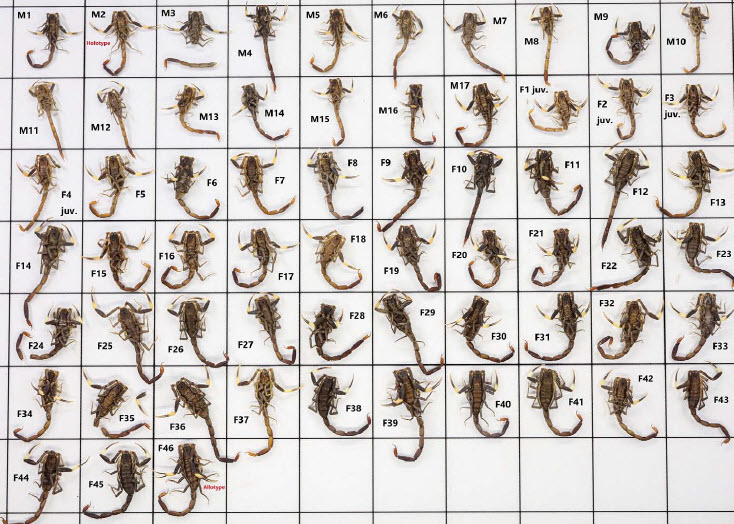
A new species of scorpion belonging to the genus Androctonus Ehrenberg, 1828 (family Buthidae C.L. Koch, 1837), is described on the basis of one adult female and seven males and six females juveniles collected in the savannah formations of Sanguéré-Djoi, Cameroon. The material was collected with the use of Barber traps what explains a predominance of immature individuals in the sample. This Androctonus population is the first record of the genus for Cameroon and can be associated with Androctonus hoggarensis (Pallary, 1929), species originally described from the Hoggar Mountains in Algeria. The analysis of a several morphological characters of both species confirms some differences. More conclusive however are the characteristics of endemic populations of the two species. Respectively in a Saharan Massif, major endemic centres within the Sahara desert, and in a savannah-like formation.

Reference:
Lourenco WR. A new species of Androctonus Ehrenberg, 1828 from the Northern savannas of Cameroon (Scorpiones: Buthidae). Serket. 2023;19(2):111-20. [Open Access]

Thanks to Dr. Hisham K. El-Hennawy for sending me this article!

Family Buthidae

19 April, 2023

All you need to know about the medical important buthid Tityus obscurus from Brazil and French Guiana


South America hosts a number of medical important scorpions, mainly in the genus Tityus C. L. Koch, 1836 (Buthidae) and knowledge about the biology and distribution of these species is important so the we can prevent and reduce the negative impact scorpions have on the human population.

Jonas Gama Martins and several co-workers have put together "a review" summing up most of the knowledge that is available for Tityus obscurus (Gervais, 1843). This species is distributed in Brazil and French Guiana and is known to cause both. mild, moderate and serious symptoms in humans. 

The present study sums up information about taxonomy, distribution, habitat, epidemiology of sting cases, reproduction for this species. Treatment of sting cases is also discussed and especially the challenges of producing an effective anti-venom for this species.

Abstract:
Tityus obscurus has caused mild, moderate and severe accidents of medical relevance in the eastern Brazilian Amazon and French Guiana. Tityus obscurus has sexual dimorphism although males and females have uniform black coloration. In the Amazon, one of the habitats of this scorpion is seasonally flooded forests (igap´os and v´arzeas). However, most stings occur in terra firme forest areas (non-flooded region), where most rural communities are located. Adults and children stung by T. obscurus may experience an “electric shock” sensation for more than 30 h after the sting. Our data shows that people inhabiting remote forest areas, including rubber tappers, fishermen and indigenous people, with no access to anti-scorpion serum, use parts of native plants, such as seeds and leaves, against pain and vomiting caused by scorpion stings. Although there is a technical effort to produce and distribute antivenoms in the Amazon, many cases of scorpion stings are geographically unpredictable in this region, due to the lack of detailed knowledge of the natural distribution of these animals. In this manuscript, we compile information on the natural history of T. obscurus and the impact of its envenoming on human health. We identify the natural sites that host this scorpion in the Amazon, in order to warn about the risk of human envenoming. The use of specific antivenom serum is the recommended treatment for accidents involving venomous animals. However, atypical symptoms not neutralized by the available commercial antivenom are reported in the Amazon region. Facing this scenario, we present some challenges to the study of venomous animals in the Amazon rainforest and possible experimental bottlenecks and perspectives for establishing a method aimed at producing an efficient antivenom.

Reference:
Martins JG, de Castro Figueiredo Bordon K, Moreno-González JA, de Almeida BRR, Pardal PPO, Lira AFdA, et al. On the noxious black Amazonian scorpion, Tityus obscurus (Scorpiones, Buthidae): Taxonomic notes, biology, medical importance and envenoming treatment. Toxicon. 2023;228:107125. [Subscription required for full text]

Family Buthidae

14 April, 2023

A new buthid genus and species from China


Victora Tang and co-workers have recently published an extensive study describing a new genus and species from Xizang (Tibet), China. 

Langxie Tang, Jia & Liu, 2023

Langxie feti Tang, Jia & Liu, 2023

The new species seems to be extremely abundant in the region.

I would like to compliment the authors for this work, which was completed despite of major challenges!

Abstract:
A new monotypic genus, Langxie gen. n., is described from Xizang (Tibet), China. The new genus shares an important morphological character with Afrolychas Kovařík, 2019: absence of external accessory denticles (EADs) along the sixth row of median denticles (MDs) on the pedipalp movable finger. Langxie gen. n. is different from Afrolychas in the following aspects: loss of EAD near the proximally enlarged MD within each row (i. e., loss of all EAD on the movable finger; this also distinguishes the new genus from other related genera in the “(Ananteris + Isometrus)” clade (Štundlová et al., 2022)), subaculear tubercle armed with or without a secondary tubercle dorsally, immaculate color pattern, more slender appendages and metasoma, and less sexually dimorphic pectines. Langxie gen. n. further differs from another geographically close genus, Himalayotityobuthus Lourenço, 1997, by the presence of highly developed pectinal fulcra (vs. absent in Himalayotityobuthus), six rows of MDs on the pedipalp movable finger (vs. 7–8 in Himalayotityobuthus) and five pairs of lateral ocelli (vs. 3 in Himalayotityobuthus). The new species, Langxie feti sp. n., is small and slender, exhibiting no obvious sexual dimorphism in pedipalp and metasoma, but the sexes are visibly different in the relative size of median ocelli and coarseness of carapacial granulation. Lattice microstructures are prominently developed on its cuticle.

Reference:
Tang V, Jia Q, Liu L. A new monotypic genus and species from China, Langxie feti gen. et sp. n. (Scorpiones: Buthidae). Euscorpius. 2023(370):1-101. [Open Access]

Family Buthidae


31 March, 2023

A new species of Opistophthalmus from Namibia


Eric Ythier recently published a new article describing a new species in the African genus Opistophthalmus C. L. Koch, 1837 (Scorpionidae) from Namibia.

Opistophthalmus tumas Ythier, 2023

Abstract:
A new species of Opistophthalmus C. L. Koch, 1837 is described on the basis of one adult male and one adult female collected in the inselberg of Tumasberg, Namib-Naukluft National Park, Erongo region, Namibia. Opistophthalmus tumas sp. n. shows similarities with O. holmi (Lawrence, 1969) and O. jenseni (Lamoral, 1972) but can be easily distinguished from both species by several morphological features. The new taxon described here raises the number of known species for the genus Opistophthalmus in Namibia to 30, and the total number of currently recognized species for the genus to 60.

Reference:
Ythier E. A new species of Opistophthalmus C. L. Koch, 1837 from Namibia (Scorpiones: Scorpionidae). Faunitaxys. 2023;11(23):1-6. [Open Access]

Thanks to Eric for sending me this article!

Family Scorpionidae

30 March, 2023

A new species of Scorpiops from China


He-Yu Lv and Co-workers have recently described a new species of Scorpiops Peters, 1861 (Scorpiopidae) from Chongqing in China.

Scorpiops zhui Lv, Lourenco & Di, 2023

Abstract:
A new species of Scorpiops Peters, 1861 is described from Wuxi and Wushan County, Chongqing City, China. The new species is mainly characterized by a moderate size, in relation to the other species of genus, with dark reddish-brown to reddish-black coloration; 15–17 (usually 17) external trichobothria (5 eb, 1–2 esb, 1–2 em, 4 est, 4 et), 8–11 (usually 10) ventral trichobothria in the pedipalp patella and 4–5 (usually 5) ventral trichobothria on chela; pedipalp chela fingers are scalloped in males and nearly straight in females. With the present description the number of known species of Scorpiops recorded from China is raised to 33.

Reference:
Lv H-Y, lourenco WR, Di Z-Y. Scorpiops zhui sp. n., a new species of Scorpiops Peters, 1861 from Chongqing, China (Scorpiones: Scorpiopidae). Zootaxa. 2023;5257(1):040-8. [Subscription required for full text]

Thanks to Gerard Dupre for sending me this article!

Family Scorpiopidae

28 March, 2023

A second species described in the genus Buthiscus


Eric Ythier and Wilson Lourenco have recently described a second species in the genus Buthiscus Birula, 1905 (Buthidae). The new specimen is based on a finding in old museum materials from Mali.

Buthiscus ifoghas Ythier & Lourenco, 2023

Abstract:
A new species of scorpion belonging to the genus Buthiscus Birula, 1905 (Buthidae) is described from the Southwestern part of the Adrar des Ifoghas, in the region of Kidal, Mali. The new species, Buthiscus ifoghas n. sp. is the second element belonging to the genus Buthiscus and seems to inhabit mountainous environments, contrarily to the other species of the genus, Buthiscus bicalcaratus Birula, 1905 which is a typical species of low altitude desert areas.

Reference:
Ythier E, Lourenco WR. A new species of Buthiscus Birula, 1905 (Scorpiones: Buthidae) from the Adrar des Ifoghas, Mali. Faunitaxys. 2023;11(22):1-7. [Open Access]

Thanks to Eric Ythier and Gerard Dupre for sending me this article!

Family Buthidae