21 February, 2023

Non-aggressive competition in Srilankametrus yaleensis and a review of other types of agonistic behavior in scorpions


Competition happens in scorpions, both between species and within the same species. The cause of competition can be food, territory, hiding places, mates etc. As with many other animals, competition and other types of encounters do not have to be aggressive and cause damage.

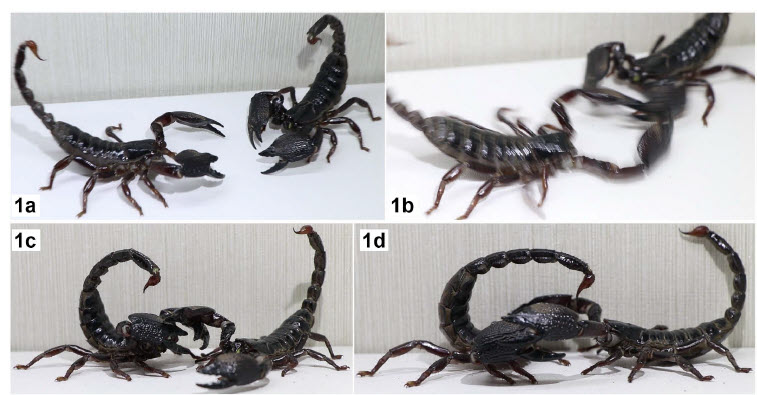
Victoria Tang has recently published an article describing non-aggressive physical combat between adult males of Srilankametrus yaleensis (Kovařík et al., 2019) (Scorpionidae). The article also list other known examples of agonistic behaviors (intraguild or antipredatory) observed in scorpions.

The article is illustrated with many pictures illustration the different types of agonistic behavior. Video documentation can also be found in the supplemental materials.

Abstract:
A peculiar intraspecific agonistic behavior involving a non-aggressive physical combat is reported between the adult males of Srilankametrus yaleensis (Kovařík et al., 2019) (Scorpionidae: Heterometrinae). The adult males were observed to resort to a ritualized and relatively gentle way for strength demonstration. The combat is characterized by lateral spreading of pedipalps, chelicerae-to-chelicerae collision, and entanglement of metasomal segments. This behavior is hereby considered a form of an intrasexual combat defined as the “arm-span competition”. It is hypothesized to be beneficial for solving territorial and/ or sexual competitions while avoiding unnecessary mortality which could pose adverse impact to the natural populations. Other Heterometrinae species that possess sexually dimorphic, elongate pedipalps in males were also found to display similar behavior. This may account for at least one potential reason for the evolution of such sexual dimorphism. Finally, this study supplements several other agonistic behaviors (intraguild or antipredatory) observed in scorpions, with special attention to the family Scorpionidae. Three basic types of behavior are defined for this family: aggressive response, shielding response, and armspan competition. These types of behavior may have implications for the evolution of this family.

Reference:
Tang V. Non-aggressive competition between males of Srilankametrus yaleensis (Kovařík et al., 2019)(Scorpionidae), and other types of agonistic behavior observed in scorpions. Euscorpius. 2023;2023(368):1-17. [Open Access]

20 February, 2023

Updated information about the distribution of scorpions in Sudan


Manal Siyam and co-workers have recently published a study with updated information about the scorpion fauna of Sudan. Of special interest is the new distributional data about medical important species like Androctonus amoreuxi (Audouin, 1826), Leiurus quinquestriatus (Ehrenberg, 1829) and Parabuthus abyssinicus (Pocock, 1901) (Buthidae). 

Abstract:
Six species of scorpion (Arachnida: Scorpiones) are documented from eighteen localities in seven different states within the Republic of the Sudan. Combining this new data with historical records in the Sudan Natural History Museum and the published literature enables the first provisional distribution maps for Sudanese scorpions. New state records could be added for three medically significant species: Androctonus amoreuxi (Audouin, 1826) from Khartoum, North Kordofan and North Darfur, Leiurus quinquestriatus (Ehrenberg, 1829) from Kassala, River Nile, White Nile and North Darfur, and Parabuthus abyssinicus (Pocock, 1901) from Kassala. Among the less venomous species, we offer new state records for Buthacus leptochelys (Ehrenberg, 1829) in White Nile State, for Compsobuthus werneri (Birula, 1908) in North Kordofan, White Nile and Kassala States and for Orthochirus olivaceus (Karsch, 1881) in River Nile, Northern and Kassala States. Further information about the taxonomy, distribution and toxicity of Sudanese scorpions is presented.

Reference:
Siyam M, Dunlop JA, Kovařík F, Mohammad A. Additions to the distribution of Sudanese scorpions. Zoosystematics and Evolution. 2023;99(1). [Open Access]

Thanks to Matt Simon for informing me about this article!

12 February, 2023

A new species of Scorpio from Jordan


 Mohammad Al-Saraireh and co-workers have recently described a new species of Scorpio Linnaeus, 1758 (Scorpionidae) from the Dibbeen Forest, Jerash Governorate in Jordan.

Scorpio granulomanus Al-Saraireh, Yagmur, Afifeh & Amr, 2023

Abstract:
A new species Scorpio granulomanus sp. n. is described and illustrated from Dibbeen Forest, Jerash Governorate, Jordan. The new species is compared with the previously recorded species of the genus Scorpio in the Middle East; it can be distinguished from all other congeners by its very large, pointed granules on the dorsoexternal surface of the chela manus, and an untypically elongated chela manus.

Reference:
Al-Saraireh M, Yagmur EA, Afifeh BA, Amr Z. A new species of Scorpio from Jordan (Scorpiones: Scorpionidae). Euscorpius. 2023(369):1-17. [Open Access]

Family Scorpionidae

03 February, 2023

Two new buthid species described from Saudi Arabia


Eric Yhtier and Wilson Lourenco have recently described two new species in the family Buthidae from Saudi Arabia.

Compsobuthus mahazat Ythier & Lourenco, 2023

Orthochirus arabicus  Ythier & Lourenco, 2023

Abstract:
New buthid scorpions are described from Saudi Arabia, from a site never studied previously, the Mahazat as-Sayd Reserve, in the centre of the country. Two species are described, based on one adult male (Compsobuthus mahazat sp. n.) and one adult female (Orthochirus arabicus sp. n.). The total number of scorpion species currently recognized in Saudi Arabia is now raised to 30.

Reference:
Ythier E, Lourenco WR. Two new scorpion species from Central Saudi Arabia (Scorpiones: Buthidae). Faunitaxys. 2023;11(8):1-8.

Thanks to Eric for informing me about this species!

Family Buthidae

30 January, 2023

A case of intraguild predation in Indian buthids


Mihir Joshi & Shubhankar Deshpande recently reported about a case of intraguild predation where an unknown species from the genus Orthochirus fed on a juvenile individual of Hottentotta tamulus (Fabricius,1798) from Maharashtra, India (both from the family Buthidae).

This is an interesting observation as Hottentotta tamulus is known for its very potent venom, while Orthochirus scorpions the opposite.

Abstract:
We report an event of intraguild predation by Orthochirus sp. feeding on a juvenile individual of Hottentotta tamulus (Fabricius,1798) from Maharashtra, India. This is the first report of intraguild predation among Indian scorpions.

Reference:
Joshi M, Deshpande S. A report of intraguild predation by Orthochirus sp. on Hottentotta tamulus (Scorpiones: Buthidae) in Maharashtra, India. Euscorpius. 2022;2022(366):1-3. [Open Access]

27 January, 2023

Scorpions are harmed by pollution of their habitats - A study of the leaf litter-dwelling scorpion Tityus pusillus in Brazil


It is well known that human activities that expands into untouched habitats of different animals will very often have a negative impact on the flora and fauna. Especially pollution can have negative short- and long term effects. Some of these can affect the genetic composition of organisms and causing harmful effects.

Aleson Aparecido da Silva and co-workers have recently published a study of populations of the leaf litter-dwelling Tityus pusillus Pocock, 1893 (Buthidae) from five sites in Northeast Brazil with different levels of human disturbance. A laboratory populations was also included as a control group. 

The results showed that DNA damage in T. pusillus from areas with human interference and pollution was higher than in the individuals from better-conserved environments. The authors believe that the observed effects may be due to the presence of genotoxic substances in the habitats (originating from human activities and pollution).

Abstract:
Invertebrates are harmed by pollution of their habitats. Litter-dwelling sedentary scorpions, such as Tityus pusillus, studied here, may be good models for examining the genotoxic effects of xenobiotics in soil. Thirty specimens were collected from five sites in Northeast Brazil with different levels of human disturbance, as well as a laboratory group. The comet assay was performed on hemolymph cell samples. Damage Index (DI) and Damage Frequency (DF%) were measured. Much higher genotoxicity was observed in animals collected in an area with human interference and solid waste, compared to those obtained in more pristine areas or the laboratory. T. pusillus may be a useful model for environmental genotoxicity assays.

Reference:
Silva AAd, Amorim ÉMd, Pereira MG, Santana SLd, Silva MAd, Lira AFdA, et al. Genotoxic effects of anthropogenic environments in the leaf litter-dwelling scorpion Tityus pusillus Pocock, 1893 (Scorpiones; Buthidae). Mutation Research/Genetic Toxicology and Environmental Mutagenesis. 2023;887:503585. [Subscription required for full text]

22 January, 2023

Three new species of Scorpio from the Oriental region in Morocco


Eric Ythier and Alexandre Francois have recently published a study of scorpions collected in the Oriental region in Morocco. Based on the material, three new species in the genus Scorpio Linnaeus, 1758 (Scorpionidae) are described.

Scorpio iznassen Ythier & Francois, 2023

Scorpio moulouya Ythier & Francois, 2023

Scorpio touili Ythier & Francois, 2023

See article for a complete list of species found in this study.

Abstract:
A study of the scorpions collected in around 110 locations in the Oriental region and surrounding areas in Morocco by the Emirates Center for Wildlife Propagation (ECWP, Missour, Morocco) during the last 22 years is presented. 11 species among four genera are recorded, including three new species belonging to the genus Scorpio Linnaeus, 1758 (Scorpionidae) which are described here based on material collected in the high plateaus of the Oriental region (Scorpio touili sp. n.), in the Beni Snassen mountains (Scorpio iznassen sp. n.) and in the middle Moulouya river basin (Scorpio moulouya sp. n.). These new taxa raise the number of known species for the genus Scorpio to 21, height of them occurring in Morocco. A total of 12 scorpion species are recognized to occur in the Oriental region in Morocco.

Reference:
Ythier E, Francois A. The scorpion fauna of the Oriental region in Morocco (Scorpiones: Buthidae, Scorpionidae) with description of three new species of the genus Scorpio Linnaeus, 1758. Faunitaxys. 2023;11(3):1-15. [Open Access]

Thanks to Eric for sending me this article!

Family Scorpionidae