12 September, 2022

A phylogenetic study of the family Iuridae reveals three new genera


The family Iuridae are mainly found in Turkey and Greece and contains some of the largest scorpions in Europe. There have been some studies of this family in the recent years, but in a recent article Aristeidis Parmakelis and co-workers have conducted a phylogenetic analysis of the family and based on this suggested several taxonomic decisisons.

The subfamily Calchinae Birula, 1917 is raised from synonymy with Iurinae Thorell, 1876.

The three new genera are described (listed with the taxa assiciated with them):

Anatoliurus Parmakelis, Dimitriadou, Gkigkiza, Karampatsou, Stathi, Fet, Yağmur & Kovařík, 2022.

A. kraepelini (von Ubisch, 1922 (Turkey: Antalya, Isparta, Konya, Karaman, Mersin, and Muğla Provinces; Greece: Megisti (Kastelorizo) Island.

A. kumlutasi (Yagmur, Soleglad, Fet & Kovarik 2015) (Turkey: Hıdırellez Cave in Antalya).

Letoiurus Parmakelis, Dimitriadou, Gkigkiza, Karampatsou, Stathi, Fet, Yağmur & Kovařík, 2022.

L. rhodiensis (Soleglad, Fet, Kovarik & Yagmur, 2012) (Greece: Rhodes Island; Turkey: Muğla Province.

Metaiurus Parmakelis, Dimitriadou, Gkigkiza, Karampatsou, Stathi, Fet, Yağmur & Kovařík, 2022.

M. kadleci (Kovarik, Fet, Soleglad & Yagmur, 2010) (Turkey: Antalya and Mersin Provinces).

M. stathiae (Soleglad, Fet, Kovarik & Yagmur, 2012) (Greece: Karpathos Island). 

Abstract:
Iuridae is a family of scorpions that exhibits a highly complex biogeographic and taxonomic history. Iuridae taxa are mainly found in Turkey and Greece, whereas a single species is found in northern Iraq. Several taxonomic revisions have been conducted on this family that initially comprised two genera. The latest taxonomic review, based on morphological and anatomical features, raised the number of Iuridae genera to four, and the number of species to 14.

Sequence data from three molecular markers (COX1, 16S rDNA, ITS1) originating from numerous Iuridae taxa were analyzed within a phylogenetic framework. Divergence time-estimate analyses, species delimitation approaches and estimation of ancestral areas were implemented in order to: (1) reconstruct the phylogenetic relationships of the Iuridae taxa, (2) evaluate the morphological classifications, and (3) obtain insights into the biogeographic history of the family in the East Mediterranean.

The multi-locus phylogeny clearly confirms an ancient division into two clades, Calchinae and Iurinae. Ancient patterns of isolation and dispersal are revealed. Both subfamilies are largely confined to the Anatolian peninsula and its few coastal islands; only the most derived genus Iurus has dispersed westward to Crete and Peloponnese. Based on our findings, three new genera of Iurinae (Metaiurus, Anatoliurus, and Letoiurus) are established. The genus Neocalchas emerges as one of the most ancient scorpion clades, with divergence time about 27 mya.

Reference:
Parmakelis A, Dimitriadou D, Gkigkiza E, Karampatsou L, Stathi I, Fet V, et al.  The evolutionary history of the relict scorpion family Iuridae of the eastern Mediterranean. Mol Phylogenet Evol. 2022:107622. [Subscription required for full text]

Thanks to Gerard Dupre for sending me this article!

Family Iuridae

08 September, 2022

Two new Euscorpius species from Greek islands


Gioele Tropea and co-workers are continuing the never ending quest to unravel all the secrets of the Euscorpius Thorell, 1876 (Euscorpiidae) populations of Europe. In a recent article they describe two new species from the islands Skyros and Andros in Greece.

Euscorpius simaiakisi Tropea, Fet, Parmakelis & Stathi, 2022 (Andros Island, Greece)

Euscorpius triantisi Tropea, Fet, Parmakelis & Stathi, 2022 (Skyros Island, Greece)

Abstract:
Two new scorpion species are described from Skyros and Andros Islands (Greece), Euscorpius triantisi sp. n. and E. simaiakisi sp. n. respectively, based on morphological and molecular evidence. Identity and level of divergence of these taxa are confirmed by a phylogeny based on multiple DNA markers (Parmakelis et al., 2013 b). Euscorpius triantisi sp. n. forms a sister clade to E. mylonasi Fet et al., 2014 from Euboea; the new species is characterized primarily by higher trichobothrial numbers (Pv = 8 and Pe-et = 6). E. simaiakisi sp. n. forms a sister clade to E. kritscheri Fet et al., 2013 from Tinos; the new species is primarily characterized by lower trichobothrial numbers (Pv = 7 and Pe-et = 5).

Reference:
Tropea G, Fet V, Parmakelis A, Stathi I. Two new species of Еuscorpius (Scorpiones, Euscorpiidae) from Skyros and Andros islands, Greece. Zoodiversity. 2022;56(4):307-22. [Open Access]

Thanks to Gioele for sending me their article!

Family Euscorpiidae

22 August, 2022

Genetic diversity of medically important scorpions of the genus Centruroides from Panama


Panama is one of the countries in Central America with the highest incidens of sting cases, mainly caused by several species in the genus Centruroides Marx, 1890 (Buthidae). Identifying medical important species is important, but can be difficult because of their similarities in morphology and habitus (but at the same time high intraspecific variaton in some of the species). Samuel Escudera-Sanjur and co-workers have recently published a study of the genetic diversity data from four species of Centruroides from Panama.

Abstract:
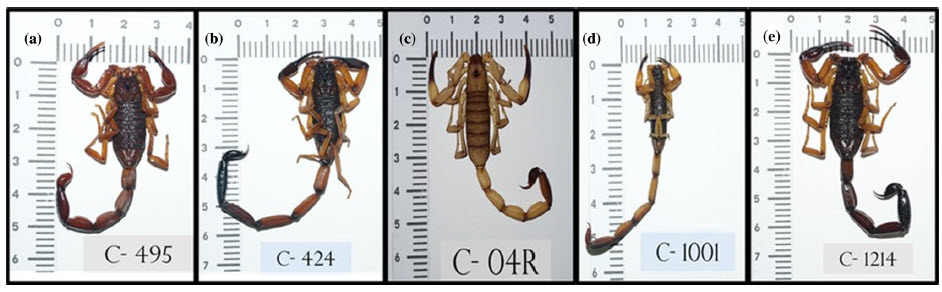
With more than 33,000 sting cases and 47 deaths recorded between 2000 and 2016, Panama is the country with the highest incidence of envenomations by scorpions in Central America. Species in the genus Centruroides are responsible for most scorpion sting reports, however, identification at the species level is complicated because the genus has considerable intraspecific morphological variation. To date no molecular data have been reported from Panama that would help to estimate their genetic diversity and validate morphometric identification methods. We provide here the first genetic diversity data of the two endemic species (C. granosus and C. panamensis) and other two species reported in Panama (C. bicolor and C. limbatus). A total of 41 specimens were sequenced for COI and 16S rDNA mitochondrial genes. The phylogenetic concatenated analysis separates the Panamanian samples into four well-supported clades represented by C. bicolor, C. granosus and (C. panamensis ? C. limbatus). The two endemic species are not the closest relatives in the tree. Low diversity in combination with its very narrow distribution suggest that C. panamensis is susceptible to environmental degradation. A single specimen of Coiba island is intermediate in the tree structure between C. bicolor and C. panamensis and may represent an early stage of speciation. The haplotype network is also consistent with the phylogenetic trees.

Reference:
Escudero-Sanjur S, Castro-Perez E, De Patino HA, Rastogi I, Ramos CW. Genetic diversity of medically important scorpions of the genus Centruroides (Buthidae) from Panama including two endemic species. Journal of genetics. 2022;101. [Subscription required for full text]

Family Buthidae

16 August, 2022

Two new species of Paruroctonus from a special habitat type in California, USA


Prakrit Jain and co-workers have recently described two new species of Paruroctonus Werner, 1934 (Vaejovidae) from California, USA.

Paruroctonus conclusus Jain, Forbes & Esposito, 2022

Paruroctonus soda Jain, Forbes & Esposito, 2022

The two new species have a limited distribution and seem to be limited to a alkali-sink habitat surrounding desert playas. The special habitats are described and the species' future is discussed.

Abstract:
Herein we describe two new species of Paruroctonus (Werner 1934) from California: Paruroctonus soda sp. nov. from the Soda Lake playa at the center of the Carrizo Plain in San Luis Obispo county and Paruroctonus conclusus sp. nov. from the Koehn Lake playa in the Mojave Desert of Kern County. They can be differentiated from other Paruroctonus by a combination of morphological features including deeply scalloped pedipalp fingers in males, specific patterns of fuscous pigmentation, unique setal counts, and unique morphometric ratios. They can also be separated from one another by the latter three characters. Photographs of a large selection of live scorpions are provided, including detailed images and figures of many morphological features. Their distributions, habitats, and ecologies are discussed; and important steps towards their conservation are described.

Reference:
Jain P, Forbes H, Esposito LA. Two new alkali-sink specialist species of Paruroctonus Werner 1934 (Scorpiones, Vaejovidae) from central California. ZooKeys. 2022;1117. [Open Access]

Thanks to Matt Simon and Gerard Dupre for informing me about this article!

Family Vaejovidae

09 August, 2022

A new species of Androctonus from Libya


Wilson Lourenco and Hisham El-Hennawy have recently described a new species of Androctonus Ehrenberg, 1828 (Buthidae) from the Tibesti Massif in Libya.

Androctonus tibesti Lourenco & El-Hennaway, 2022

The biogeography of the region is also discussed.

Abstract:
A further new species of scorpion belonging to the genus Androctonus Ehrenberg, 1828 (Family Buthidae C.L. Koch, 1837), is described on the basis of one male specimen collected in the NE range of the Tibesti Mountains in Libya. This is the first record of the genus Androctonus for the Tibesti Massif and the new species most certainly corresponds to an endemic element to this mountain range. As in previous studied cases, these Saharan Massifs prove to be very important endemic centres within the Sahara desert.

Reference:
Lourenco WR, El-Hennawy HK. A new species of Androctonus Ehrenberg, 1828 from the North East portion of the Tibesti Massif in Libya (Scorpiones: Buthidae). Serket. 2022;18(4):428-40. [Open Access]

Thanks to Hisham El-Hennawy for informing me about their article!

Family Buthidae

A new species of Leiurus from Iraq


Wilson Lourenco has recently published a description of a new species of Leiurus Ehrenberg, 1828 (Buthidae) from the Al-Anbâr Province in Iraq.

Leiurus maculatus Lourenco, 2022.

A new subgenus is also created to accomodate the new species that has characteristics both from Leiurus and Buthus Leach, 1815.

Iraquioleiurus Lourenco, 2022

Abstract:
A new species of buthid scorpion belonging to the genus Leiurus Ehrenberg is described based on one female collected in the Al-Anbâr Province in Iraq. Since the early 2000s, the genus Leiurus Ehrenberg, 1828 (family Buthidae) started to be the subject of several new studies. Some of the populations previously considered as subspecies were raised to the rank of species, but also many new species have been described. Nevertheless, although the important number of modifications brought to the composition of the genus Leiurus, no attempt was done to divide it in sub generic units. The study of an atypical new species of Leiurus from Iraq, suggests the creation of a new subgenus to accommodate it. Further investigations should bring more precise conclusions about the status of this particular population. The type locality of the new species represents the first confirmed record of the genus Leiurus for Iraq.

Reference:
Lourenco WR. A new subgenus and species of Leiurus Ehrenberg, 1828 from Iraq (Scorpiones: Buthidae). Serket.18(4):421-7. [Open Access]

Thanks to Hisham El-Hennawy for informing me about this article!

Family Buthidae

04 August, 2022

An update on the infamous, medical important buthid Tityus serrulatus from Brazil


Among the most dangerous scorpions in the word, the genus Tityus C. L. Koch, 1836 (Buthidae) from South America has some of the most potent species. Bad guy number one in the genus is probably the Brazilian species Tityus serrulatus Lutz & Mello, 1922. The species is well known for its medical potency, but also for its rapid geographical expansion, occurrence in urban habitats and for its large populations of asexual (parthenogentic) members.

Wilson Lourenco has recently published an update on the historical, geographical and ecological aspects connected to this important species. The article also discuss the status of other species in the genus.

Abstract:
A synopsis on the historical, geographical and ecological aspects related to the most conspicuous scorpion species of the genus Tityus known from Brazil is proposed. Tityus serrulatus Lutz & Mello, 1922 was described precisely one century ago, nevertheless many questions related to its ecological adaptations and geographical expansion remain without a precise response. This species, well known for its infamous reputation of noxious species, is also known for its capacity to reproduce asexually, by parthenogenesis. Although the individuals of a given population are considered clones, a new hypothesis could  suggest the occurrence of mutations within isolated individuals, leading to distinct subpopulations that could present better phenotypic performances in ecological habitats distinct from those of the original area of distribution of the species.

Reference:
Lourenço WR. Back to Tityus serrulatus Lutz & Mello, 1922 (Scorpiones: Buthidae): new comments about an old species. J Venom Anim Toxins Incl Trop Dis. 2022;28:e20220016. [Open Access]

Family Buthidae